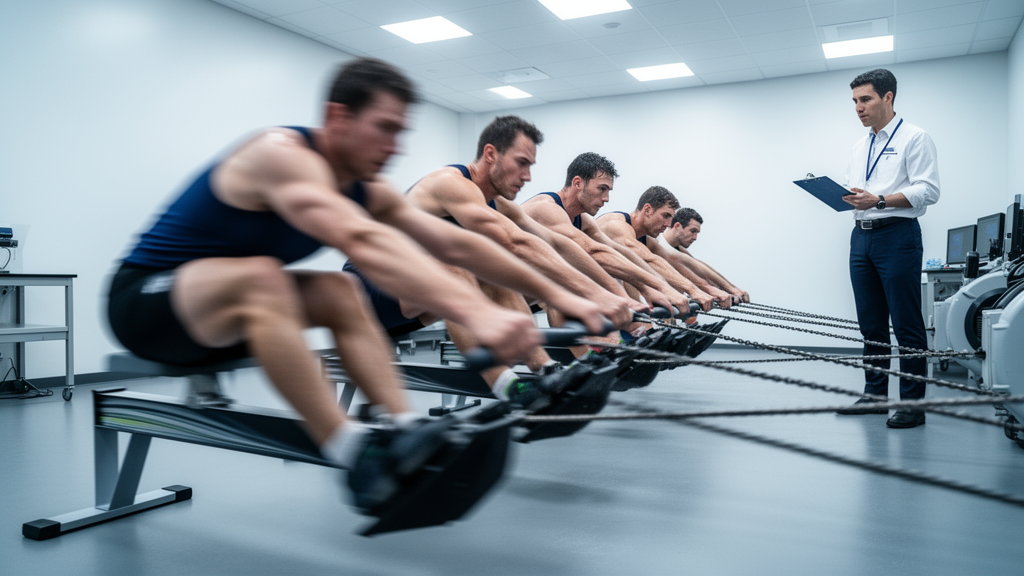
Young trained rowers rely on aerobic metabolism for most of the energy needed to complete a 2000-m ergometer race, but the balance between energy systems shifts markedly from one 500-m segment to the next, according to a new research article published in BMC Sports Science, Medicine and Rehabilitation.
The study set out to investigate how the three energy systems contribute during a 2000-m ergometer simulation divided into four segments. Twelve Tier 2 rowers took part: six male and six female, with an average age of 17.0 years, an average body mass of 79.6 kg, an average height of 188.6 cm, and an average of 3.4 years of training experience.
Each athlete completed four 2000-m ergometer simulation trials, instructed to maintain a uniform, race-pace strategy described as a reverse J-shaped pacing profile. Unbeknownst to the athletes, the trials were randomly terminated at 500 m, 1000 m, 1500 m, and 2000 m, with a minimum interval of 24 hours between tests. This design allowed the researchers to calculate energy contributions for each of the four 500-m segments.
Energy contributions were estimated from three physiological markers: the fast component of oxygen debt, which reflects phosphocreatine resynthesis; accumulated blood lactate, which reflects anaerobic glycolysis; and oxygen uptake during the test itself, which reflects aerobic metabolism.
The four testing strategies showed good consistency, with a mean typical error ranging from 0.8% to 4.4%. The results revealed a clear pattern across the race. The relative contribution of aerobic metabolism increased from the second 500-m segment to the fourth segment compared with the first, with all comparisons reaching statistical significance at p < 0.01.
In contrast, the absolute and relative contributions of the phosphocreatine system were highest during the first 500-m segment and remained lower thereafter, again with all comparisons significant at p < 0.01. The lactate-derived anaerobic contribution was also higher during the first 500-m segment than during subsequent segments. Together, these findings indicate that the start phase of a simulated 2000-m race draws disproportionately on anaerobic sources, while the later segments depend increasingly on aerobic metabolism.
Sex differences in this redistribution pattern were limited. Females showed a higher relative aerobic contribution than males in the third 500-m segment, with a p value of 0.04 and an effect size of g = 1.16. Males, meanwhile, showed a higher relative phosphocreatine contribution than females in the same third segment, with a p value of 0.01 and an effect size of g = 1.16.
The authors conclude that aerobic metabolism predominated throughout the 2000-m race, but that the relative energy system contributions varied substantially across segments, with greater anaerobic contribution during the start phase and greater aerobic contribution during subsequent segments. Only limited sex differences were observed in this redistribution pattern.
The findings offer a segment-by-segment picture of how young trained rowers fuel a simulated race, based on a modest sample of twelve Tier 2 athletes using a terminated-trial design. Because the study examined a single simulated race protocol in this population, the results are specific to young trained rowers racing 2000 m on an ergometer under the pacing conditions described.
Subject of Research: Energy system contributions across four 500-m segments of a simulated 2000-m rowing ergometer race in young trained rowers.
Article Title: Energy contribution characteristics across different segments during a simulated rowing ergometer race in young trained rowers
Article References: Wang, X., Yan, S., Lyu, M., Li, J., Bi, Z., Li, L., Yang, W., Tao, M., Zeng, X., Dai, S., & Li, Y. (2026). Energy contribution characteristics across different segments during a simulated rowing ergometer race in young trained rowers. BMC Sports Science, Medicine and Rehabilitation. https://doi.org/10.1186/s13102-026-02179-6
Image Credits: AI Generated
DOI: 10.1186/s13102-026-02179-6
Keywords: rowing, ergometer, energy systems, aerobic metabolism, anaerobic metabolism, pacing strategy, blood lactate, oxygen debt, sex differences, exercise physiology, young athletes, 2000-m race
News Source: Daisy Hatcher. (October 27, 2026). Aerobic metabolism dominates but anaerobic surges mark the start of simulated 2000-m rowing races. Scienmag.