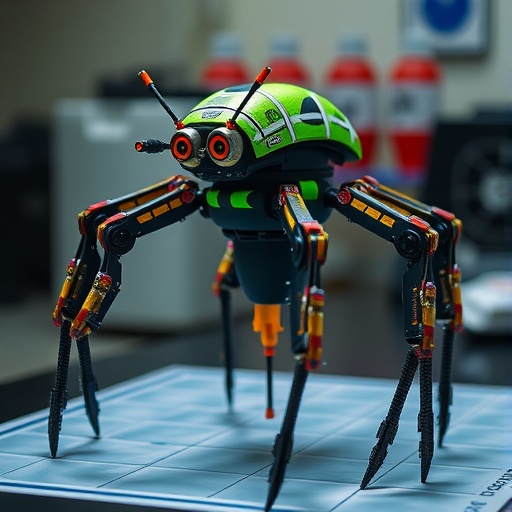
In a groundbreaking development at the intersection of synthetic biology and robotics, researchers have succeeded in engineering living cellular robots equipped with self-organizing nervous systems, marking a transformative leap toward autonomous biological machines capable of complex behaviors. These novel entities, aptly termed “neurobots,” arise from integrating neuronal precursor cells into biobots—living robots initially constructed from frog embryonic skin cells—thereby endowing them with functional neural networks that profoundly influence their morphology, motility, and gene expression.
Biobots first captured widespread scientific attention as synthetic biological constructs composed solely of living cells derived from Xenopus laevis embryos. These early biobots demonstrated remarkable motility driven by multiciliated surface cells, propelling themselves through aqueous environments autonomously. Originally, their structural simplicity lacked a nervous system, constraining the sophistication of their movement patterns and limiting their potential for environmental responsiveness and adaptation.
The research conducted by teams at the Wyss Institute and collaborating institutions has now pushed the boundaries of this technology. Through a precisely timed microsurgical procedure, neuronal precursor cells are implanted into nascent biobots during a critical morphogenetic window. This integration enables the neurons to differentiate, mature, and establish synaptic networks within the living construct, thereby self-organizing a functional nervous system for the first time in these synthetic life forms.
Microscopic and molecular analyses reveal that these neurons not only connect extensively among themselves, forming dense neural networks, but also project axonal and dendritic processes toward the robot’s peripheral cell types. Notable targets include multiciliated cells, which underlie locomotion, mucus-secreting goblet cells that regulate surface fluid dynamics aiding ciliary motion, ionocytes responsible for ionic homeostasis, and small secretory cells that produce signaling molecules modulating ciliary activity. This intricate neuro-epithelial interface signifies a sophisticated biological integration that transcends previous models of living robotics.
Functionally, neurobots exhibit enhanced morphological complexity compared to their neuron-free predecessors. Their shapes tend to be more elongated, a feature correlated with increased motility and richer behavioral repertoires. Observations document that neurobots do not merely move more than classical biobots but demonstrate nuanced, repeated motifs characteristic of spontaneous, complex behaviors suggestive of emergent neural control architectures.
Pharmacological experiments further underscore the nervous system’s functional relevance. Administration of pentylenetetrazole (PTZ), a convulsant that antagonizes inhibitory GABA_A receptors, elicited divergent responses between neurobots and standard biobots. While biobots lacking neurons showed decreased motility under PTZ, presumably due to drug effects on their epithelial components, neurobots responded heterogeneously—some displayed heightened activity, indicating that neuronal networks can modulate and override peripheral cell responses, dynamically influencing the robots’ behavior.
At the molecular level, comparative transcriptomic analyses between neurobots, biobots, and control sham constructs uncovered significant upregulation of genes central to nervous system development in neurobots. Intriguingly, a constellation of genes implicated in the development of the visual system emerged conspicuously expressed, hinting at the potential genesis of primitive sensory capabilities. Should these genomic patterns translate into functional photosensitivity, neurobots could one day exhibit visually guided behaviors, opening avenues for sophisticated environmental interactions and programmable responses.
The emergence of visual and other sensory systems would mark a paradigm shift in engineered autonomous biological entities, potentially enabling light-mediated navigation or stimulus-responsive modulation of movement. Such advancements could prove invaluable for biomedical applications, including targeted therapeutics, regenerative medicine, and the creation of living machines with tailor-made functional modalities.
Importantly, these neurobots challenge foundational questions about the origins of anatomy and physiology in biological systems lacking evolutionary selection. By synthesizing whole organisms with new morphologies and behaviors from unmodified genomes, the research probes the intrinsic capacities of multicellular plasticity and developmental flexibility. This line of inquiry promises to shed light on evolutionary developmental biology and the principles guiding form-function relationships in living matter.
Beyond the bioengineering feats, the study underscores the possibilities that arise when combining developmental biology with engineering disciplines. Constructing living systems that self-organize both structurally and functionally bridges the divide between synthetic constructs and natural organisms, enabling a novel class of programmable life forms.
As the researchers press forward, key challenges remain in delineating the neural circuitries specific to different behavioral phenotypes, deciphering how neurons govern target cell physiology, and validating the putative emergence of sensory modalities at protein and functional levels. Success in these areas will deepen understanding of synthetic neurobiology and accelerate translational prospects for living robotic systems.
The path pioneered by neurobots opens transformative horizons not only for advancing fundamental science but also for inventing novel biological machines capable of adaptive, self-directed activity. These living entities hold promise for revolutionary medical interventions—ranging from neural tissue repair to precise drug delivery—and invite a reevaluation of what constitutes behavior, cognition, and life itself in artificial yet living constructs.
This research was published on February 20, 2026, in the journal Advanced Science and supported by grants from the Department of Defense, the John Templeton Foundation, and Northpond Ventures. The pioneering work involved a multidisciplinary team led by Dr. Michael Levin from Tufts University and the Wyss Institute, with contributions from senior scientist Dr. Haleh Fotowat and other collaborators.
Subject of Research: Cells
Article Title: Engineered Living Systems With Self-Organizing Neural Networks: From Anatomy to Behavior and Gene Expression
News Publication Date: 20-Feb-2026
Web References:
Wyss Institute at Harvard University
University of Vermont
Tufts University
Advanced Science Journal
References:
“Engineered Living Systems With Self-Organizing Neural Networks: From Anatomy to Behavior and Gene Expression,” Advanced Science, 2026.
Image Credits: Wyss Institute at Harvard University
Keywords: Synthetic biology, Robotics, Mechanical engineering, Locomotion, Developmental biology, Evolutionary biology, Genetics, Neuroscience, Omics, Behavioral neuroscience, Cellular neuroscience, Developmental neuroscience, Gene expression, Evolutionary developmental biology, Tissue regeneration
Tags: advanced biobotics with environmental responsivenessautonomous biological robotsbiobot motility enhancementfunctional neural networks in synthetic organismsgene expression regulation in biobotsliving cellular robots from frog cellsmicrosurgical techniques in bioengineeringneurobots with neural networksneuronal precursor cell implantationself-organizing nervous systems in biobotssynthetic biology and robotics integrationXenopus laevis derived biobots