Living beings can evolve to lose biological structures due to potential survival benefits from such losses. For example, certain groups of ray-finned fishes show such regressive evolution—medakas, minnows, puffera, and wrasses do not have a stomach in the gastrointestinal tract, making them agastric or stomachless fishes. However, the specific evolutionary mechanisms underlying the evolution of agastric fishes remains unclear.
Credit: Tokyo tech
Living beings can evolve to lose biological structures due to potential survival benefits from such losses. For example, certain groups of ray-finned fishes show such regressive evolution—medakas, minnows, puffera, and wrasses do not have a stomach in the gastrointestinal tract, making them agastric or stomachless fishes. However, the specific evolutionary mechanisms underlying the evolution of agastric fishes remains unclear.
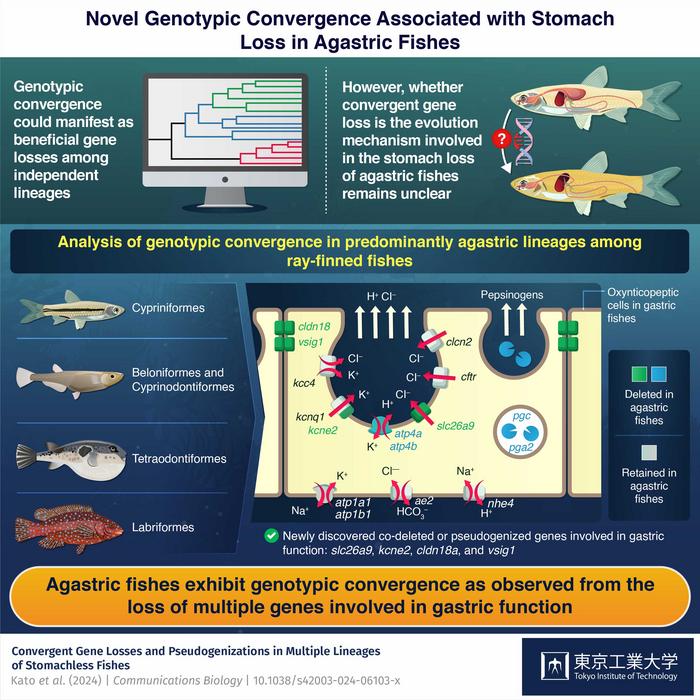
Studies about Slc26a9—a molecular transporter highly expressed in the stomach of many species—in fishes provided the initial clue. Researchers in Tokyo Institute of Technology (Tokyo Tech), Mayo Clinic College of Medicine, and Atmosphere and Ocean Research Institute, The University of Tokyo found that the slc26a9 gene was absent in many agastric ray-finned fishes but present in many gastric ray-finned fishes. These findings led them to ponder if more genes required for gastric function were absent in agastric fishes. Could such convergent gene losses account for stomach loss in agastric fishes?
A team of scientists from Japan and the USA, led by Associate Professor Akira Kato from Tokyo Tech, sought to answer this question. Kato explains, “We compared gene losses between agastric and gastric ray-finned fishes and identified additional genes co-deleted in agastric fishes.” Accordingly, the researchers identified several genes required for gastric functions that are co-deleted or pseudogenized (gene inactivation through mutations resulting in pseudogenes) in agastric fishes compared to gastric fishes, namely slc26a9, kcne2, cldn18a, and vsig1. Their findings are published in Communications Biology.
Specifically, they identified four gene deletions—slc26a9, kcne2, cldn18a, and vsig1—resulting in a reduction or loss of stomach structure in ray-finned fishes through comparative genomic analyses (a set of experiments for comparing similarities and differences among different genomes). Not surprisingly, each of these four genes codes for essential gastric functions. slc26a9 codes for the chlorine ion channel transporter. kcne2 codes for a regulatory subunit of the potassium ion channel. slc26a9 and kcne2 functions are, thus, essential for secretions of gastric acids, such as hydrochloric acid. cldn18a similarly codes for a barrier protecting the gastric cells from acid-induced damage from hydrogen ions, while vsig1 codes for controlling stomach development.
In addition, the researchers found that agastric egg-laying mammals, such as echidna and platypus, also have kcne2 and vsig1 either deleted or pseudogenized. Moreover, the researchers discovered that cldn18, if present in agastric bony fishes, is mutated compared to gastric fishes. All these findings indicate that the gene losses correlated with stomach loss represent a genotypic convergence.
Furthermore, they observed that the gastric fish, stickleback, expressed kcne2, pga, pgc, vsig1, and cldn18a in organs other than the stomach, indicating gene functions other than gastric functions. They deduced that agastric fishes could possess other genes to compensate for such gene functions, facilitating the observed gene losses.
Kato concludes, “We identified novel genes absent in agastric fishes among four major bony fish lineages, which suggests a convergent evolution scenario in the context of stomach loss. Our findings, thus, imply that a similar cassette of gene losses occurred independently during or after stomach loss in the several agastric fish groups.” Indeed, this study is a milestone in understanding the novel genotypic convergence that fine-tuned the agastric fish body to suit its specific ecological niche.
Journal
Communications Biology
DOI
10.1038/s42003-024-06103-x
Method of Research
Experimental study
Subject of Research
Not applicable
Article Title
Convergent gene losses and pseudogenizations in multiple lineages of stomachless fishes
Article Publication Date
3-Apr-2024