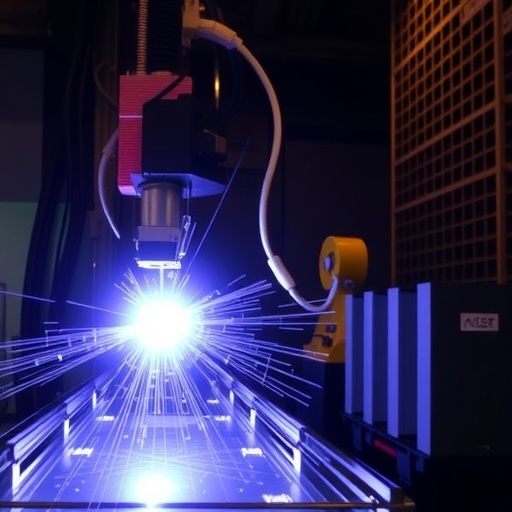
In the realm of laser technology, the advent of hollow-core fiber gas lasers (HCFGLs) marks a transformative leap forward, poised to redefine the boundaries of high-power laser generation. Traditional solid-core fiber lasers, while achieving considerable milestones in power scaling and mode-area enlargement, have long been confined within spectral limits dictated by the intrinsic energy transitions of rare-earth ions. This spectral confinement predominantly restricts their outputs to the near-infrared region, specifically between 1 and 2 micrometers, constraining their applicability in broader spectral domains such as the ultraviolet (UV) and mid-infrared (MIR). The emergence of HCFGLs, underpinned by advancements in hollow-core fiber (HCF) fabrication and innovative pump source technologies, heralds a new era of laser systems characterized by unparalleled spectral versatility and enhanced power potential in previously elusive wavelength regimes.
Hollow-core fibers, by virtue of their unique architecture where light propagation occurs largely through an air or gas-filled central channel rather than a solid glass core, introduce fundamentally novel mechanisms for light-gas interactions and laser emission. This markedly contrasts with conventional double-clad or multicore fiber lasers, which rely on doping the solid fiber core with rare-earth ions to achieve population inversion and subsequent lasing. The low interaction of light with the fiber material itself in HCFs substantially reduces nonlinear effects and thermal limitations, critical factors that traditionally hinder power scaling in solid-core fibers. Consequently, HCFGLs exploit gas media introduced within the fiber core, utilizing molecular or atomic transitions that unlock new spectral domains, including UV and MIR bands where rare-earth doping is ineffective or insufficient.
The technical maturation of HCF fabrication methods has been instrumental in realizing the potential of gas-filled fiber lasers. Sophisticated fiber designs, such as photonic bandgap fibers and anti-resonant hollow-core fibers, have dramatically improved light confinement and transmission losses, facilitating efficient lasing action even at challenging wavelengths. These fiber types leverage advanced microstructure engineering to tailor modal properties and enhance interaction lengths between the guided light and the gaseous gain medium, leading to improved gain and output power scalability. Furthermore, the integration of these fibers with precise gas pressure and composition control systems enables dynamic tuning of laser emission characteristics, signifying a level of spectral agility unattainable in traditional solid-core fiber lasers.
Two primary operational principles dominate the landscape of HCFGLs: population inversion-based lasing and stimulated Raman scattering (SRS)-based lasing. Population inversion in gas-filled hollow cores can be achieved through selective optical pumping schemes that excite specific molecular or atomic transitions, enabling narrow linewidth lasing with high spectral purity. In contrast, SRS-based HCFGLs utilize nonlinear optical processes within the gas medium to shift pump laser frequencies to desired output wavelengths, facilitating the generation of novel laser lines, especially in spectral regions not readily accessible by direct emission. The synergy between these mechanisms and the fiber’s intrinsic properties fosters laser sources that combine spectral purity, high power, and wavelength versatility.
Despite these impressive advancements, HCFGL technology remains in its nascent stages, confronted by several formidable challenges that demand innovative solutions. Chief among these is the imperative to scale output power without compromising beam quality or inducing adverse nonlinearities. Achieving high-power performance necessitates meticulous balancing of gas composition, pressure, and fiber design to optimize gain while minimizing detrimental effects such as photodarkening or parasitic lasing. Moreover, expanding spectral coverage to include multiple output wavelengths requires engineering highly tunable gas mixtures and developing sophisticated pumping architectures capable of selective excitation over a broad spectral range.
Compactness and system integration stand as critical design goals for future HCFGLs, particularly for their adoption in practical applications ranging from precision spectroscopy and remote sensing to medical diagnostics and telecommunications. While the inherent complexity of gas handling and fiber fabrication poses obstacles to miniaturization, ongoing strides in packaging technologies and microfluidic integration hint at feasible pathways toward robust, user-friendly HCFGL modules. Achieving such integration will not only enhance the adaptability of these lasers to diverse operational environments but also accelerate their transition from laboratory prototypes to commercially viable instruments.
The compelling attributes of HCFGLs—wavelength extensibility, narrow linewidth, and potential for high power—place them at the forefront of next-generation laser sources. Their ability to operate efficiently in the UV and MIR spectral regions, largely inaccessible to conventional rare-earth doped fibers, opens exciting avenues for scientific exploration and technological innovation. These spectral bands hold immense promise for various disciplines including environmental monitoring, quantum communications, and biomedical imaging, where precise and high-power laser sources are indispensable. The advent of HCFGLs thereby promises to catalyze breakthroughs that were previously constrained by the limitations of solid-state laser media.
Looking ahead, multidisciplinary research endeavors focused on fiber design refinement, gas medium tailoring, and pump laser innovation will be pivotal in harnessing the full capabilities of hollow-core fiber gas lasers. Combining advances in nanofabrication, nonlinear optics, and laser physics, the next generation of HCFGLs is expected to push performance boundaries, delivering unprecedented power levels with tunable and ultra-stable output. Additionally, exploring hybrid configurations that synergize population inversion and SRS mechanisms might yield novel lasing schemes with enhanced efficiency and spectral reach.
Moreover, the refinement of numerical modeling tools and diagnostic techniques will play an essential role in optimizing device architectures and operational parameters. Accurate simulations of light-matter interactions within complex hollow-core fiber geometries, coupled with real-time spectroscopic feedback, will enable targeted improvements in laser performance and more efficient troubleshooting during development. These computational and experimental capabilities will accelerate the pace at which laboratory innovations translate into field-ready HCFGL systems.
The transformative impact of HCFGLs extends beyond technical achievements to potential societal benefits. High-power lasers with tailored spectral properties are critical enablers for cutting-edge applications such as lidar-based atmospheric sensing, laser-induced breakdown spectroscopy, and selective phototherapy. The capability to generate coherent radiation at wavelengths corresponding to molecular vibrational modes could revolutionize chemical sensing and control, enabling more sensitive detection of pollutants and hazardous substances. In medicine, precise MIR lasers promise minimally invasive treatments with enhanced specificity, potentially improving patient outcomes.
In conclusion, the evolution of hollow-core fiber gas lasers signifies a paradigm shift within the laser community, challenging the conventional reliance on solid-core rare-earth doping schemes. By leveraging innovative fiber designs and gas-based gain media, HCFGLs unlock spectral territories previously out of reach, offering enhanced power scalability and laser performance. Although current obstacles related to power output, spectral diversity, and system integration persist, robust ongoing research efforts provide a promising trajectory toward overcoming these challenges. As this technology matures, it is poised to become an indispensable tool, driving advancements across scientific, industrial, and medical fields with its unique combination of versatility and power.
Subject of Research:
Development and advancement of hollow-core fiber gas lasers focusing on overcoming spectral limitations inherent to conventional solid-core fiber lasers.
Article Title:
Wang, Z., Pei, W., Zhou, Z. et al. Hollow-core fiber gas lasers [Invited]. Light Sci Appl 15, 208 (2026).
Article References:
Wang, Z., Pei, W., Zhou, Z. et al. Hollow-core fiber gas lasers [Invited]. Light Sci Appl 15, 208 (2026). https://doi.org/10.1038/s41377-026-02256-y
Image Credits:
AI Generated
DOI:
https://doi.org/10.1038/s41377-026-02256-y
Keywords:
Hollow-core fiber lasers, gas lasers, fiber laser technology, high-power lasers, spectral flexibility, ultraviolet lasers, mid-infrared lasers, population inversion, stimulated Raman scattering, fiber fabrication, laser scalability
Tags: advanced fiber laser architecturesgas-filled fiber lasershigh-power laser generationhollow-core fiber fabricationhollow-core fiber gas laserslaser spectral range expansionlight-gas interactions in lasersmid-infrared laser sourcespump source innovations for lasersrare-earth ion limitations in lasersspectral versatility in lasersultraviolet laser technology