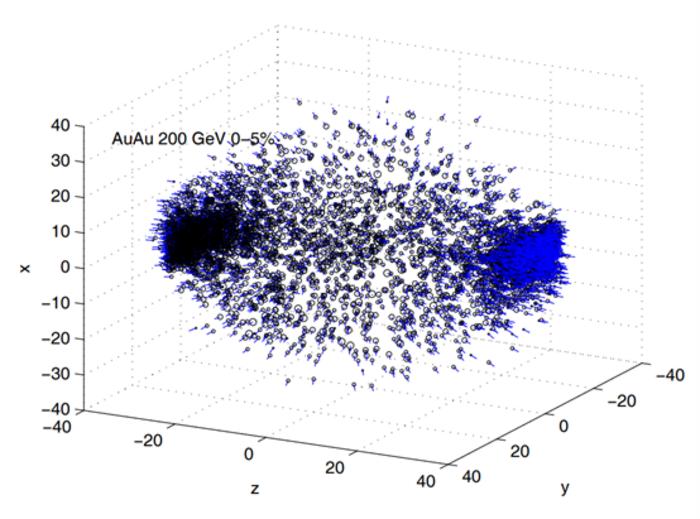
In the development of particle physics, researchers have introduced an innovative particle encoding mechanism that promises to improve how information in particle physics is digitally registered and analyzed. This new method, focusing on the quantum properties of constituent quarks, offers unprecedented scalability and precision. It paves the way for significant advancements in high-energy experiments and simulations.
In the development of particle physics, researchers have introduced an innovative particle encoding mechanism that promises to improve how information in particle physics is digitally registered and analyzed. This new method, focusing on the quantum properties of constituent quarks, offers unprecedented scalability and precision. It paves the way for significant advancements in high-energy experiments and simulations.
Quantum-Enhanced Encoding for Complex Particle Information
The newly proposed encoding mechanism can seamlessly incorporate complex quantum information for particles, including multi-quark states with up to nine valence quarks and an angular momentum of up to 99/2. This comprehensive approach addresses the longstanding issue of accurately distinguishing between particles with similar properties, ensuring precise and detailed digital representation.
Overcoming Challenges in Particle Identification
High-energy heavy-ion collision experiments continuously identify new particles, leading to the need for precise and unique identification codes. Conventional methods, which added mass to distinguish between particles, have proven insufficient, especially with the discovery of numerous particles sharing similar quantum characteristics. “Our new encoding mechanism not only meets current demands but is also adaptable for future discoveries,” emphasize Prof. Zhiguang Tan and Prof. Hua Zheng, the corresponding authors.
Robust and Rational Encoding Framework Developed
The research involved extensive analysis of existing particle data and encoding practices. The team evaluated current methods, identifying their limitations, particularly in handling multi-quark states. By developing a system that integrates seamlessly with popular event generators and digital simulations, they created an encoding mechanism that is durable and rational. “We’ve ensured that this new framework can be expanded and adapted easily, which is crucial given the rapid pace of discovery in our field,” adds Prof. Zheng.
Enhancing Accuracy in Digital Simulations and Experimental Analyses
This new encoding mechanism is poised to become an invaluable tool for researchers and scientists involved in particle physics. Its ability to provide detailed and distinguishable particle codes will enhance the accuracy of digital simulations and experimental analyses. With this mechanism, researchers can expect more reliable and precise data, which is critical for advancing their understanding of particle physics.
Future Prospects and Broader Applications
The research team is optimistic about the broader applications of their encoding mechanism. They anticipate that future discoveries of exotic particles and multi-quark states will be effortlessly integrated into their system. Further refinement and user feedback will ensure that the mechanism evolves with the latest scientific advancements. “We are excited about the future and the potential this has to unlock new frontiers in particle physics,” Prof. Tan emphasizes.
Collaborative Effort Sets Stage for Advancements in Particle Physics
This study introduces a novel particle encoding mechanism that stands to impact the field of particle physics significantly. By addressing the limitations of current methods and providing a scalable, adaptable solution, researchers have set the stage for more precise and comprehensive digital simulations. As Prof. Tan and Prof. Zheng state, “This is just the beginning. Our mechanism is designed to evolve, supporting the scientific community as we continue to explore the fundamental particles of our universe.”
This research is a collaborative effort between Changsha University, Shaanxi Normal University, Texas A&M University, and Istituto Nazionale di Fisica Nucleare (INFN).
Journal
Nuclear Science and Techniques
DOI
10.1007/s41365-024-01537-8
Method of Research
Experimental study
Subject of Research
Not applicable
Article Title
A novel encoding mechanism for particle physics
Article Publication Date
21-Aug-2024