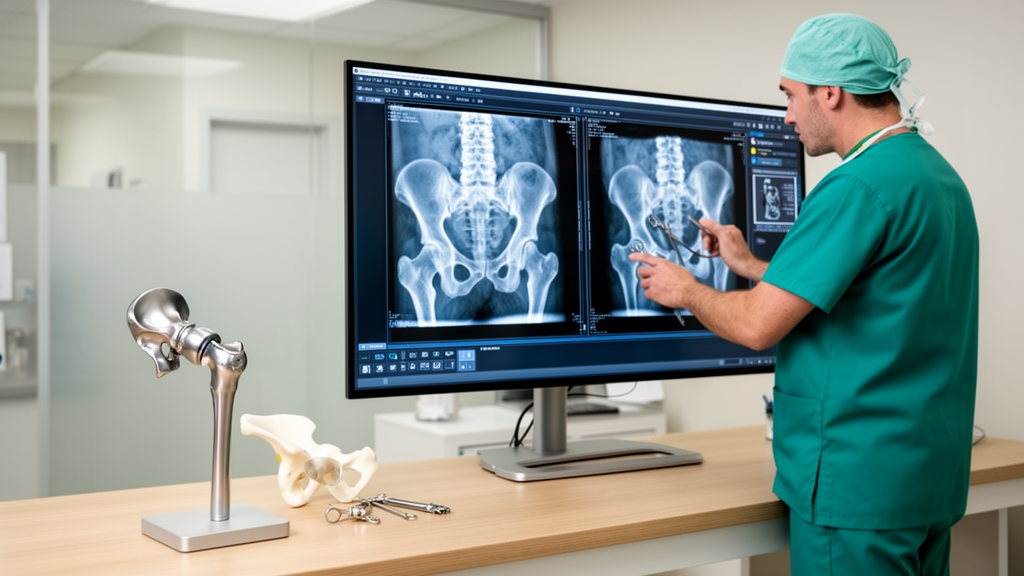
A systematic review and meta-analysis published in Arthroplasty reveals that advanced preoperative planning—specifically three-dimensional imaging models and artificial intelligence-assisted software—significantly improves implant sizing accuracy in total hip arthroplasty compared with conventional two-dimensional radiograph templating. Conducted by an international team of surgical researchers, the study evaluated data across thirty-two comparative and observational studies encompassing thousands of reconstructive hip procedures. Across the examined literature, surgical teams employing three-dimensional reconstructions or automated algorithmic planning achieved substantially higher rates of exact agreement between planned and implanted femoral stems and acetabular cups, while reducing major component sizing discrepancies. In addition to refining sizing precision, artificial intelligence-assisted planning systems were associated with measurable reductions in operative duration, decreased blood loss, and reduced postoperative leg-length discrepancy, although recorded functional score improvements remained below clinical significance thresholds.
Preoperative planning serves as a cornerstone of reconstructive hip surgery, establishing component dimensions, guiding spatial alignment, restoring native biomechanics, and optimizing leg length and femoral offset. In clinical practice, inaccurate component selection or malpositioning can precipitate joint instability, dislocation, accelerated bearing wear, persistent pain, and early revision surgery. For decades, standard orthopedic workflows have relied on manual two-dimensional templating performed on standard radiographs. However, conventional planar radiography suffers from inherent projection distortions, magnification inconsistencies, and an inability to represent complex three-dimensional osseous architecture. While surgeons have increasingly adopted three-dimensional computed tomography scans and low-dose biplanar stereoradiography systems to navigate surgical challenges and mitigate anatomical uncertainty, routine adoption has remained constrained by elevated costs, expanded radiation exposure, and an absence of standardized guidelines confirming clinical superiority over traditional planar techniques.
To establish definitive pooled estimates regarding modern digital planning, researchers conducted their systematic investigation in accordance with PRISMA guidelines, following prospective protocol registration in the PROSPERO database under registration code CRD420251270329. On April 24, 2025, investigators executed comprehensive literature searches across MEDLINE, Scopus, and the Web of Science without date or geographic constraints, targeting studies evaluating three-dimensional or artificial intelligence-assisted planning in primary or revision total hip arthroplasty. Citations were imported into the Rayyan screening platform, and duplicate records were excised using reference management software. Two independent reviewers systematically screened titles, abstracts, and full texts against predefined eligibility criteria, resolving disagreements through consultation with a third adjudicator. Comparative investigations contrasting advanced modalities directly against conventional two-dimensional templating contributed to quantitative meta-analytic pooling, whereas single-arm cohorts were restricted to descriptive syntheses.
Methodological quality and susceptibility to bias across all thirty-two included investigations were formally appraised using the Joanna Briggs Institute critical appraisal checklists. The resulting dataset comprised seventeen cohort studies, five randomized controlled trials, four cross-sectional analyses, five case series, and one case-control study. Appraisals revealed that all cross-sectional evaluations and case series met criteria, while cohort studies demonstrated sound statistical methodologies, albeit with occasional limitations regarding confounding factors or incomplete follow-up. Among randomized trials, baseline group comparability and randomization sequences were generally documented, whereas allocation concealment and blinding were frequently unfeasible or poorly described. Quantitative pooling was executed within Cochrane Review Manager version 5.4 utilizing random-effects models, with heterogeneity quantified via Chi-square tests and the I-squared statistic. Sensitivity was verified through leave-one-out analyses, while publication bias was examined via funnel plots and Egger’s regression tests.
The primary literature search yielded 2,053 candidate records, which were condensed to thirty-two unique studies following deduplication and multi-stage screening, representing thirty-three distinct planning-category evaluations because one trial contributed data to both advanced arms. Within the three-dimensional planning cohort, seventeen studies encompassing 1,583 patients with mean ages ranging from 45 to 74 years were published between 2003 and 2024. These investigations spanned institutions across France, China, Japan, Germany, the United States, Italy, the United Kingdom, Spain, and Switzerland, employing technologies including HipPlan, EOS, ZedHip, Mimics, Stryker planning suites, patient-specific models, Hip-Op, OPSInsight, and robotic software. Conversely, fourteen studies evaluating artificial intelligence-assisted templating involved 1,889 patients with mean ages between 42.3 and 64.2 years, published between 2021 and 2025. Notably, all artificial intelligence investigations originated exclusively from hospitals in China, with thirteen of fourteen relying on the AIHIP algorithmic platform, alongside applications of computer-aided design simulation and robotic software.
Quantitative synthesis revealed consistent advantages for advanced modalities in predicting femoral stem dimensions. For three-dimensional templating versus conventional two-dimensional radiographs, the odds of achieving exact femoral stem size agreement were doubled (odds ratio 2.00, 95% confidence interval 1.34 to 2.97, p-value less than 0.001; I-squared of 56%), while agreement within one manufacturer size was significantly higher (odds ratio 2.51, 95% confidence interval 1.67 to 3.79, p-value less than 0.001). Major femoral sizing deviations exceeding two sizes decreased by 63% under three-dimensional planning (odds ratio 0.37, 95% confidence interval 0.24 to 0.58, p-value less than 0.001). Algorithmic artificial intelligence templating demonstrated even stronger predictive gains, yielding a threefold increase in exact stem prediction (odds ratio 3.27, 95% confidence interval 2.52 to 4.24, p-value less than 0.001; I-squared of 17%) and elevated agreement within one size (odds ratio 4.52, 95% confidence interval 3.23 to 6.33, p-value less than 0.001), alongside a 78% reduction in major deviations (odds ratio 0.22, 95% confidence interval 0.16 to 0.31, p-value less than 0.001). Egger’s testing indicated significant small-study effects for major femoral stem deviations under artificial intelligence planning (p-value equals 0.002).
Parallel improvements were documented for acetabular cup sizing accuracy. Three-dimensional templating conferred more than a fivefold increase in the odds of exact cup size prediction compared with planar radiography (odds ratio 5.32, 95% confidence interval 1.89 to 14.94, p-value equals 0.002; I-squared of 90%), while agreement within one cup size was likewise elevated (odds ratio 5.67, 95% confidence interval 2.01 to 15.99, p-value equals 0.001). Major cup deviations exceeding two sizes decreased by 82% (odds ratio 0.18, 95% confidence interval 0.06 to 0.50, p-value equals 0.001). Leave-one-out sensitivity analyses confirmed that exact acetabular matching remained statistically significant across all exclusions. Under artificial intelligence-assisted templating, exact acetabular cup sizing accuracy was nearly quadrupled (odds ratio 3.96, 95% confidence interval 2.95 to 5.32, p-value less than 0.001; I-squared of 41%), with increased agreement within one size (odds ratio 3.43, 95% confidence interval 1.77 to 6.64, p-value less than 0.001) and a 71% reduction in major sizing deviations (odds ratio 0.29, 95% confidence interval 0.15 to 0.56, p-value less than 0.001). Egger’s testing demonstrated significant small-study effects for major acetabular cup deviations (p-value equals 0.002).
Beyond component sizing metrics, the meta-analysis established that artificial intelligence-assisted preoperative planning was linked to statistically significant improvements in key perioperative endpoints. Operative duration was curtailed by an average of 15.54 minutes when surgeons utilized artificial intelligence workflows compared to conventional two-dimensional planning (mean difference -15.54 minutes, 95% confidence interval -24.25 to -6.83, p-value equals 0.005; I-squared of 93%). Leave-one-out sensitivity testing confirmed that this reduction in operating time remained statistically significant upon the sequential omission of each contributing study. Concurrently, estimated intraoperative blood loss was significantly diminished among patients planned with artificial intelligence assistance, exhibiting a mean reduction of 36.21 milliliters (mean difference -36.21 milliliters, 95% confidence interval -46.58 to -25.85, p-value less than 0.001; I-squared of 0%). These perioperative efficiencies stem directly from more reliable preoperative sizing: accurate component estimates prior to skin incision reduce trial reduction cycles, minimize sequential reaming and broaching passes, and eliminate unplanned implant exchanges, thereby limiting repetitive mechanical trauma to surrounding soft tissues.
Postoperative anatomical alignment and joint symmetry also favored artificial intelligence-guided planning. Patients whose procedures incorporated algorithmic templating experienced significantly lower postoperative leg-length discrepancy, with a pooled mean reduction of 1.58 millimeters compared to two-dimensional controls (mean difference -1.58 millimeters, 95% confidence interval -2.22 to -0.93, p-value less than 0.001; I-squared of 81%), an effect that demonstrated robust stability across leave-one-out re-evaluations. Furthermore, postoperative acetabular cup abduction angles were slightly higher in the artificial intelligence group, with a mean difference of 1.64 degrees (95% confidence interval 0.37 to 2.92, p-value equals 0.01; I-squared of 0%). Contributing studies highlighted that artificial intelligence templating significantly increased the proportion of cups placed within the classic Lewinnek and Callanan radiographic safe zones, indicating fewer extreme alignment outliers. By providing patient-specific digital representations of neck cut, offset, and head-neck combinations, advanced planning enables surgeons to translate digital targets into operative reality using anatomical reference markers like the transverse acetabular ligament.
In contrast to perioperative and anatomical gains, patient-reported functional improvements associated with artificial intelligence planning were modest and clinically inconsequential. Although pooled analysis demonstrated a statistically significant elevation in postoperative Harris Hip Score ratings at final follow-up (mean difference 0.73 points, 95% confidence interval 0.03 to 1.43, p-value equals 0.04; I-squared of 55%), this sub-one-point differential falls drastically below the recognized minimal clinically important improvement threshold of 15.9 to 18 points. Leave-one-out sensitivity analyses revealed that this statistical significance was fragile, disappearing upon the exclusion of individual studies. From a biomechanical perspective, authors emphasized that advanced planning holds higher implementation value in hip replacement than in knee arthroplasty, where conventional templating already predicts femoral component dimensions within one size in roughly 96% of cases. In the hip, volumetric three-dimensional assessment of the endosteal canal establishes safety margins against femoral fracture, ensures stable press-fit fixation for uncemented stems, and aids reconstruction in complex scenarios including developmental dysplasia and revision acetabular defects.
Despite these encouraging statistical findings, the systematic review underscored substantial methodological and demographic limitations that temper unreserved clinical adoption. A primary caveat involves the strict geographic and technological concentration of the artificial intelligence evidence base: all fourteen artificial intelligence investigations were conducted exclusively in Chinese medical centers, with thirteen relying on the single AIHIP software package. Adult Chinese orthopedic cohorts exhibit distinct anatomical profiles compared to Western populations, including a markedly higher baseline prevalence of developmental dysplasia of the hip (approximately 1.5% versus 0.1% in the United States), smaller femoral medial offset, wider femoral isthmus diameters, and lower average body mass index (22.9 versus 26.3). These anatomical divergences directly influence fit-and-fill stem kinematics, predisposing implants engineered on Caucasian data to sizing mismatch. Furthermore, retrospective designs introduced potential confounding from surgeon experience, small-study publication bias affected major deviation metrics, follow-up rarely extended beyond 24 months leaving long-term survivorship unknown, and no study directly compared artificial intelligence platforms against conventional three-dimensional planning workflows.
Subject of Research: Preoperative three-dimensional and artificial intelligence templating in total hip arthroplasty
Article Title: Three-dimensional and artificial intelligence-assisted preoperative templating in total hip arthroplasty: a systematic review and meta-analysis
Article References: Taghavi, S. P., Salmani, A., Karlidag, T., Nokay, A. E., Suresh, S. J., Conway, J. D., Hoveidaei, A. H., & Citak, M. (2026). Three-dimensional and artificial intelligence-assisted preoperative templating in total hip arthroplasty: a systematic review and meta-analysis. Arthroplasty, 8(1), Article 56. https://doi.org/10.1186/s42836-026-00417-3
Image Credits: AI Generated
DOI: 10.1186/s42836-026-00417-3
Keywords: total hip arthroplasty, preoperative templating, artificial intelligence, three-dimensional planning, systematic review, meta-analysis, femoral stem sizing, acetabular cup sizing, Three-dimensional, artificial, intelligence-assisted, preoperative
News Source: Ophelia Keating. (November 10, 2026). Advanced Preoperative Templating Improves Sizing Accuracy in Total Hip Arthroplasty. Scienmag.