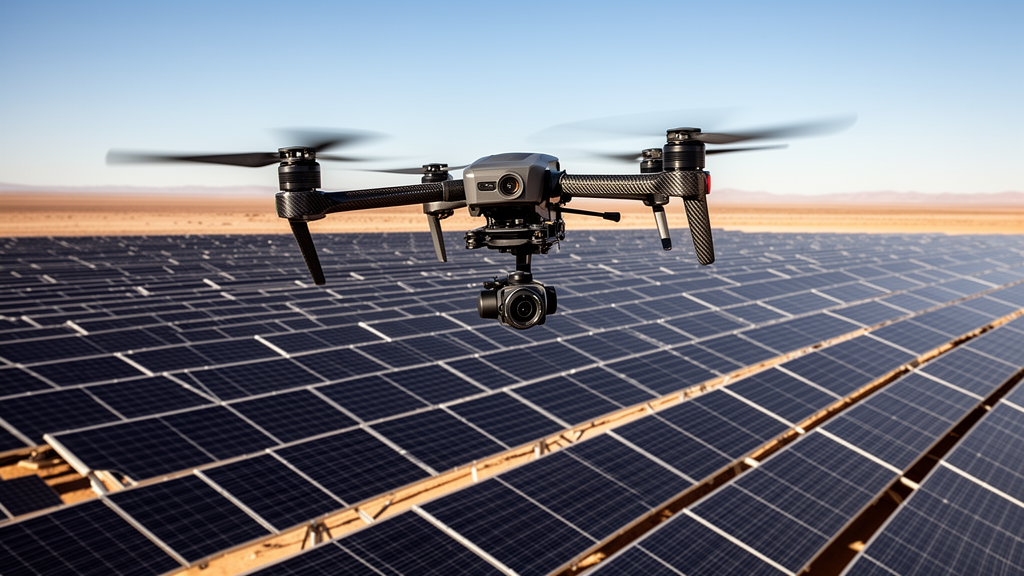
The planning method, designated RiskPath-PV, demonstrated an 8.6 percentage point gain in defect recall over an energy-aware baseline planner guided by maximum power point anomalies. Researchers evaluated the autonomous system across four distinct seasonal flight missions on an operational photovoltaic facility that was completely withheld during model training, confirming performance gains across all four operational seasons.
Large-scale photovoltaic installations feature spatially sparse hardware anomalies that present significant operational challenges for battery-limited aerial inspection platforms. To overcome these flight endurance constraints without missing critical hardware failures, the inspection architecture incorporates real-time photovoltaic string operational information directly into its routing logic as an informative defect risk prior.
The planning architecture processes raw string telemetry by constructing a dedicated string topology graph that converts operational sensor streams into a continuous, module-level risk field across the entire solar facility. Rather than training this spatial model to maximize intermediate detection accuracy, the authors trained the topology graph on a perturbed surrogate of inspection regret.
To guarantee that critical equipment failures are not overlooked during abbreviated flights, the system integrates a weighted non-exchangeable conformal risk control layer. This statistical mechanism converts a user-specified nominal miss rate for severe defects directly into an enforceable coverage constraint along the planned route. In validation flights configured with a nominal miss threshold of 0.05, the measured critical miss rate remained at 0.049. Ablation experiments verified that the conformal layer kept critical misses below 5 percent, whereas omitting the module allowed critical misses to surge to 12.4 percent.
Trajectory optimization combines an overarching reinforcement learning policy with a greedy policy that enforces an adaptive submodular guarantee through an internal consistency gate. Limiting replanning to rounds bound to battery swap windows reduced flight time by 12.3 percent, whereas operating without limited round replanning consumed the full 13.2 kilowatt-hour cap.
The underlying machine learning models were developed on operational monitoring data collected from two utility-scale solar generating stations and evaluated on a separate, previously unobserved plant. Across the experimental program, plant generation capacities ranged from 50 megawatts to 210 megawatts.
Beyond absolute defect recall, the path planning framework exhibited robust cross-scale generalization, retaining 96.4 percent of its baseline defect recall when tested on an installation 4.2 times larger than its training environments. Additional ablation studies isolated the performance impact of each structural component: decision-focused learning contributed 5.7 percentage points of absolute recall, while coordinate-free feature encoding and the policy consistency gate proved vital for scale transfer, without which scale retention dropped to 85.3 percent and 89.2 percent respectively.
Subject of Research: Adaptive unmanned aerial vehicle path planning for photovoltaic array inspection
Article Title: RiskPath-PV: risk-aware adaptive UAV path planning for automated inspection of photovoltaic arrays
Article References: Wu, W., Jin, X., Feng, R., & Gao, D. (2026). RiskPath-PV: risk-aware adaptive UAV path planning for automated inspection of photovoltaic arrays. Frontiers in Mechanical Engineering, 12, Article 2000551. https://doi.org/10.3389/fmech.2026.2000551
Image Credits: AI Generated
DOI: 10.3389/fmech.2026.2000551
Keywords: photovoltaic plant inspection, unmanned aerial vehicles, UAV path planning, RiskPath-PV, conformal risk control, decision-focused learning, defect risk prior, string topology graph, reinforcement learning, submodular optimization, electroluminescence testing, infrared thermography, solar array defects, battery swap windows, telemetry analysis, flight time reduction
News Source: Denise Maddox. (November 25, 2026). Adaptive UAV Path Planning Achieves 86.8 Percent Solar Array Defect Recall. Scienmag.