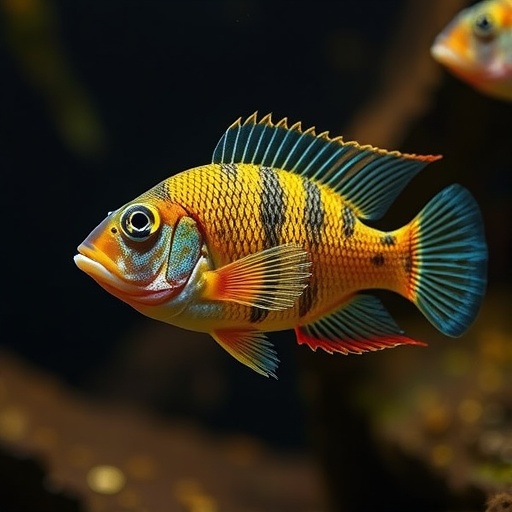
In the vast and ecologically rich waters of Lake Tanganyika, an evolutionary marvel unfolds daily as cichlid fishes showcase remarkable dietary diversity. These fishes, which represent one of the most extensive adaptive radiations among vertebrates, have evolved specialized feeding strategies that are crucial for their survival and diversification. A recent breakthrough study employing cutting-edge single-cell transcriptomics explores how these dietary adaptations manifest not only in feeding morphology but also at the cellular and molecular levels within the fish intestine.
For decades, evolutionary biologists have praised the morphological innovations in cichlid jaws as a classic example of adaptation driving speciation. Yet, the role of the digestive system, especially the intestinal structures that directly process food, has remained enigmatic. This new research shifts the spotlight to the gut, illuminating how intestinal cells evolve to support rapid dietary shifts in this hyperdiverse fish lineage. The intricate adaptations uncovered provide unprecedented insight into how ecological pressures sculpt biological systems beyond visible traits.
At the heart of these findings lies the anterior enterocytes—specialized cells lining the beginning of the intestine. Unlike previous assumptions focusing solely on physical feeding adaptations, the study reveals that adjustments in the number and gene expression patterns of these intestinal cells align closely with the diets these species pursue. Carnivorous and herbivorous cichlids display distinct cellular compositions, indicating that the gut epithelium itself is a dynamic frontline responding directly to ecological niches.
In generating comprehensive single-cell RNA sequencing data across 24 cichlid species, the researchers meticulously mapped the transcriptomic landscapes of intestinal cells. This approach allowed them to observe the expression of thousands of genes at cell-type resolution, unveiling complex regulatory networks tailored to dietary preferences. Such granular data demonstrate that shifts in cell population abundances are accompanied by modulations in cell-specific gene activity, highlighting a dual layer of cellular evolution.
The implications of these adaptations are profound. By evolving the molecular machinery within anterior enterocytes, cichlids optimize digestion, nutrient absorption, and overall metabolic efficiency according to their respective feeding strategies. This plasticity in cellular function complements structural adaptations and suggests that evolutionary success is contingent on the coordination of multiple biological systems, including subtle molecular changes within cells.
One striking outcome of the study is the identification of fast-evolving genes specific to certain cell populations in the intestine. These genetic changes appear to be instrumental in enabling cichlids to quickly adapt to new diets across diverse environments. Such rapid evolution at the cellular level may explain how this fish group continuously radiates into new ecological niches with varied trophic regimes, reinforcing the intricate link between genetics, cell biology, and ecology.
Noteworthy is that the diversification observed is not only phylogenetic but also highly plastic. Population-specific gene expression adjustments underscore an ongoing evolutionary dialogue between the environment and organism, mediated by cellular remodeling. This deeper understanding of intestinal cell dynamics underlines that adaptation is not a static endpoint but a continuous process involving intricate molecular tuning.
Furthermore, this research contributes significantly to the broader field of evolutionary biology by expanding the adaptive narrative beyond gross morphological changes. It fosters a more integrative view, emphasizing the importance of underexplored physiological and cellular processes. Moreover, understanding the intestinal adaptations in cichlids could have broader implications for vertebrate ecology, physiology, and even biomedical sciences, offering lessons on how organs remodel in response to dietary evolution.
Lake Tanganyika’s cichlids thus serve as a powerful natural laboratory, demonstrating how cellular evolution complements organismal diversification. These findings invite a reexamination of how biologists study adaptation, encouraging future investigations to consider molecular specificity within tissues. The precision that single-cell transcriptomics affords marks a new epoch in uncovering evolutionary innovations.
Beyond theoretical advances, the study’s methodological rigor sets a new benchmark. Integrating ecological data, morphological analyses, genomic information, and single-cell sequencing into a cohesive framework provides a reproducible template for dissecting adaptation in other complex radiations. This multi-dimensional approach exemplifies interdisciplinary synergy, merging evolutionary ecology with modern molecular technologies to solve longstanding biological puzzles.
The discovered link between diet and intestinal cell evolution also sparks questions about the limits and potentials of cellular plasticity. How might these mechanisms operate under environmental stress or dietary shifts caused by climate change? Could similar cellular adaptations be observed in other vertebrate groups undergoing rapid ecological diversification? These are avenues ripe for exploration catalyzed by this landmark study.
In sum, the evolution seen in the intestines of Lake Tanganyika’s cichlids epitomizes the dynamic interplay between ecological demands and cellular evolution. As these fishes continue to radiate and conquer new niches, they reveal that adaptation is a layered process, deeply embedded within tissue architecture and gene regulation. This comprehensive cellular perspective enriches our understanding of evolution’s intricate tapestry, promising to inspire novel evolutionary concepts and applications.
Subject of Research: Adaptive cellular evolution in the intestine of hyperdiverse cichlid fishes
Article Title: Adaptive cellular evolution in the intestine of hyperdiverse cichlid fishes
Article References:
Fages, A., Luxey, M., Ronco, F. et al. Adaptive cellular evolution in the intestine of hyperdiverse cichlid fishes. Nature (2026). https://doi.org/10.1038/s41586-026-10494-8
Image Credits: AI Generated
DOI: https://doi.org/10.1038/s41586-026-10494-8
Keywords: adaptive evolution, cichlid fishes, intestine, single-cell transcriptomics, trophic specialization, gene expression, cellular adaptation, Lake Tanganyika, ecological diversification
Tags: adaptive evolution in cichlidsanterior enterocytes in fish intestinescichlid feeding morphology evolutiondietary diversification in vertebratesecological pressures on digestive systemsevolutionary biology of cichlidsgut evolution and speciationhyperdiverse fish intestinesintestinal cell adaptation in fishLake Tanganyika cichlid dietmolecular basis of gut adaptationsingle-cell transcriptomics in fish