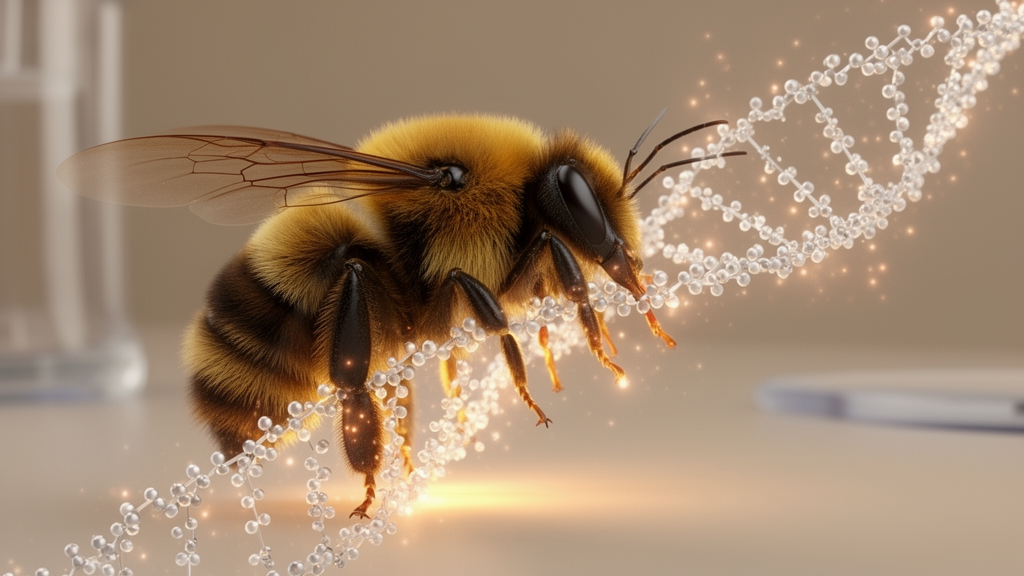
A laboratory investigation examining how elevated ambient temperatures alter gene regulation in pollinators has revealed that acute heat exposure induces pronounced but transient modifications to the epigenome of the buff-tailed bumblebee, Bombus terrestris. Writing in BMC Ecology and Evolution, researchers demonstrated that exposing young adult male bumblebees to a sixty-minute heat challenge of 42 degrees Celsius altered DNA methylation at hundreds to thousands of genomic sites. Rather than locking in permanent epigenetic marks, these molecular changes proved to be highly dynamic, shifting substantially between immediate and delayed sampling intervals and indicating active regulatory remodeling rather than the passive accumulation of environmental damage.
Bumblebees are essential cold-adapted pollinators that support wild plant reproduction and commercial agricultural yields throughout temperate and boreal zones of the Northern Hemisphere. Because of their relatively compact physical dimensions, high surface-to-volume ratios, and limited physiological capacities to regulate internal temperature, insects face extreme vulnerability to ambient temperature spikes. These risks are intensified by global climate change and the documented rise in the frequency and intensity of severe heatwaves. Although previous studies have established that elevated temperatures degrade bumblebee worker foraging behaviors, diminish queen reproductive output, and compromise whole-colony productivity, the direct epigenetic consequences of thermal stress in male bees had remained unexplored.
To investigate the timing and stability of heat-induced epigenetic modifications, the researchers exposed six-day-old male bumblebees to either a control temperature of 25 degrees Celsius or an acute heat stress regime of 42 degrees Celsius in a digitally regulated water bath for one hour. The heat stress protocol imposed substantial biological costs, reducing mean lifespan by 58 percent—from 28.7 days in control males to 12.2 days in heat-stressed males—and driving a six-fold increase in mortality hazard. The surviving bees were then maintained under standard laboratory conditions until molecular assessment. DNA methylomes were subsequently sequenced one day post-exposure at seven days of age and fifteen days post-exposure at twenty-one days of age to contrast immediate molecular reactions against delayed long-term profiles.
High-molecular-weight genomic DNA was extracted from the thorax and legs of individual males and analyzed using Oxford Nanopore Technologies long-read sequencing on a PromethION platform. Native long-read sequencing enabled the direct detection of base modifications across both CpG and non-CpG genomic contexts without requiring bisulfite chemical conversion, which is crucial given that global 5-methylcytosine levels in bumblebees hover around approximately one percent. Raw reads were processed with Dorado using high-accuracy basecalling algorithms and aligned to the Bombus terrestris reference genome, retaining genomic positions that met a minimum coverage depth of 10X for rigorous differential methylation assessments.
The resulting methylome profiles demonstrated that acute heat stress reorganized site-specific methylation patterns across distinct developmental windows. Pairwise differential methylation analyses identified 452 differentially methylated sites between control and heat-stressed males at seven days of age, whereas twenty-one-day-old males exhibited 1,836 differentially methylated sites. A substantial proportion of these altered loci mapped directly to genes operating within conserved cellular pathways, such as mitogen-activated protein kinase signaling and mechanistic target of rapamycin pathways, which help regulate the fundamental biological trade-off between somatic repair and reproductive investment.
Tracking the temporal trajectory of individual methylation marks demonstrated that the immediate and delayed epigenetic responses were largely decoupled. Among the cataloged alterations, the authors identified 405 transient differentially methylated sites that were significant only at the seven-day mark, and 692 delayed differentially methylated sites that appeared uniquely at twenty-one days. Only ten sites maintained differential methylation across both time points in the same direction, termed lasting sites, while five sites displayed reversed methylation trajectories over time. Gene ontology enrichment analyses further underlined this divergence: although transient and delayed alterations both implicated broad functional categories like proteostasis, signaling, and epigenetic regulation, only twenty specific biological process terms were shared between the two time frames.
To evaluate whether subtle, distributed methylation changes could serve as a predictive molecular signature of past thermal injury, the team trained multiple random forest classification models on seven-day-old individuals and tested their performance on twenty-one-day-old bees. Although models attained high specificity by correctly classifying older control bees at rates between 90 and 100 percent, their predictive sensitivity for detecting prior heat exposure in older bees collapsed, falling to 0 percent in the full genomic model and 25 percent in consensus and subset models. This failure to classify older stressed individuals confirmed that the short-term methylomic signature does not persist intact into later life stages.
The study also leveraged penalized elastic net regression to construct an epigenetic clock based on forty-seven informative cytosine sites whose methylation levels correlate closely with chronological age. Applying this clock revealed that acute heat stress induced significant immediate epigenetic age acceleration in seven-day-old bees, adding an average of 11.4 days of apparent biological age compared to 2.7 days in controls. However, by twenty-one days of age, the epigenetic age difference between surviving heat-stressed males and age-matched controls was no longer statistically significant, pointing to a recovery in biological aging trajectories among surviving insects.
The investigators emphasized several methodological boundaries when interpreting these patterns. Because heat exposure generated heavy initial mortality, sampling at day twenty-one inherently selected for more resilient surviving individuals, potentially obscuring persistent alterations that might have occurred in more susceptible bees. Furthermore, sequencing bulk tissue mixtures from legs and thoraces limited the resolution to broad tissue-level patterns rather than distinct cellular subtypes. Because DNA methylation correlates only weakly with gene expression in bumblebees, future work will need to resolve whether these dynamic epigenetic shifts actively drive physiological resilience or represent incidental cellular responses during thermal stress recovery.
Ultimately, these findings show that environmental heat stress dynamically reshapes the insect methylome over time rather than leaving static, permanent molecular scars across the entire genome. Demonstrating that epigenetic aging accelerates acutely after a heatwave but can stabilize in surviving individuals provides a valuable baseline for tracking thermal stress through molecular biomarkers. As global warming continues to elevate the severity and recurrence of acute temperature anomalies across temperate habitats, measuring epigenetic stability will become increasingly vital for understanding the resilience and vulnerability of key ecological pollinators.
Bumblebees follow an annual colony cycle that begins when mated queens emerge from winter diapause to establish nests and produce successive cohorts of workers. As colonies mature during summer, they produce sexual individuals, including males that depart the nest to search for mating partners. Because adult males spend most of their lives outside the colony without the thermal buffering provided by social hive structures, they face severe exposure to summer temperature spikes. Over a century of observational records indicates that bumblebees have experienced southern range contractions without shifting northward, worsening their vulnerability to climate warming. While earlier investigations noted that thermal stress impairs male morphology, diminishes visual acuity, and lowers fertility, exploring the underlying molecular mechanisms has remained critical for evaluating reproductive health.
To eliminate external confounders during the heat trials, the researchers housed the male microcolonies under strictly controlled conditions with constant humidity, regular light-dark intervals, and continuous access to sugar syrup. The thermal challenge of 42 degrees Celsius was chosen based on pilot testing establishing that it created acute physiological stress without reaching heat stupor, which occurred at an average duration of 71.4 minutes. All tissue collections were restricted to a window between 10:00 and 11:00 in the morning to prevent daily circadian rhythms from biasing DNA methylation levels. Unsupervised clustering and principal component analyses illustrated that control males across both age points grouped tightly together. In contrast, seven-day-old heat-stressed individuals displayed wide dispersion along the first principal component, while older stressed bees showed variable profiles in which three individuals clustered alongside controls and one separated completely.
Model performance diagnostics across the classification frameworks provided deeper computational confirmation that heat-induced epigenetic marks undergo temporal turnover. The consensus random forest model, which selected the ten most consistently informative sites across cross-validation folds, produced the lowest training classification error of 0.02, outperforming models built upon all sites, differentially methylated positions, or fold-specific site subsets. Although the full, subset, and consensus models achieved 71.4 percent overall classification accuracy on older bees by correctly categorizing control males with 90 to 100 percent specificity, they could not reliably detect prior heat stress. The full model failed to identify any of the four heat-stressed older males, while the subset and consensus variants detected only one out of four. Elastic net regression clock training similarly demonstrated strong predictive fidelity, showing a correlation of 0.98 during cross-validation and 0.95 in independent controls.
Beyond individual site classifications, biological enrichment analyses revealed distinct pathways participating in immediate and delayed cellular reactions. While immediate differentially methylated sites were enriched for 71 biological process terms, delayed sites associated with 192 terms, engaging pathways governing the cell cycle, DNA metabolism, and neuronal activity. Lasting alterations occurred within genes dedicated to lipid processing, intracellular transport, and stress detection, whereas reversed marks implicated autophagy, nutrient movement, and stress signaling. Similar pathways respond to life extension in bumblebees and viral exposure in honeybees, mirroring dynamic epigenetic oscillations observed in mammals. Extending epigenetic clock analyses to queens and workers will help clarify whether stress-induced epigenetic remodeling operates consistently across female castes.
Subject of Research: Epigenetic dynamics and aging responses to acute heat stress in bumblebees
Article Title: Acute heat stress induces short- and long-term epigenetic changes in the buff-tailed bumblebee (Bombus terrestris)
Article References: Renard, T., Boseret, M., & Aron, S. (2026). Acute heat stress induces short- and long-term epigenetic changes in the buff-tailed bumblebee (Bombus terrestris). BMC Ecology and Evolution, 26(1), Article 94. https://doi.org/10.1186/s12862-026-02564-2
Image Credits: AI Generated
DOI: 10.1186/s12862-026-02564-2
Keywords: Bombus terrestris, buff-tailed bumblebee, DNA methylation, epigenetics, epigenetic clock, heat stress, epigenetic age acceleration, Oxford Nanopore Technologies, thermal biology, insect physiology, global warming, pollinators, random forest classification, differential methylation, 5-methylcytosine, mTOR signalling
News Source: Drew Townsend. (November 13, 2026). Acute Heat Stress Triggers Dynamic, Non-Persistent DNA Methylation Changes in Bumblebees. Scienmag.