• HOME
  • NEWS
  • EXPLORE
    • CAREER
      • Companies
      • Jobs
    • EVENTS
    • iGEM
      • News
      • Team
    • PHOTOS
    • VIDEO
    • WIKI
  • BLOG
  • COMMUNITY
    • FACEBOOK
    • INSTAGRAM
    • TWITTER
Wednesday, July 8, 2026
BIOENGINEER.ORG
No Result
View All Result
  • Login
  • HOME
  • NEWS
  • EXPLORE
    • CAREER
      • Companies
      • Jobs
        • Lecturer
        • PhD Studentship
        • Postdoc
        • Research Assistant
    • EVENTS
    • iGEM
      • News
      • Team
    • PHOTOS
    • VIDEO
    • WIKI
  • BLOG
  • COMMUNITY
    • FACEBOOK
    • INSTAGRAM
    • TWITTER
  • HOME
  • NEWS
  • EXPLORE
    • CAREER
      • Companies
      • Jobs
        • Lecturer
        • PhD Studentship
        • Postdoc
        • Research Assistant
    • EVENTS
    • iGEM
      • News
      • Team
    • PHOTOS
    • VIDEO
    • WIKI
  • BLOG
  • COMMUNITY
    • FACEBOOK
    • INSTAGRAM
    • TWITTER
No Result
View All Result
Bioengineer.org
No Result
View All Result
Home NEWS Science News

Acute breakdown of the glial network in epilepsy

Bioengineer by Bioengineer
March 1, 2021
in Science News
Reading Time: 2 mins read
0
IMAGE
Share on FacebookShare on TwitterShare on LinkedinShare on RedditShare on Telegram

IMAGE

Credit: Ko Matsui

Tohoku University scientists and their colleagues in Germany have revealed that a first-time exposure to only a brief period of brain hyperactivity resulted in an acute breakdown of the inter-cellular network of glial cells. Pharmacological intervention of the glial plasticity may provide a new preventative strategy for fighting epilepsy.

The findings were detailed in the Journal of Neuroscience.

Epilepsy is a disorder characterized by neuronal hyper-excitation and a progression of seizures with each episode. Anti-epileptic drugs are mostly aimed at suppressing hyperactivity, but approximately 30% of patients worldwide show drug-resistance.

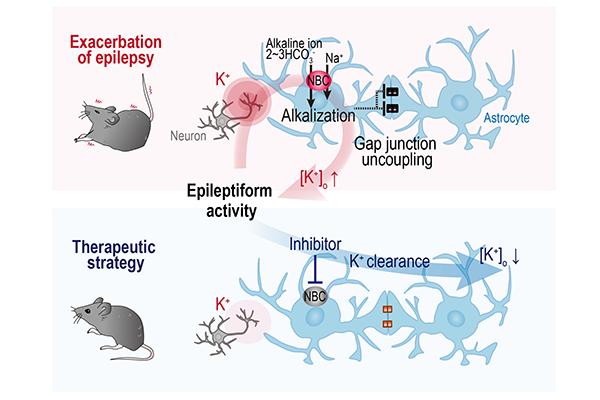
Half of the brain is occupied by non-neuronal glial cells. Astrocytes are star-shaped glial cells that are connected to each other via gap junctions. Neuronal excitation leads to potassium extrusion from neurons. The excess potassium is picked up by astrocytes and diluted in the astrocyte network. Efficacy of the potassium clearance can affect neuronal signal processing.

“Astrocytes have a strong control over neuronal activity,” says professor Ko Matsui of the Super-network Brain Physiology lab at Tohoku University, who led the research. “Plasticity of the neuronal network underlies learning and memory but apparently astrocyte function is also susceptible to plastic change.”

A collaborative research group led by Matsui, doctoral student Mariko Onodera and researchers at Heinrich Heine University Düsseldorf, studied the plastic change of astrocytes associated with epileptogenesis in mice.

In response to hyperactivity of the surrounding neurons, Na+/HCO3- co-transporter (NBC) in astrocytes was activated. The resulting intracellular alkalization led to gap junction uncoupling and impairment of prompt potassium clearance. Pharmacological blockade of the NBC suppressed the plastic change of the astrocyte network and prevented intensification of epileptiform activity.

“Astrocytes play a crucial role in taking control of neuronal activity in healthy brains as well, said Matsui. “Our research reveals the presence of glial plasticity and suggests a future therapeutic strategy can be aimed to control the glial function for treating disease.”

###

Media Contact
Ko Matsui
[email protected]

Original Source

https://www.tohoku.ac.jp/en/press/acute_breakdown_of_glial_network_in_epilepsy.html

Related Journal Article

http://dx.doi.org/10.1523/JNEUROSCI.2365-20.2020

Tags: Medicine/HealthTechnology/Engineering/Computer Science
Share13Tweet8Share2ShareShareShare2

Related Posts

Flame retardant BDE-209 targets molecularly linked to ulcerative colitis

July 6, 2026
Ultra-high frequency particle impacts mimic rockbursts to shatter hard rock

Ultra-high frequency particle impacts mimic rockbursts to shatter hard rock

July 6, 2026

Kidney transplant outcomes in older adults studied by German researchers

July 6, 2026

Embodied cognition yields interpretable trajectory predictions for autonomous systems.

July 6, 2026
Please login to join discussion

POPULAR NEWS

  • Detection of EDCs in Breast Milk and Infant Urine Up to Six Months Highlights Early Exposure Risks

    77 shares
    Share 31 Tweet 19
  • New Drug Candidate Developed at McMaster Shows Potential for Treating Brain Cancer

    58 shares
    Share 23 Tweet 15
  • Saying Goodbye to PGY-6: Pediatric Fellowship Realities

    103 shares
    Share 41 Tweet 26
  • KTU Researchers Explore Ultrasound’s Role in Enhancing Blood Flow Beyond Diagnostics

    53 shares
    Share 21 Tweet 13

About

We bring you the latest biotechnology news from best research centers and universities around the world. Check our website.

Follow us

Recent News

Flame retardant BDE-209 targets molecularly linked to ulcerative colitis

Ultra-high frequency particle impacts mimic rockbursts to shatter hard rock

Kidney transplant outcomes in older adults studied by German researchers

Subscribe to Blog via Email

Success! An email was just sent to confirm your subscription. Please find the email now and click 'Confirm' to start subscribing.

Join 83 other subscribers
  • Contact Us

Bioengineer.org © Copyright 2023 All Rights Reserved.

Welcome Back!

Login to your account below

Forgotten Password?

Retrieve your password

Please enter your username or email address to reset your password.

Log In
No Result
View All Result
  • Homepages
    • Home Page 1
    • Home Page 2
  • News
  • National
  • Business
  • Health
  • Lifestyle
  • Science

Bioengineer.org © Copyright 2023 All Rights Reserved.