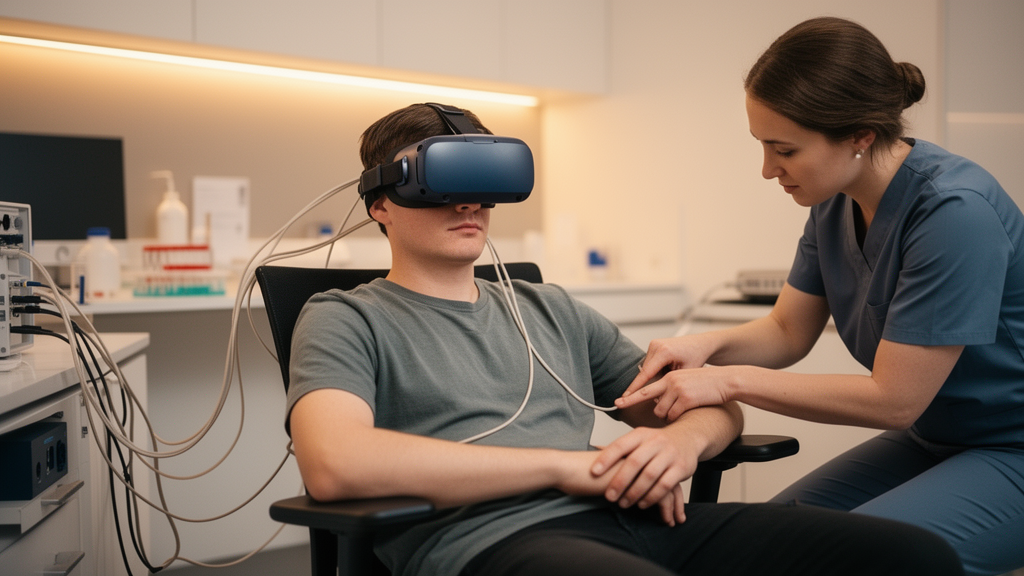
Stimulating a single acupuncture point on the wrist produces measurably different patterns of brain activity depending on how the point is stimulated, according to a new study published in Frontiers in Computational Neuroscience. Researchers at the China Academy of Chinese Medical Sciences and collaborating institutions recorded continuous electroencephalography (EEG) from 200 healthy volunteers while applying four different types of stimulation to the Neiguan acupoint, known as PC6, during virtual reality immersion.
The Neiguan point has a long clinical history: acupuncture there is used to ease postoperative and chemotherapy-induced nausea and vomiting. Whether stimulating PC6 also affects virtual reality motion sickness, a form of physiological vertigo arising from conflict between visual and vestibular signals, had remained unclear, as had the underlying brain mechanisms. The new study was designed to address that gap by tracking dynamic changes in brain function during VR exposure under different stimulation conditions, using microstate analysis as the primary method.
Participants were selected on the basis of their Motion Sickness Susceptibility Questionnaire scores, with a cut-off of 34 or higher used as the inclusion criterion. All 200 enrolled participants were randomly assigned to one of four equal groups of 50. One group served as a control and received stimulation at 32 degrees Celsius, while the others received thermal stimulation at 40 degrees Celsius, thermal stimulation at 44 degrees Celsius, or 2-hertz transcutaneous electrical acupoint stimulation, abbreviated TEAS. Each participant underwent a 40-minute session targeting the right PC6 acupoint, structured in three phases: baseline, active stimulation, and post-stimulation, with EEG recorded continuously throughout.
The results revealed distinct electrophysiological signatures for each stimulation modality. During the active stimulation phase, the 2-hertz TEAS group showed significantly increased duration, occurrence, and coverage of microstate D compared with the control group, meaning that this particular brain state lasted longer, appeared more often, and occupied a larger share of total recording time. The 40-degree thermal group, by contrast, affected only the duration of microstate D. These differences suggest that low-frequency electrical stimulation engages a broader set of microstate parameters than moderate warmth applied to the same point.
Effects also persisted and evolved after stimulation ended. In the post-stimulation phase, the 44-degree thermal group showed a decreased duration of microstate A along with significantly increased duration and coverage of microstate B relative to controls, while the TEAS group continued to display sustained effects on the duration of microstate D. The authors conclude that the neuroelectrophysiological signatures of PC6 stimulation under these conditions are reflected primarily in the dynamic behavior of microstates A, B, and D, and that thermal and low-frequency electrical stimulation appear to recruit distinct central modulatory pathways.
Several caveats are worth noting. The study enrolled healthy participants screened for motion sickness susceptibility and measured brain activity patterns, not clinical outcomes; the abstract does not report whether any stimulation modality reduced motion sickness symptoms themselves. The findings therefore describe how different stimulation parameters alter EEG microstate dynamics during VR immersion, providing a neuroelectrophysiological basis that the authors say can inform the optimization of stimulation parameters in future studies on virtual reality motion sickness, rather than demonstrating a therapeutic effect.
Subject of Research: Effects of different PC6 acupoint stimulation modalities on EEG microstates during virtual reality motion sickness
Article Title: Different modes of stimulation at the Neiguan acupoint (PC6) regulate different EEG microstates under VR immersion conditions
Article References: Huo, Z., Zhao, S., Liu, Q., Jia, S., Lyu, Q., Liu, X., Tu, N., Song, X., Wang, S., Zhang, W., Geng, L., Sun, L., Guo, Y., & Wang, G. (2026). Different modes of stimulation at the Neiguan acupoint (PC6) regulate different EEG microstates under VR immersion conditions. Frontiers in Computational Neuroscience, 20, Article 1938329. https://doi.org/10.3389/fncom.2026.1938329
Image Credits: AI Generated
DOI: 10.3389/fncom.2026.1938329
Keywords: EEG microstates, Neiguan acupoint, PC6, virtual reality motion sickness, transcutaneous electrical acupoint stimulation, thermal stimulation, electroencephalography, neuroscience, motion sickness susceptibility, brain dynamics, Different, modes
News Source: Cassandra Pierce. (October 27, 2026). Acupoint stimulation shapes brain microstates during virtual reality immersion. Scienmag.