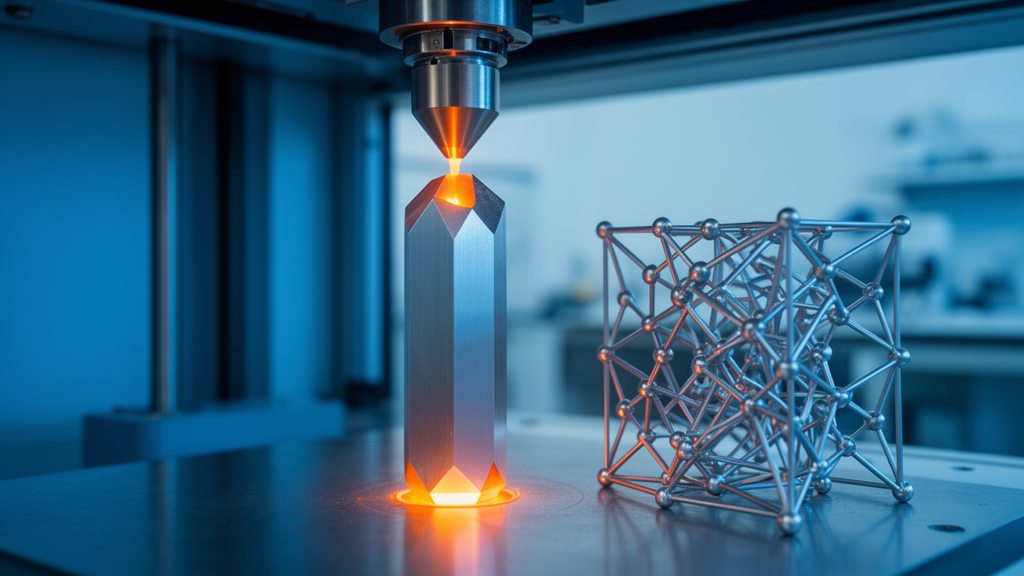
Single-crystal metals, prized for their performance in demanding applications, have long been difficult to make in large or complex shapes, because conventional crystal-growth methods require strict quasi-steady thermal conditions. A study published in Nature on 21 October 2026 reports a free-form additive manufacturing approach that overcomes this limitation by using delicately controlled alternating and pulsed heat inputs to govern and direct single-crystal growth during printing.
Using this method, the researchers demonstrated the fabrication of metre-tall, centimetre-diameter single-crystal Ti-6Al-4V. They also report, to their knowledge, the first single-crystal lattice structures containing complex zigzag ligaments, which the authors say effectively eliminates theoretical size constraints for single-crystal components.
The approach addresses a fundamental conflict: the intense cyclic thermal fluctuations inherent to additive manufacturing have historically prevented the 3D printing of large or architected single crystals. By carefully choreographing heat input, the technique directs crystal growth in a way that maintains a single crystallographic orientation throughout the printed part.
The mechanical performance of the printed material is a central finding. The bulk single-crystal Ti-6Al-4V exhibited an order-of-magnitude increase in creep resistance over standard grain-size scaling predictions. According to the authors, this improvement is driven by the synergistic elimination of grain boundaries together with an additive manufacturing-induced hierarchical α/β-architecture that regulates dislocation density, dislocation mobility and void evolution.
The comparison of the as-fabricated single-crystal Ti-6Al-4V with forged and additively manufactured polycrystalline counterparts is presented in the study’s figures, which document both the creep performance and the hierarchical microstructural analysis underlying the mechanical behaviour.
Beyond titanium alloys, the team demonstrated the broad applicability of the technique by printing single crystals of hard-to-process refractory metals, including tungsten, molybdenum, niobium and MoNb alloys.
The work, led by Changmeng Liu, Yinan Cui and colleagues with Y. Morris Wang among the senior authors, introduces what the authors describe as a large-scale method for single-crystal additive manufacturing. The combination of metre-scale dimensions and complex geometries, such as lattices with zigzag ligaments, had previously been unattainable by classical single-crystal growth methods.
The reported creep resistance gain is attributed to two mechanisms acting together. Second, the hierarchical α/β microstructure created by the printing process itself modulates dislocation density and mobility, and influences how voids evolve under load. The study’s microstructural analysis compares the as-fabricated single-crystal material with forged polycrystalline material to document these effects.
Because the findings are reported in the abstract of a subscription-preview article, the full experimental details, including the exact thermal schedules and complete mechanical test data, are available in the published paper. The reported results cover the demonstrated materials and geometries described above, and the authors frame the method as enabling high-performance, complex geometries previously unattainable by classical methods.
Subject of Research: Additive manufacturing of large and architected single-crystal metals
Article Title: Additive manufacturing of ultralong and architected single crystals
Article References: Liu, C., Cui, Y., Wang, J., Han, X., Ji, Z., Liang, Z., Zhang, C., Marian, J., Li, Z., Lu, T., Xu, T., Zhang, J., Cui, W., Liu, W., Fang, D., & Wang, Y. M. (2026). Additive manufacturing of ultralong and architected single crystals. Nature. https://doi.org/10.1038/s41586-026-11185-0
Image Credits: AI Generated
DOI: 10.1038/s41586-026-11185-0
Keywords: additive manufacturing, single crystals, Ti-6Al-4V, 3D printing, creep resistance, refractory metals, lattice structures, metallurgy, thermal control, materials science, Additive, manufacturing
News Source: Denise Maddox. (October 27, 2026). 3D printing method produces metre-tall single crystals and single-crystal lattices. Scienmag.