• HOME
  • NEWS
  • EXPLORE
    • CAREER
      • Companies
      • Jobs
    • EVENTS
    • iGEM
      • News
      • Team
    • PHOTOS
    • VIDEO
    • WIKI
  • BLOG
  • COMMUNITY
    • FACEBOOK
    • INSTAGRAM
    • TWITTER
Thursday, May 21, 2026
BIOENGINEER.ORG
No Result
View All Result
  • Login
  • HOME
  • NEWS
  • EXPLORE
    • CAREER
      • Companies
      • Jobs
        • Lecturer
        • PhD Studentship
        • Postdoc
        • Research Assistant
    • EVENTS
    • iGEM
      • News
      • Team
    • PHOTOS
    • VIDEO
    • WIKI
  • BLOG
  • COMMUNITY
    • FACEBOOK
    • INSTAGRAM
    • TWITTER
  • HOME
  • NEWS
  • EXPLORE
    • CAREER
      • Companies
      • Jobs
        • Lecturer
        • PhD Studentship
        • Postdoc
        • Research Assistant
    • EVENTS
    • iGEM
      • News
      • Team
    • PHOTOS
    • VIDEO
    • WIKI
  • BLOG
  • COMMUNITY
    • FACEBOOK
    • INSTAGRAM
    • TWITTER
No Result
View All Result
Bioengineer.org
No Result
View All Result
Home NEWS Science News Chemistry

Active asteroid unveils fireball identity

Bioengineer by Bioengineer
January 15, 2020
in Chemistry
Reading Time: 2 mins read
0
IMAGE
Share on FacebookShare on TwitterShare on LinkedinShare on RedditShare on Telegram

IMAGE

Credit: NAOJ/Kasuga et al.


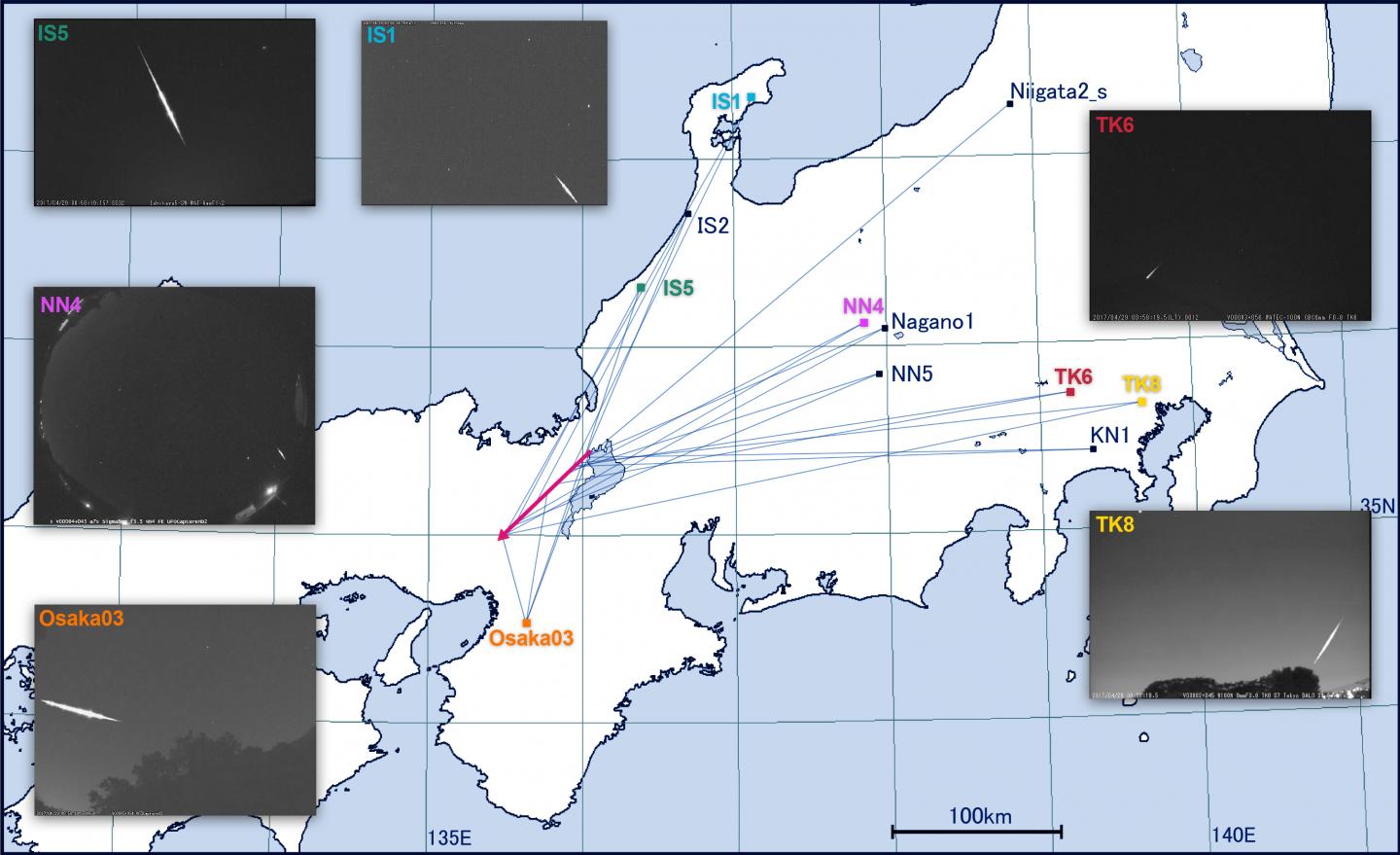
At around 1 a.m. local standard time on April 29, 2017, a fireball flew over Kyoto, Japan. Compared to other fireballs spotted from Earth, it was relatively bright and slow. Now, scientists have determined not only what the fireball was, but also where it came from.

“We uncovered the fireball’s true identity,” says Toshihiro Kasuga, paper author and visiting scientist at the National Astronomical Observatory of Japan and Kyoto Sangyo University. “It has a similar orbit to that of the near-Earth asteroid 2003 YT1, which is likely its parent body.”

2003 YT1, a binary asteroid first detected in 2003, appears to have been active in the past, meaning it fissured and released dust particles, such as the one responsible for the 2017 fireball. It does not currently show any activity, though, according to Kasuga. However, the researchers found that the orbit, estimated radiant point, velocity and appearance date of the 2017 fireball are all consistent with dust particles that originated from 2003 YT1.

“The potential break-up of the rock could be dangerous to life on Earth,” Kasuga says. “The parent body 2003 YT1 could break up, and those resulting asteroids could hit the Earth in the next 10 million years or so, especially because 2003 YT1 has a dust production mechanism.”

The researchers found that this dust production mechanism, or the asteroid’s likelihood of releasing dust and rock particles, stems from its rotational instability in a process called the YORP effect. When the asteroid is warmed by the Sun, the energy results in a small thrust, which can produce a corresponding recoil, depending on the gravitational pull and other physical variables. The recoil can twist the asteroid, introducing a rotational change. The change can be at physical odds with the gravity and/or other forces, and force the asteroid to physically break — even just a little, a process which produces dust.

“The released particles can enter Earth’s atmosphere and appear as fireballs, which is exactly what happened in 2017,” says Kasuga.

According to Kasuga, that particular fireball was not a threat to Earth, as it was estimated to only be a few centimeters in size. Something so small would burn up before it reached the surface.

“The 2017 fireball and its parent asteroid gave us a behind-the-scenes look at meteors,” says Kasuga. “Next, we plan to further research predictions for potentially hazardous objects approaching the Earth. Meteor science can be a powerful asset for taking advanced steps towards planetary defense.”

###

Other contributors include Mikiya Sato, Masayoshi Ueda, and Yasunori Fujiwara, all of the Nippon Meteor Society. Chie Tsuchiya and Jun-Ichi Watanabe, both of the National Astronomical Observatory of Japan, also co-authored the paper.

Media Contact
Hitoshi Yamaoka
[email protected]

Original Source

https://www.nao.ac.jp/en/news/science/2020/20200115-prc.html

Related Journal Article

http://dx.doi.org/10.3847/1538-3881/ab4e1b

Tags: AstronomyAstrophysicsComets/AsteroidsMeteorologySpace/Planetary Science
Share12Tweet8Share2ShareShareShare2

Related Posts

Scientists Achieve Breakthrough in Molecular ‘Sandwich’ Assembly — Chemistry

Scientists Achieve Breakthrough in Molecular ‘Sandwich’ Assembly

May 21, 2026
Advancing In Vivo and In Situ Monitoring: Science Bulletin Highlights Host-Based Antifouling Gold Nanotube Sensor for Selective Detection of Mechanically Sensitive Serotonin Release in Intestinal Mucosa — Chemistry

Advancing In Vivo and In Situ Monitoring: Science Bulletin Highlights Host-Based Antifouling Gold Nanotube Sensor for Selective Detection of Mechanically Sensitive Serotonin Release in Intestinal Mucosa

May 20, 2026

How Magnetic Orientation Could Influence the Building Blocks of Life

May 20, 2026

Breaking a 200-Year-Old Belief: Novel Surface Design Achieves Two Distinct Wetting States on One Substrate

May 20, 2026
Please login to join discussion

POPULAR NEWS

  • blank

    New Study Reveals Plants Can Detect the Sound of Rain

    733 shares
    Share 292 Tweet 183
  • ESMO 2025: mRNA COVID Vaccines Enhance Efficacy of Cancer Immunotherapy

    304 shares
    Share 122 Tweet 76
  • Research Indicates Potential Connection Between Prenatal Medication Exposure and Elevated Autism Risk

    846 shares
    Share 338 Tweet 212
  • Breastmilk Balances E. coli and Beneficial Bacteria in Infant Gut Microbiomes

    58 shares
    Share 23 Tweet 15

About

We bring you the latest biotechnology news from best research centers and universities around the world. Check our website.

Follow us

Recent News

Innovative Reusable Brick Walls Revolutionize Construction Industry

Nonlinear Atomic Tunneling Enhanced by Bright Squeezed Vacuum

Label-Free Super-Resolution Imaging of Live Cells

Subscribe to Blog via Email

Enter your email address to subscribe to this blog and receive notifications of new posts by email.

Join 82 other subscribers
  • Contact Us

Bioengineer.org © Copyright 2023 All Rights Reserved.

Welcome Back!

Login to your account below

Forgotten Password?

Retrieve your password

Please enter your username or email address to reset your password.

Log In
No Result
View All Result
  • Homepages
    • Home Page 1
    • Home Page 2
  • News
  • National
  • Business
  • Health
  • Lifestyle
  • Science

Bioengineer.org © Copyright 2023 All Rights Reserved.