At ultracold temperature of 4 kelvins, the carbon increased efficiency by more than 30%.
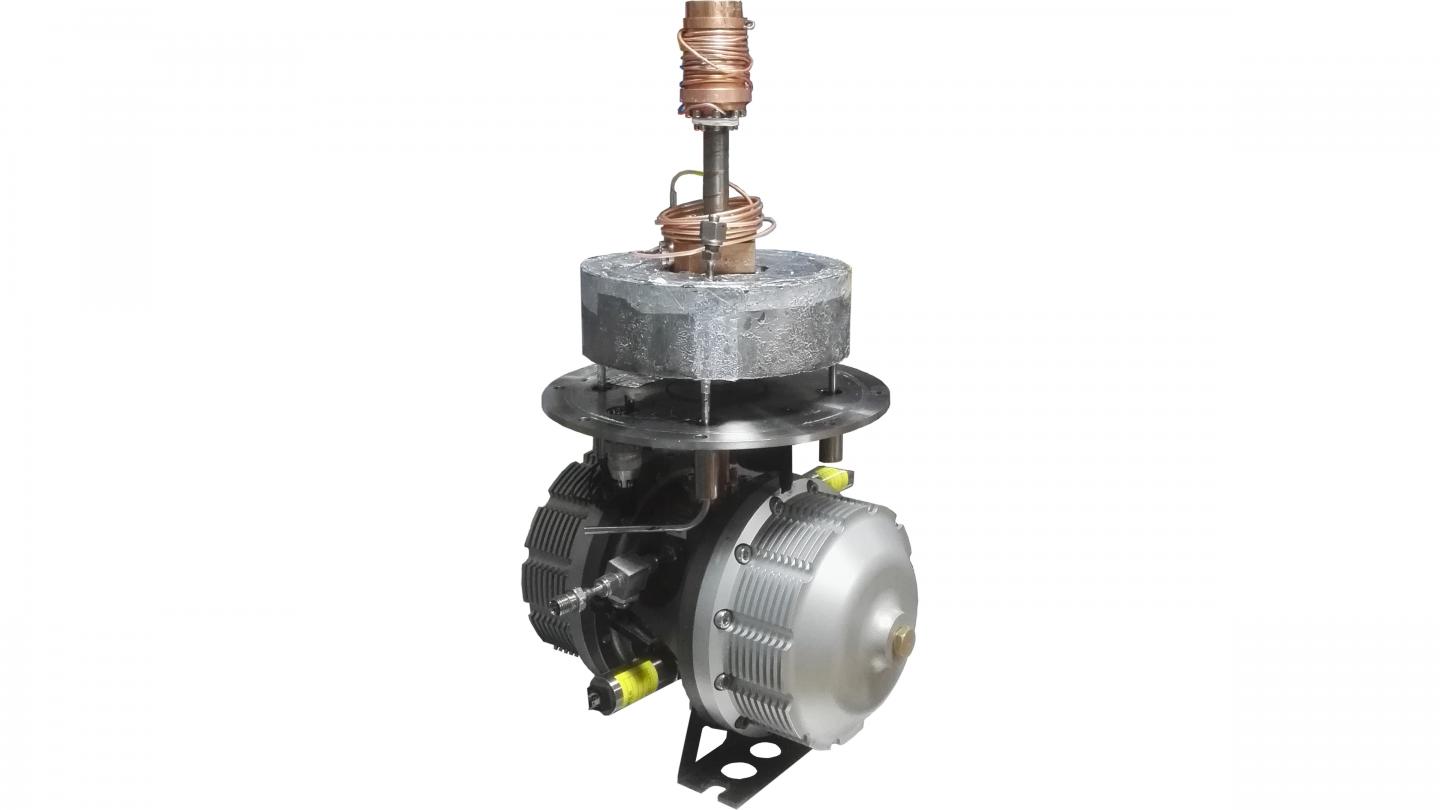
Credit: Liubiao Chen/University of Chinese Academy of Sciences
WASHINGTON, April 6, 2021 — Cryocoolers are ultracold refrigeration units used in surgery and drug development, semiconductor fabrication, and spacecraft. They can be tubes, pumps, tabletop sizes, or larger refrigerator systems.
The regenerative heat exchanger, or regenerator, is a core component of cryocoolers. At temperatures below 10 kelvins (-441.67 degrees Fahrenheit), performance drops precipitously, with maximum regenerator loss of more than 50%.
In their paper, published in Applied Physics Letters, by AIP Publishing, researchers at the University of Chinese Academy of Sciences used superactivated carbon particles as an alternative regenerator material to increase cooling capability at temperatures as low as 4 kelvins.
In most cryocoolers, a compressor drives room temperature gas through the regenerator. The regenerator soaks up heat from the compression, and the cooled gas expands. The oscillating ultracold gas absorbs the heat trapped in the regenerator, and the process repeats.
Nitrogen is the most commonly used gas in cryocoolers. But for applications requiring temperatures below 10 kelvins, such as space telescope instruments and magnetic resonance imaging systems, helium is used, because it has the lowest boiling point of any gas, enabling the coldest attainable temperatures.
However, helium’s high specific heat (the amount of heat transfer needed to change the temperature of a substance) results in large temperature fluctuations during the compression and expansion cycle at low temperatures, which seriously affects cooling efficiency.
To address this problem, researchers replaced the regenerator’s conventional rare-earth metals with activated carbon, which is carbon treated with carbon dioxide or superheated steam at high temperatures. This creates a matrix of micron-size pores that increases the carbon’s surface area, enabling the regenerator to hold more helium at low temperatures and remove more heat.
The researchers used a 4 kelvins Gifford-McMahon cryocooler to test the helium adsorption capacity in superactivated carbon particles with a porosity of 0.65 within varying temperature ranges of 3-10 kelvins.
They found when they filled the regenerator with 5.6% of carbon with diameters between 50 and 100 microns, the obtained no-load temperature of 3.6 kelvins was the same as using precious metals. However, at 4 kelvins, cooling capacity increased by more than 30%.
They confirmed improved performance by placing coconut shell-activated carbon into an experimental pulse tube they built and using a thermodynamic calculation model.
“In addition to providing increased cooling capacity, the activated carbon can serve as a low-cost alternative to precious metals and could also benefit low-temperature detectors that are sensitive to magnetism,” author Liubiao Chen said.
###
The article “Study on the use of porous materials with adsorbed helium as the regenerator of cryocooler at temperatures below 10 K” is authored by Xiaotong Xi, Biao Yang, Yuanheng Zhao, Liubiao Chen, and Junjie Wang. The article will appear in Applied Physics Letters on April 6, 2021 (DOI: 10.1063/5.0044221). After that date, it can be accessed at https:/
ABOUT THE JOURNAL
Applied Physics Letters features rapid reports on significant discoveries in applied physics. The journal covers new experimental and theoretical research on applications of physics phenomena related to all branches of science, engineering, and modern technology.
See https:/
Media Contact
Larry Frum
[email protected]
Related Journal Article
http://dx.