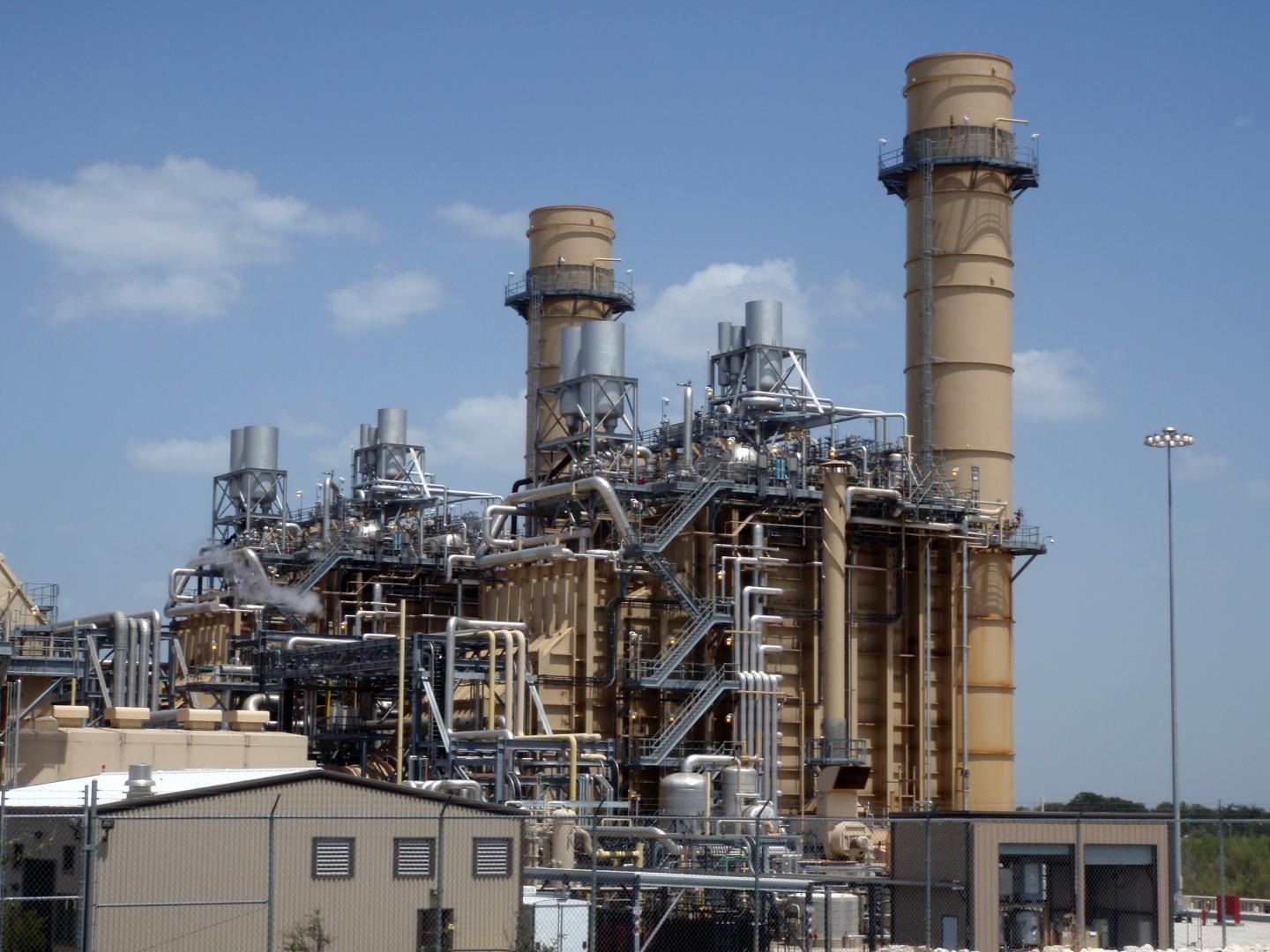
Credit: Image courtesy of Rob Jackson.
Without a significant effort to reduce greenhouse gases, including an accelerated deployment of technologies for capturing atmospheric carbon and storing it underground, and sustained growth in renewables such as wind and solar, the world could miss a key global temperature target set by the Paris Agreement and the long-term goal of net-zero climate pollution.
The finding, published in the Jan. 30 issue of the journal Nature Climate Change, is part of a new study that aims to track the progress and compare emission pledges of more than 150 nations that signed the Paris Agreement, a 2015 United Nations convention that aims to keep global warming below 2 degrees Celsius of pre-industrial levels — the threshold that scientists have marked as the point of no return for catastrophic warming.
"The good news is that fossil fuel emissions have been flat for three years in a row," said Robert Jackson, chair of the Department of Earth System Science at Stanford's School of Earth, Energy & Environmental Sciences. "Now we need actual reductions in global emissions and careful tracking of emission pledges and country-level statistics."
In the new study, Jackson and his colleagues developed a nested family of metrics that can be used to track different national emissions pledges and thus global progress toward the objectives of the Paris Agreement.
Applying their method to the recent past, the researchers found that global carbon dioxide emissions have remained steady at around 36 gigatons of carbon dioxide for the third year in a row in 2016.
"The rapid deployment of wind and solar is starting to have an effect globally, and in key players such as China, the U.S. and the European Union," said Glen Peters, senior researcher at the Center for International Climate and Environmental Research – Oslo (CICERO) and lead author for the study. "The challenge is to substantially accelerate the new additions of wind and solar, and find solutions for effectively integrating these into existing electricity networks."
However, wind and solar alone won't be sufficient to meet the goals of the Paris Agreement. When the researchers examined the drivers behind the recent slowdown, they found that most of them boiled down to economic factors and reduced coal use, mostly in China but also the United States.
In China, the decline in coal use was driven by reduced output of cement, steel and other energy-intensive products, as well as a dire need to alleviate outdoor air pollution, which is responsible for more than 1 million premature deaths annually.
The reasons for the decline in the United States were more complex, driven not only by a decline in coal use but also by gains in energy efficiency in the industrial sector and the rapid rise of natural gas and wind and solar power. "2016 was the first year that natural gas surpassed coal for electricity generation," said Jackson, who is also chair of the Global Carbon Project, which tracks the amount of carbon dioxide emitted by humans each year.
Looking to the future, the researchers predict that the greatest challenge to meeting the goals of the Paris Agreement is the slower than expected rollout of carbon capture and storage technologies. Most scenarios suggest the need for thousands of facilities with carbon capture and storage by 2030, the researchers say, far below the tens that are currently proposed.
Jackson notes that carbon capture and storage technology will prove even more crucial if President Donald Trump follows through with his campaign pledge of resuscitating the nation's struggling coal industry.
"There's no way to reduce the carbon emissions associated with coal without carbon capture and storage," Jackson said.
Jackson is also a senior fellow at the Stanford Woods Institute for the Environment and the Precourt Institute for Energy.
###
Other authors on the study, titled "Key indicators to track current progress and future ambition of the Paris Agreement," include Robbie Andrews and Jan Ivar Korsbakken of CICERO; Josep Canadell of the Global Carbon Project; Sabine Fuss of the Mercator Research Institute on Global Commons and Climate Change; Corinne Le Que?re? of the University of East Anglia; and Nebojsa Nakicenovic of IIASA, the International Institute for Applied Systems Analysis.
Funding was provided by the Research Council of Norway and the National Environmental Science Program-Earth Systems and Climate Change (NESP-ESCC) Hub.
Media Contact
Ker Than
[email protected]
650-723-9820
@stanfordearth
https://earth.stanford.edu/
############
Story Source: Materials provided by Scienmag