

• HOME
  • NEWS
  • EXPLORE
    • CAREER
      • Companies
      • Jobs
    • EVENTS
    • iGEM
      • News
      • Team
    • PHOTOS
    • VIDEO
    • WIKI
  • BLOG
  • COMMUNITY
    • FACEBOOK
    • INSTAGRAM
    • TWITTER
Sunday, December 21, 2025
BIOENGINEER.ORG
No Result
View All Result
  • Login
  • HOME
  • NEWS
  • EXPLORE
    • CAREER
      • Companies
      • Jobs
        • Lecturer
        • PhD Studentship
        • Postdoc
        • Research Assistant
    • EVENTS
    • iGEM
      • News
      • Team
    • PHOTOS
    • VIDEO
    • WIKI
  • BLOG
  • COMMUNITY
    • FACEBOOK
    • INSTAGRAM
    • TWITTER
  • HOME
  • NEWS
  • EXPLORE
    • CAREER
      • Companies
      • Jobs
        • Lecturer
        • PhD Studentship
        • Postdoc
        • Research Assistant
    • EVENTS
    • iGEM
      • News
      • Team
    • PHOTOS
    • VIDEO
    • WIKI
  • BLOG
  • COMMUNITY
    • FACEBOOK
    • INSTAGRAM
    • TWITTER
No Result
View All Result
Bioengineer.org
No Result
View All Result
Home NEWS Science News Health

Access to federally qualified health centers does not translate into lower rates of ED use

Bioengineer by Bioengineer
February 11, 2019
in Health
Reading Time: 2 mins read
0
IMAGE
Share on FacebookShare on TwitterShare on LinkedinShare on RedditShare on Telegram

IMAGE

Credit: LAUREN MALONEY, MD, STONY BROOK MEDICINE


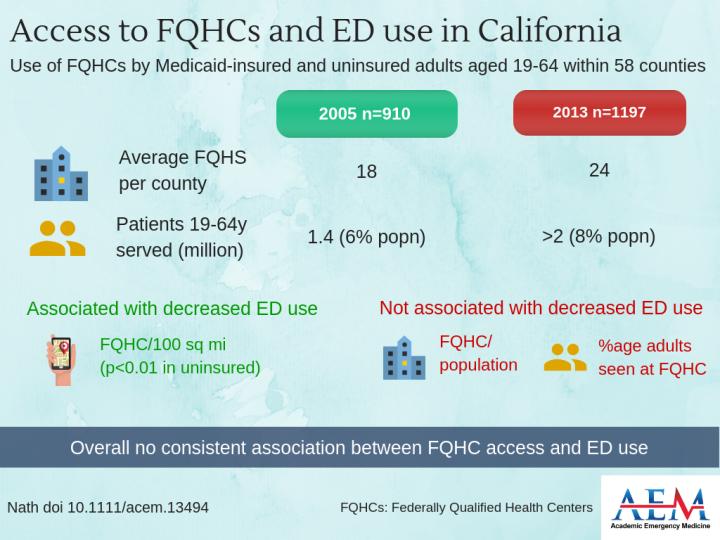
DES PLAINES, IL — There is no association between access to federally qualified health centers (FQHCs) and emergency department visits for either uninsured or Medicaid-insured patients. That is the conclusion of a study to be published in the February 2019 issue of Academic Emergency Medicine (AEM), a journal of the Society for Academic Emergency Medicine (SAEM).

The lead author of the study is Julia B. Nath, MD, a resident in the University of Chicago Internal Medicine Residency Program, Chicago.

The study underscores the importance of investigating additional intervention points beyond nonspecific primary care access in the effort to reduce emergency department overuse among vulnerable populations.

Commenting on the study is Jeremiah Schuur, MD, MHS, chair of the Department of Emergency Medicine at The Warren Alpert Medical School of Brown University and physician-in-chief for emergency medicine at Lifespan. Dr. Schuur, an expert in quality, patient safety measurement and policy, is also the chief of the Division of Health Policy Translation, the Director of Quality, Patient Safety and Performance Improvement for the Department of Emergency Medicine of the Brigham and Women’s Hospital, and an associate professor of medicine (emergency) at Harvard Medical School:

“The analysis by Nath et al will surprise many because it did not show a clear or consistent association between the density of Federally Qualified Health Centers (FQHCs) and reduced use of emergency departments by patients with Medicaid and the uninsured. This should not be surprising because while we know that FQHCs provide important access to care and a broad range of services to this population, we also know that access to traditional primary care is not always effective in reducing emergency department use, as patients often decide to seek care at times when FQHCs aren’t open or for conditions which FQHCs are not capable of addressing.”

###

ABOUT ACADEMIC EMERGENCY MEDICINE

Academic Emergency Medicine, the monthly journal of Society for Academic Emergency Medicine, features the best in peer-reviewed, cutting-edge original research relevant to the practice and investigation of emergency care. The above study is published open access and can be downloaded by following the DOI link: 10.1111/acem.13494. Journalists wishing to interview the authors may contact Stacey Roseen at [email protected].

ABOUT THE SOCIETY FOR ACADEMIC EMERGENCY MEDICINE

SAEM is a 501(c)(3) not-for-profit organization dedicated to the improvement of care of the acutely ill and injured patient by leading the advancement of academic emergency medicine through education and research, advocacy, and professional development. To learn more, visit saem.org.

Media Contact
Stacey Roseen
[email protected]
708-606-7120

Related Journal Article

http://dx.doi.org/10.1111/acem.13494

Tags: Critical Care/Emergency MedicineGerontologyHealth Care Systems/ServicesHealth ProfessionalsMedicine/HealthPublic HealthTrauma/Injury
Share12Tweet8Share2ShareShareShare2

Related Posts

MINFLUX Reveals Cardiac Ryanodine Receptor Structure in 3D

December 21, 2025

Antisense Therapy Reverses Developmental Defects in SMA Organoids

December 21, 2025

Unraveling Influenza A Host Tropism through Nucleotide Signatures

December 21, 2025

Frailty and Malnutrition Impact Pneumonia Severity in Vaccinated Elderly

December 21, 2025
Please login to join discussion

POPULAR NEWS

  • Nurses’ Views on Online Learning: Effects on Performance

    Nurses’ Views on Online Learning: Effects on Performance

    70 shares
    Share 28 Tweet 18
  • NSF funds machine-learning research at UNO and UNL to study energy requirements of walking in older adults

    71 shares
    Share 28 Tweet 18
  • Unraveling Levofloxacin’s Impact on Brain Function

    54 shares
    Share 22 Tweet 14
  • Exploring Audiology Accessibility in Johannesburg, South Africa

    51 shares
    Share 20 Tweet 13

About

We bring you the latest biotechnology news from best research centers and universities around the world. Check our website.

Follow us

Recent News

MINFLUX Reveals Cardiac Ryanodine Receptor Structure in 3D

Antisense Therapy Reverses Developmental Defects in SMA Organoids

Black Soldier Fly Larvae Boost African Catfish Growth

Subscribe to Blog via Email

Enter your email address to subscribe to this blog and receive notifications of new posts by email.

Join 70 other subscribers
  • Contact Us

Bioengineer.org © Copyright 2023 All Rights Reserved.

Welcome Back!

Login to your account below

Forgotten Password?

Retrieve your password

Please enter your username or email address to reset your password.

Log In
No Result
View All Result
  • Homepages
    • Home Page 1
    • Home Page 2
  • News
  • National
  • Business
  • Health
  • Lifestyle
  • Science

Bioengineer.org © Copyright 2023 All Rights Reserved.


