• HOME
  • NEWS
  • EXPLORE
    • CAREER
      • Companies
      • Jobs
    • EVENTS
    • iGEM
      • News
      • Team
    • PHOTOS
    • VIDEO
    • WIKI
  • BLOG
  • COMMUNITY
    • FACEBOOK
    • INSTAGRAM
    • TWITTER
Friday, June 26, 2026
BIOENGINEER.ORG
No Result
View All Result
  • Login
  • HOME
  • NEWS
  • EXPLORE
    • CAREER
      • Companies
      • Jobs
        • Lecturer
        • PhD Studentship
        • Postdoc
        • Research Assistant
    • EVENTS
    • iGEM
      • News
      • Team
    • PHOTOS
    • VIDEO
    • WIKI
  • BLOG
  • COMMUNITY
    • FACEBOOK
    • INSTAGRAM
    • TWITTER
  • HOME
  • NEWS
  • EXPLORE
    • CAREER
      • Companies
      • Jobs
        • Lecturer
        • PhD Studentship
        • Postdoc
        • Research Assistant
    • EVENTS
    • iGEM
      • News
      • Team
    • PHOTOS
    • VIDEO
    • WIKI
  • BLOG
  • COMMUNITY
    • FACEBOOK
    • INSTAGRAM
    • TWITTER
No Result
View All Result
Bioengineer.org
No Result
View All Result
Home NEWS Science News Biology

A real turn on: Evolutionary rotation of fly genitalia tied to mating success

Bioengineer by Bioengineer
February 27, 2019
in Biology
Reading Time: 3 mins read
0
IMAGE
Share on FacebookShare on TwitterShare on LinkedinShare on RedditShare on Telegram

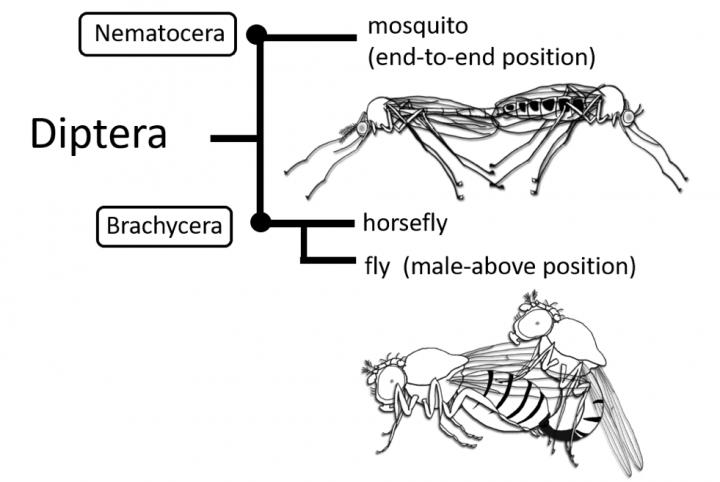
Research at Osaka University on the angle of male flies’ genitalia suggests a cooperative evolution of body structure and behavior
IMAGE

Credit: © Inatomi M. et al. (2019) Scientific Reports 9:210

Osaka, Japan – In the order Diptera, more-primitive species such as mosquitos generally do their deed in the end-to-end position. Higher (more evolved) species such as flies tend toward the male mounting the female from behind (male-above position).

It’s nature’s infallibility at work: these positions are the most effective and productive alignment of the two sexes’ genitalia for the sake of successful reproduction.

The genitalia of healthy higher species rotate a full 360 degrees early in their development, compared with the 180-degree rotation of males in the lower species. Both rotations allow ideal accommodation of the respective positions. There are broader implications here in terms of how species’ morphology (shape) and behavior evolutionarily cooperate.

Researchers at Osaka University set out to test how rotation of certain dipterans’ genitalia related to their mating behavior and copulatory success, and thereby to how this rotation ties to evolution. They recently reported their findings in Scientific Reports.

The researchers studied Myo31DF mutant flies, in which the genitalia sometimes prematurely terminate their rotation. This choice provided them with subjects with the same genetic background, though with a range of genital directions, which was ideal for examining correlation of the genitalia angle with mating behaviors and reproductive outcomes. In controlled conditions, they used video monitoring to analyze how the dorsoventral (back-to-belly) direction of the males’ genitalia affected their courtship behaviors and sexual success.

“Males with genitalia that had larger angle deviations from proper dorsovental direction had notably lesser success at producing offspring,” study co-author Kenji Matsuno explains.

Thus, genital rotation to accommodate the best sexual position for reproductive success bolstered the hypothesis that morphology (in this case, genital adaptation) and behavior (sexual position) have evolved cooperatively. However, there were exceptions. Males with genitalia 45 degrees off the ideal still copulated successfully; the key was not the degree of rotation, but rather the dorsoventral direction.

Interestingly, courtship behaviors and copulation position did not significantly vary among males with various angles of genitalia. The males generally all went through the same motions. The main indicator of ultimate success was the dorsoventral direction.

“The findings reaffirm that the male-above position evolved cooperatively with the additional 180-degree genital rotation from the ancestral end-to-end position, and that an insufficient angle can negatively affect reproduction,” study first author Momoko Inatomi says. “This is valuable from an evolutionary perspective, and we may be able to apply this finding for practical uses, such as pest control.”

###

The article, “Proper direction of male genitalia is prerequisite for copulation in Drosophila, implying cooperative evolution between genitalia rotation and mating behavior” was published in Scientific Reports at DOI: https://doi.org/10.1038/s41598-018-36301-7.

Media Contact
Saori Obayashi
[email protected]

Original Source

https://resou.osaka-u.ac.jp/en/research/2019/20190118_1

Related Journal Article

http://dx.doi.org/10.1038/s41598-018-36301-7

Tags: BiologyDevelopmental/Reproductive BiologyEntomologyEvolutionFertilizers/Pest ManagementPhysiology
Share13Tweet8Share2ShareShareShare2

Related Posts

Natural Hallucinogens: Evolution’s Ecological Tools, Not Mere Chemical Byproducts

June 25, 2026

This Famous Butterfly Revealed: Three Distinct Species Hidden in One

June 25, 2026

Scientists Attack Soybean Cyst Nematode by Starving Its Food Source

June 25, 2026

Decoding the Secret Code of a Crucial Immune Sensor

June 24, 2026
Please login to join discussion

POPULAR NEWS

  • Saying Goodbye to PGY-6: Pediatric Fellowship Realities

    103 shares
    Share 41 Tweet 26
  • Multi-Hospital Study Reveals Long Covid Burden Is Twice as High as Current Estimates

    92 shares
    Share 36 Tweet 23
  • Detection of EDCs in Breast Milk and Infant Urine Up to Six Months Highlights Early Exposure Risks

    77 shares
    Share 31 Tweet 19
  • New Drug Candidate Developed at McMaster Shows Potential for Treating Brain Cancer

    58 shares
    Share 23 Tweet 15

About

We bring you the latest biotechnology news from best research centers and universities around the world. Check our website.

Follow us

Recent News

Tracking Lanthanide-Labeled Microplastics in Plants

POSTECH Researchers Slash Cost of Reconstituted Cell-Free Systems by 95%

AI and Physics Collaborate to Design Advanced Hydrogen Storage Materials

Subscribe to Blog via Email

Success! An email was just sent to confirm your subscription. Please find the email now and click 'Confirm' to start subscribing.

Join 82 other subscribers
  • Contact Us

Bioengineer.org © Copyright 2023 All Rights Reserved.

Welcome Back!

Login to your account below

Forgotten Password?

Retrieve your password

Please enter your username or email address to reset your password.

Log In
No Result
View All Result
  • Homepages
    • Home Page 1
    • Home Page 2
  • News
  • National
  • Business
  • Health
  • Lifestyle
  • Science

Bioengineer.org © Copyright 2023 All Rights Reserved.