• HOME
  • NEWS
  • EXPLORE
    • CAREER
      • Companies
      • Jobs
    • EVENTS
    • iGEM
      • News
      • Team
    • PHOTOS
    • VIDEO
    • WIKI
  • BLOG
  • COMMUNITY
    • FACEBOOK
    • INSTAGRAM
    • TWITTER
Friday, June 12, 2026
BIOENGINEER.ORG
No Result
View All Result
  • Login
  • HOME
  • NEWS
  • EXPLORE
    • CAREER
      • Companies
      • Jobs
        • Lecturer
        • PhD Studentship
        • Postdoc
        • Research Assistant
    • EVENTS
    • iGEM
      • News
      • Team
    • PHOTOS
    • VIDEO
    • WIKI
  • BLOG
  • COMMUNITY
    • FACEBOOK
    • INSTAGRAM
    • TWITTER
  • HOME
  • NEWS
  • EXPLORE
    • CAREER
      • Companies
      • Jobs
        • Lecturer
        • PhD Studentship
        • Postdoc
        • Research Assistant
    • EVENTS
    • iGEM
      • News
      • Team
    • PHOTOS
    • VIDEO
    • WIKI
  • BLOG
  • COMMUNITY
    • FACEBOOK
    • INSTAGRAM
    • TWITTER
No Result
View All Result
Bioengineer.org
No Result
View All Result
Home NEWS Science News

A professor from RUDN University developed new liquid crystals

Bioengineer by Bioengineer
January 22, 2021
in Science News
Reading Time: 2 mins read
0
IMAGE
Share on FacebookShare on TwitterShare on LinkedinShare on RedditShare on Telegram

IMAGE

Credit: RUDN University

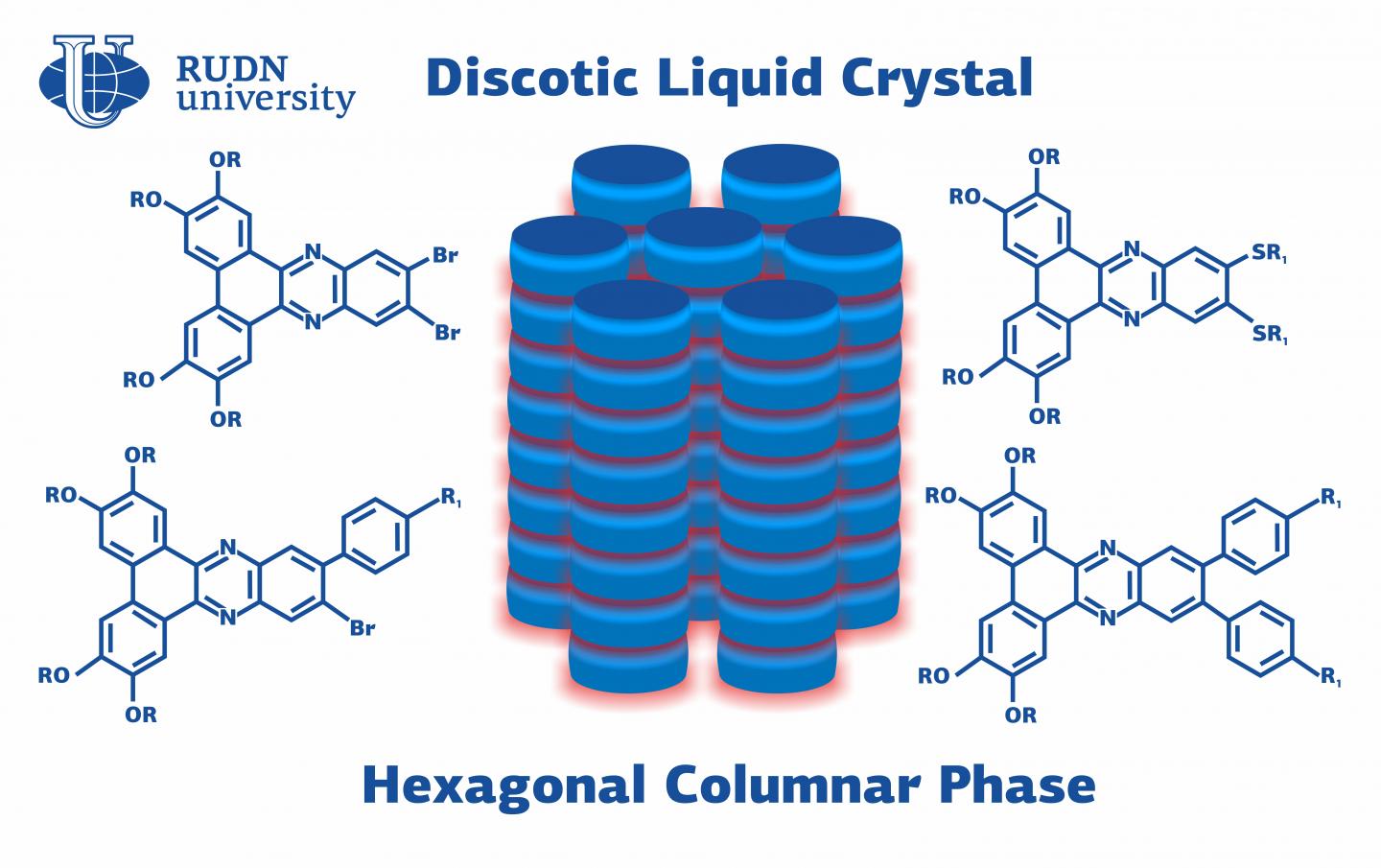
A professor from RUDN University together with his Indian colleagues synthesized and studied new dibenzophenazine-based liquid crystals that could potentially be used in optoelectronics and solar panels. The results of the study were published in the Journal of Molecular Liquids.

Liquid crystals are an intermediate phase between a liquid and a solid body. They are ordered like regular chrystals but at the same time have a flow like liquids. It is this duality that allows them to be used in organic LEDs and LCDs. Unlike other liquid crystals, discotic ones (DLC) are capable of self-assembly into ordered structures. This makes them a promising material for industrial electronics, namely, for the production of displays. A professor from RUDN University together with his Indian colleagues synthesized and described new dibenzophenazine-based DLCs.

“Discotic liquid crystals are interesting because of their ability to form self-assembled ordered columnar structures. In such structures, an electric charge can move along the column, which makes them useful for optoelectronic devices such as organic LEDs, organic field-effect transistors (OFET), photoelectric solar elements, and sensors,” said Prof. Viktor Belyaev, a Ph.D. in Technical Sciences from the Department of Mechanics and Mechatronics at RUDN University.

DLCs consist of disc-shaped molecules aligned in columns. In the center of each disc, there is an aromatic ring (a cyclical organic fragment) surrounded by chains of other organic fragments. Due to this aromatic center, a DLC can transfer a charge along the axis of a column. Prof. Belyaev developed discotic liquid crystals with an aromatic compound called dibenzophenazine in the center. As for the chains that surrounded it, the team tried three different types of fragments. The molecular structure of the new DLCs was studied using spectral, X-ray diffraction, and elementary analysis. Then, the team tested the three groups of DLCs in a set of experiments.

The experiments showed that alkoxy thiol chains increased the polarity of the molecules in liquid crystals thus improving the internal structure of the columns and making them more even. All new DLCs were able to withstand temperatures up to 330?. However, the crystals that consisted of smaller molecules (i.e. the ones with their aromatic center surrounded by alkyl thiols) lost their intermediary status and transitioned from the liquid crystal to the liquid form at lower temperatures (55.1 ?) that the crystals from the other two groups. This is due to the size of the molecules in the columns: the bigger they are, the more stable is the liquid crystal state.

“The new discotic liquid crystals could play an important role in organic optoelectronic devices and solar panels,” added Prof. Viktor Belyaev from RUDN University.

###

Media Contact
Valeriya Antonova
[email protected]

Related Journal Article

http://dx.doi.org/10.1016/j.molliq.2020.114419

Tags: Technology/Engineering/Computer Science
Share13Tweet8Share2ShareShareShare2

Related Posts

Real-Time 3D Scanning Detects Geometric Errors Instantly — Technology and Engineering

Real-Time 3D Scanning Detects Geometric Errors Instantly

June 12, 2026

Denoised MDS-UPDRS Reveals New Parkinson’s Progression Patterns

June 12, 2026

Resolvin D2: Marker for Cognitive Decline in Elderly?

June 12, 2026

Calcimimetics Linked to Lower Mortality in Frail Elderly

June 12, 2026
Please login to join discussion

POPULAR NEWS

  • ESMO 2025: mRNA COVID Vaccines Enhance Efficacy of Cancer Immunotherapy

    324 shares
    Share 130 Tweet 81
  • Saying Goodbye to PGY-6: Pediatric Fellowship Realities

    96 shares
    Share 38 Tweet 24
  • Multi-Hospital Study Reveals Long Covid Burden Is Twice as High as Current Estimates

    90 shares
    Share 36 Tweet 22
  • Common Food Preservatives Associated with Elevated Blood Pressure and Increased Heart Disease Risk

    58 shares
    Share 23 Tweet 15

About

We bring you the latest biotechnology news from best research centers and universities around the world. Check our website.

Follow us

Recent News

Real-Time 3D Scanning Detects Geometric Errors Instantly

Denoised MDS-UPDRS Reveals New Parkinson’s Progression Patterns

Resolvin D2: Marker for Cognitive Decline in Elderly?

Subscribe to Blog via Email

Enter your email address to subscribe to this blog and receive notifications of new posts by email.

Join 82 other subscribers
  • Contact Us

Bioengineer.org © Copyright 2023 All Rights Reserved.

Welcome Back!

Login to your account below

Forgotten Password?

Retrieve your password

Please enter your username or email address to reset your password.

Log In
No Result
View All Result
  • Homepages
    • Home Page 1
    • Home Page 2
  • News
  • National
  • Business
  • Health
  • Lifestyle
  • Science

Bioengineer.org © Copyright 2023 All Rights Reserved.