Shoppers judge a steak with their eyes long before they ever taste it, and that split-second verdict is written in the chemistry of a single pigment. When the bright red oxymyoglobin on a beef surface oxidizes into brown metmyoglobin, the meat looks tired and the discount stickers come out. A new study published in Food Chemistry: X by Cai-Yun Li, Xiao-Qian Duan, Xin Yu and Yu-Bin Zhang of Gansu Agricultural University now shows that a carefully calibrated jolt of oxidative stress can paradoxically keep beef looking freshly cut for far longer, and the team has traced the effect all the way down to the mitochondria and the ribosomes inside them.
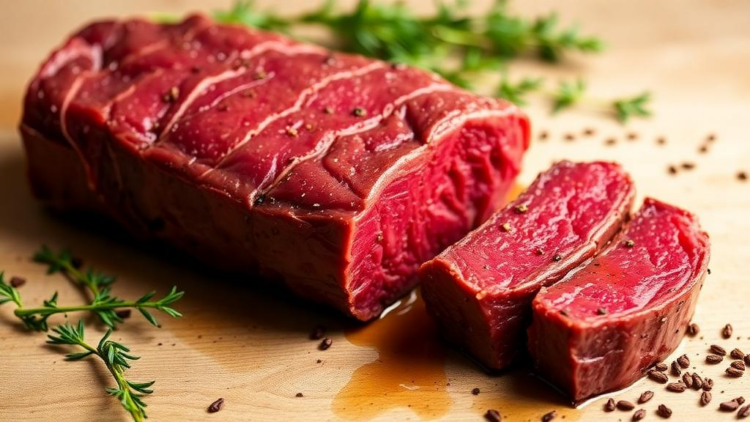
The researchers injected longissimus dorsi steaks from thirty-two Simmental bulls with hydrogen peroxide at three concentrations: 300, 500 and 1000 micromoles per liter, alongside saline-injected controls. Over 48 hours of chilled storage, the 500 micromole per liter dose emerged as a clear winner. Steaks treated at this concentration retained more than double the oxymyoglobin of controls at 48 hours, 29.48 percent versus 13.87 percent, while accumulating significantly less metmyoglobin and showing the highest redness values of any group. The 300 micromole dose, by contrast, accelerated lipid peroxidation without improving color, and the 1000 micromole dose, although it kept pH highest, actually produced worse color than the moderate dose because oxidative damage overwhelmed the cellular repair machinery.
The key to understanding this apparent paradox lies in a phenomenon biologists call hormesis: the ability of a mild stressor to trigger protective adaptations that a weak stressor never provokes and a strong one destroys. In the 500 micromole group, the activities of the antioxidant enzymes glutathione peroxidase and superoxide dismutase rose significantly, and malondialdehyde, a marker of lipid rancidity, stayed lower than in controls. The team observed a trade-off: free thiol groups on proteins declined, suggesting that protein thiols were consumed as sacrificial antioxidants while the more color-critical lipids were shielded from peroxidation.
Even more striking was what happened to the mitochondria. Conventional wisdom holds that mitochondrial function collapses within about a day after slaughter, leaving glycolysis to supply nearly all of the muscle’s ATP. Yet in the moderately stressed steaks, the activities of electron transport chain complexes I through IV were preserved or even enhanced, with complex I peaking at 121.27 units per milligram of protein at 48 hours, well above every other treatment. Sustained electron transport activity helps maintain a reducing environment inside the cell, which delays the oxidation of oxymyoglobin and slows the postmortem pH decline that otherwise accelerates browning.
To find the molecular machinery behind this protection, the researchers ran quantitative proteomics using data-independent acquisition mass spectrometry on control and 500 micromole samples at 6, 24 and 48 hours. They identified 3243 protein groups in total, and 149 proteins were consistently different in abundance across all three time points. Pathway analysis pointed squarely at metabolism, mitochondrial structure and the HIF-1 signaling pathway, with three proteins, PDK1, HMOX1 and LDHB, enriched in the latter at high significance.
Protein interaction network analysis revealed two tightly coordinated hubs. The first centered on GFM1, a mitochondrial GTP-dependent elongation factor that drives the ribosomal translocation step during translation of mitochondrial genes. GFM1 clustered with four mitochondrial ribosomal proteins, MRPL3, MRPS5, MRPL15 and MRPS27, all strongly upregulated. Because the mitochondrial genome encodes core subunits of the electron transport chain, keeping the mitochondrial translation apparatus running appears to be the mechanism by which the moderate oxidative challenge preserved respiratory chain activity. GFM1 abundance correlated strongly with complex I activity, complex IV activity, redness and oxymyoglobin retention, and negatively with metmyoglobin, protein carbonyls and malondialdehyde.
The second hub centered on lactate dehydrogenase B, an HIF-1 target that preferentially converts lactate back into pyruvate while generating NADH, the reducing equivalent that endogenous enzymes use to reduce metmyoglobin back to its red form. The direction of this reaction is exquisitely pH-sensitive: it runs forward only in a less acidic environment. The 500 micromole treatment kept pH between 5.65 and 5.79, comfortably above the threshold where the reaction would reverse, thereby sustaining NADH production for pigment reduction. LDHB abundance correlated strongly with lactate dehydrogenase and pyruvate kinase activities, antioxidant enzyme activities and the color stability indicators.
The study also reframes how HIF-1 signaling behaves in postmortem muscle. Hypoxia-driven HIF-1 activation, well documented in previous work on yak and tan sheep meat, suppresses mitochondrial respiration, pushes metabolism toward anaerobic glycolysis, accelerates lactate buildup and worsens color. The hydrogen peroxide-driven activation observed here appears to follow a different route, plausibly through mild oxidation of the iron in prolyl hydroxylases, and couples glycolytic upregulation to mitochondrial preservation rather than mitochondrial shutdown. The authors are careful to note that they did not directly measure HIF-1α protein or its nuclear translocation, so this mechanism remains a well-supported inference rather than a demonstrated fact, and they recommend Western blotting and immunofluorescence in follow-up work.
The practical implications are tantalizing but deliberately hedged. Direct hydrogen peroxide injection is not a food-safe industrial intervention, and the authors stress that their proposed strategies, from dietary polyphenols, selenium and functional amino acids that support the GFM1 pathway, to lactate precursors that sustain NADH generation, to safe natural pro-oxidants or controlled-oxygen packaging that mimic the hormetic signal, are mechanistic hypotheses rather than validated processes. What the study delivers is something arguably more valuable: a mechanistic map showing that beef color stability is not a passive decay process but an actively coordinated program, with a mitochondrial translation module and a glycolytic redox module working in concert, and two proteins, GFM1 and LDHB, standing out as the switchboard operators. If future research can trip those switches with safe interventions, the humble steak might stay red, and stay on the full-price shelf, considerably longer.
Subject of Research: Dose-dependent effects of hydrogen peroxide-induced oxidative stress on mitochondrial function, glycolytic metabolism and color stability in postmortem beef muscle
Article Title: Elucidating the coordination of mitochondrial maintenance, functional preservation and glycolytic metabolism in H 2 O 2 -induced beef color stability: an integrated proteomic and biochemical investigation
Article References: Li, C.-Y., Duan, X.-Q., Yu, X., & Zhang, Y.-B. (2026). Elucidating the coordination of mitochondrial maintenance, functional preservation and glycolytic metabolism in H2O2-induced beef color stability: an integrated proteomic and biochemical investigation. Food Chemistry: X, 39, Article 104537. https://doi.org/10.1016/j.fochx.2026.104537
Image Credits: AI Generated
DOI: 10.1016/j.fochx.2026.104537
Keywords: beef color stability, hydrogen peroxide, hormesis, mitochondria, myoglobin, metmyoglobin, GFM1, LDHB, HIF-1 signaling, glycolysis, proteomics, antioxidant enzymes
Cite Scienmag News
APA
MLA
Chicago
Bethany Barker. (October 2, 2026). A Precise Dose of Oxidative Stress Keeps Beef Redder for Longer. Scienmag. https://scienmag.com/a-precise-dose-of-oxidative-stress-keeps-beef-redder-for-longer/
Bethany Barker. “A Precise Dose of Oxidative Stress Keeps Beef Redder for Longer.” Scienmag, 2 October 2026, https://scienmag.com/a-precise-dose-of-oxidative-stress-keeps-beef-redder-for-longer/. Accessed 2 October 2026.
Bethany Barker. “A Precise Dose of Oxidative Stress Keeps Beef Redder for Longer.” Scienmag. October 2, 2026. https://scienmag.com/a-precise-dose-of-oxidative-stress-keeps-beef-redder-for-longer/
Copy citation
Download RIS
Tags: antioxidant enzymesbeef color preservation techniquesbeef color stabilityfood chemistry research on meatGFM1glycolysisHIF-1 signalinghormesishydrogen peroxidehydrogen peroxide effects on meatLDHBlipid peroxidation in meatmeat color stabilitymeat storage and quality improvementmetmyoglobinmetmyoglobin formationmitochondriamitochondrial role in meat colormuscle tissue biochemistrymyoglobinoxidative stress and meat shelf lifeoxidative stress in beef preservationoxymyoglobin oxidationProteomics