Tumors can use an enzyme called ART1 to thwart antitumor immune cells, making the enzyme a promising new target for immunity-boosting cancer treatments, according to a study from researchers at Weill Cornell Medicine and Albert Einstein College of Medicine.
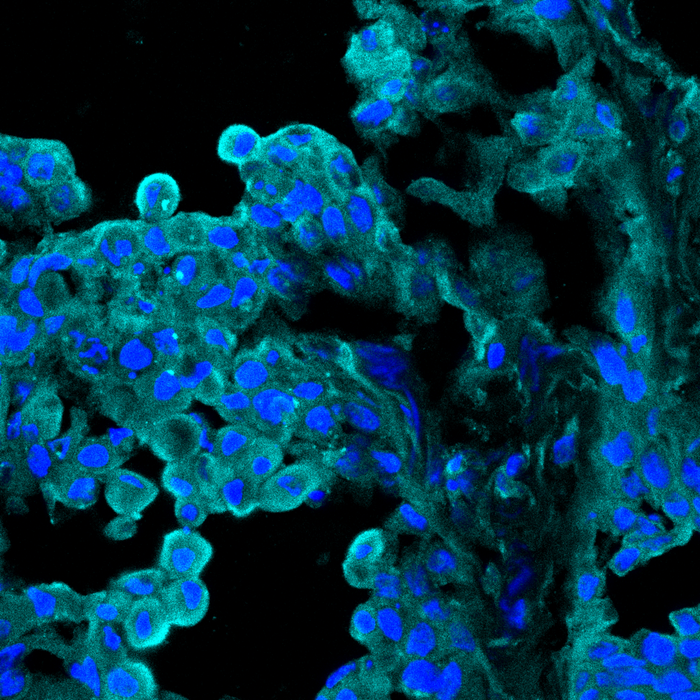
Credit: Sumit Mukherjee
Tumors can use an enzyme called ART1 to thwart antitumor immune cells, making the enzyme a promising new target for immunity-boosting cancer treatments, according to a study from researchers at Weill Cornell Medicine and Albert Einstein College of Medicine.
In the study, published Mar 16 in Science Translational Medicine, the researchers found strong evidence that ART1, when expressed on tumor cells, can modify a receptor on tumor-fighting immune cells in a way that triggers the death of these immune cells. In animal models of cancer, blocking ART1 increased the presence of the tumor-fighting immune cells within tumors and slowed or stopped tumor growth.
“These findings should allow us to add to our medicinal toolkit for enhancing the antitumor immune response, to benefit cancer patients,” said study co-corresponding author Dr. Timothy McGraw, professor of biochemistry and of biochemistry in cardiothoracic surgery and a member of the Sandra and Edward Meyer Cancer Center at Weill Cornell Medicine.
“Our main focus in this study was lung cancer, but there is evidence that this immune-evasion mechanism is at work also in other kinds of cancer,” said co-corresponding author Dr. Sandra Demaria, professor of radiation oncology and of pathology and laboratory medicine and a member of the Meyer Cancer Center at Weill Cornell Medicine.
“This is an excellent example of how translational science should work. We first found ART1 expressed in the tumors of patients with lung cancer. In the lab, we discovered that ART1 helps to block the anti-tumor immune response, specifically by inducing death of anti-tumor T cells. We then developed a therapeutic antibody that blocks the function of ART1, allows the immune system to fight the cancer and ultimately prolongs survival in tumor models,” said senior author Dr. Brendon Stiles, formerly of Weill Cornell Medicine and now chief of the Division of Thoracic Surgery and Surgical Oncology and associate director of surgical services at Montefiore Einstein Cancer Center and professor of cardiovascular and thoracic surgery at Albert Einstein College of Medicine. “Hopefully, we can very soon take that antibody back to treat our patients with cancer.”
The mammalian immune system has various safety mechanisms to prevent immune activity from becoming excessive and damaging tissues. Scientists in recent decades have come to appreciate that tumors frequently co-opt these safety mechanisms—also called immune checkpoints—to defeat natural antitumor immune responses.
That appreciation has led, in turn, to the development of “immune checkpoint inhibitor” treatments that block these safety mechanisms to enhance antitumor immunity. These treatments are now part of standard care in several types of cancer and help account for some astounding cures. However, a large proportion of individual cancers do not respond to such therapies, which hints that these cancers may make use of other, so-far-unrevealed immune checkpoint systems.
ART1 appears to be part of one such immune-checkpoint exploitation system. The researchers found that expression levels of its gene were significantly higher in the most common type of non-small-cell lung cancer (NSCLC), compared to non-cancerous lung cells. Similarly, in mice, ART1-overexpressing NSCLC tumors grew rapidly, while blocking ART1 reduced tumor growth. However, this effect on tumors appeared only in mice with intact immune systems, implying that blocking ART1 works by unleashing antitumor immunity.
Further experiments in mice with NSCLC and melanoma tumors confirmed that reducing ART1 led to a greater presence within tumors of CD8 T cells, the immune system’s most powerful weapon against cancers.
The experiments also provided strong evidence that ART1 interacts with a receptor called P2RX7R on CD8 T cells and activates signaling that causes the deaths of the CD8 T cells. The P2RX7R receptor therefore seems to be an important molecular switch that cancers use to shut down anticancer immunity.
The researchers then blocked ART1 using a humanized therapeutic antibody they had developed—in a collaboration with the Tri-Institutional Therapeutics Discovery Institute, a partnership including Weill Cornell Medicine, The Rockefeller University, and Memorial Sloan Kettering Cancer Center—and demonstrated that it slowed tumor growth and prolonged survival in mice. Dr. Stiles is now further developing the anti-ART1 antibody as a potential immune-enhancing cancer treatment.
Many Weill Cornell Medicine physicians and scientists maintain relationships and collaborate with external organizations to foster scientific innovation and provide expert guidance. The institution makes these disclosures public to ensure transparency. For this information, see profile for Dr. Sandra Demaria.
Journal
Science Translational Medicine