Credit: EPFL
Researchers at EPFL and MARVEL have developed a novel formulation that describes how heat spreads within crystalline materials. This can explain why and under which conditions heat propagation becomes fluid-like rather than diffusive. Their equations will make it easier to design next-generation electronic devices at the nanoscale, in which these phenomena can become prevalent.
Fourier’s well-known heat equation describes how temperatures change over space and time when heat flows in a solid material. The formulation was developed in 1822 by Joseph Fourier, a French mathematician and physicist hired by Napoleon to increase a cannon’s rate of fire, which was limited by overheating.
Fourier’s equation works well to describe conduction in macroscopic objects (several millimeters in size or larger) and at high temperatures. However, it does not describe hydrodynamic heat propagation, which can appear in electronic devices containing materials such as graphite and graphene.
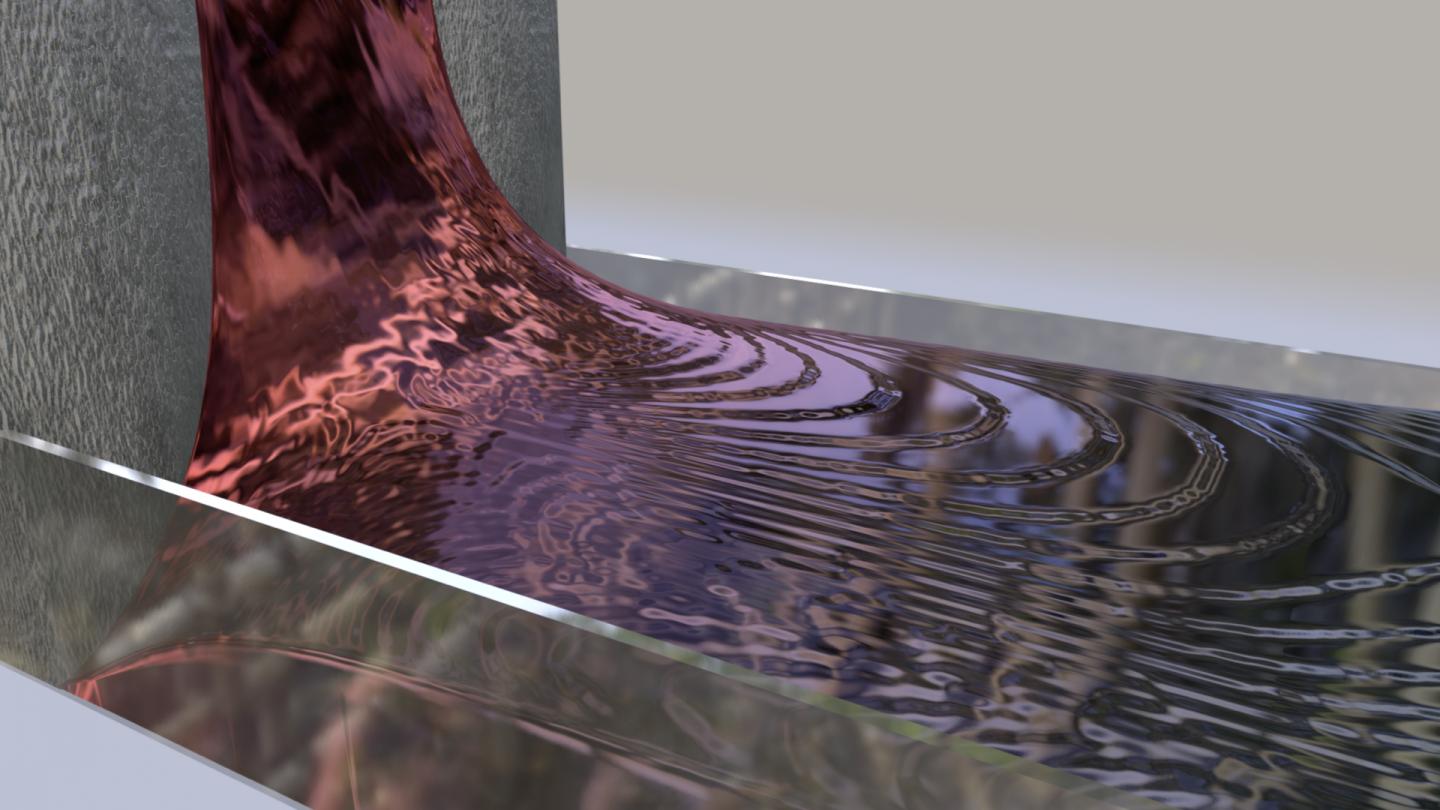
One of these heat-propagation phenomena is known as Poiseuille heat flow. This is where heat propagates within a material as a viscous-fluid flow. Another phenomenon, called “second sound,” takes place when heat propagates in a crystal like a wave, similar to the way in which sound spreads through the air.
Since these phenomena are not described by Fourier’s equation, until now researchers have analyzed them using explicit microscopic models, such as the Boltzmann transport equation. However, the complexity of these models means that they cannot be used to design complex electronic devices.
This problem has now been solved by Michele Simoncelli, a PhD student at EPFL, together with Andrea Cepellotti, a former EPFL PhD student now at Harvard, and Nicola Marzari, the chair of Theory and Simulation of Materials in the Institute of Materials at EPFL’s School of Engineering and the director of NCCR MARVEL. They showed how heat originating from the atomic vibrations in a solid can be described rigorously by two novel “viscous heat equations”, which extend Fourier’s law to cover any heat propagation that is not diffusive.
“These viscous heat equations explain why and under which conditions heat propagation becomes fluid-like rather than diffusive. They show that heat conduction is governed not just by thermal conductivity, as described by Fourier’s law, but also by a second parameter, thermal viscosity,” says Simoncelli.
This breakthrough, published in Physical Review X, will help engineers design next-generation devices, particularly those that feature materials such as graphite or diamond in which hydrodynamic phenomena are prevalent. Overheating is the main limiting factor for the miniaturization and efficiency of electronic devices, and in order to maximize efficiency and predict whether a device will work – or simply melt – it is crucial to have the right model.
The results obtained by EPFL’s team are timely. From the 1960s until recently, hydrodynamic heat phenomena had only been observed at cryogenic temperatures (around -260oC) and were therefore thought to be irrelevant for everyday applications. Already in 2015 Marzari and his colleagues predicted that this would be very different in two-dimensional and layered materials – a prediction that was confirmed with the publication in Science of pioneering experiments that found second-sound (or wavelike heat propagation) in graphite at temperatures around -170oC.
The formulation presented by the EPFL researchers yields results that line up closely with those experiments. Most important, they also predict that hydrodynamic heat propagation can also happen at room temperature, depending on the size and type of material.
Through their work, the EPFL researchers are providing new and original insight into heat transport, but also laying the groundwork for an understanding of shape and size effects – not only in next-generation electronic devices but also in “phononic” devices that control cooling and heating through engineered superstructures. Finally, the novel formulation can also be adapted to describe viscous phenomena involving electrons discovered in 2016 by Philip Moll, now a professor at EPFL’s Institute of Materials.
###
For the mathematically inclined, these viscous heat equations were also immediately included in the documentation accompanying Wolfram Mathematica software (link).
Media Contact
Nicola Marzari
[email protected]
41-216-931-129
Original Source
https:/