• HOME
  • NEWS
  • EXPLORE
    • CAREER
      • Companies
      • Jobs
    • EVENTS
    • iGEM
      • News
      • Team
    • PHOTOS
    • VIDEO
    • WIKI
  • BLOG
  • COMMUNITY
    • FACEBOOK
    • INSTAGRAM
    • TWITTER
Tuesday, May 5, 2026
BIOENGINEER.ORG
No Result
View All Result
  • Login
  • HOME
  • NEWS
  • EXPLORE
    • CAREER
      • Companies
      • Jobs
        • Lecturer
        • PhD Studentship
        • Postdoc
        • Research Assistant
    • EVENTS
    • iGEM
      • News
      • Team
    • PHOTOS
    • VIDEO
    • WIKI
  • BLOG
  • COMMUNITY
    • FACEBOOK
    • INSTAGRAM
    • TWITTER
  • HOME
  • NEWS
  • EXPLORE
    • CAREER
      • Companies
      • Jobs
        • Lecturer
        • PhD Studentship
        • Postdoc
        • Research Assistant
    • EVENTS
    • iGEM
      • News
      • Team
    • PHOTOS
    • VIDEO
    • WIKI
  • BLOG
  • COMMUNITY
    • FACEBOOK
    • INSTAGRAM
    • TWITTER
No Result
View All Result
Bioengineer.org
No Result
View All Result
Home NEWS Science News Chemistry

A novel approach to creating tailored odors and fragrances using machine learning

Bioengineer by Bioengineer
September 5, 2022
in Chemistry
Reading Time: 3 mins read
0
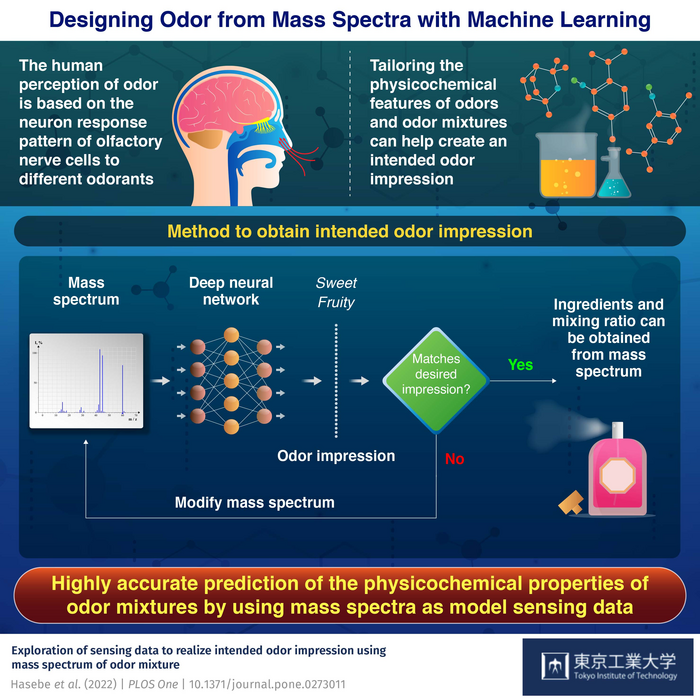
Designing Odor from Mass Spectra with Machine Learning
Share on FacebookShare on TwitterShare on LinkedinShare on RedditShare on Telegram

The sense of smell is one of the basic senses of animal species. It is critical to finding food, realizing attraction, and sensing danger. Humans detect smells, or odorants, with olfactory receptors expressed in olfactory nerve cells. These olfactory impressions of odorants on nerve cells are associated with their molecular features and physicochemical properties. This makes it possible to tailor odors to create an intended odor impression. Current methods only predict olfactory impressions from the physicochemical features of odorants. But, that method cannot predict the sensing data, which is indispensable for creating smells.
Designing Odor from Mass Spectra with Machine Learning

Credit: Tokyo Tech

The sense of smell is one of the basic senses of animal species. It is critical to finding food, realizing attraction, and sensing danger. Humans detect smells, or odorants, with olfactory receptors expressed in olfactory nerve cells. These olfactory impressions of odorants on nerve cells are associated with their molecular features and physicochemical properties. This makes it possible to tailor odors to create an intended odor impression. Current methods only predict olfactory impressions from the physicochemical features of odorants. But, that method cannot predict the sensing data, which is indispensable for creating smells.

To tackle this issue, scientists from Tokyo Institute of Technology (Tokyo Tech) have employed the innovative strategy of solving the inverse problem. Instead of predicting the smell from molecular data, this method predicts molecular features based on the odor impression. This is achieved using standard mass spectrum data and machine learning (ML) models. “We used a machine-learning-based odor predictive model that we had previously developed to obtain the odor impression. Then we predicted the mass spectrum from odor impression inversely based on the previously developed forward model,” explains Professor Takamichi Nakamoto, the leader of the research effort by Tokyo Tech. The findings have been published in PLoS One.

The mass spectra of odor mixtures is obtained by a linear combination of the mass spectra of single components. This simple method allows for the quick preparation of the predicted spectra of odor mixtures and can also predict the required mixing ratio, an important part of the recipe for new odor preparation. “For example, we show which molecules give the mass spectrum of apple flavor with enhanced ‘fruit’ and ‘sweet’ impressions. Our analysis method shows that combinations of either 59 or 60 molecules give the same mass spectrum as the one obtained from the specified odor impression. With this information, and the correct mixing ratio needed for a certain impression, we could theoretically prepare the desired scent,” highlights Prof. Nakamoto.

This novel method described in this study can provide highly accurate predictions of the physicochemical properties of odor mixtures, as well as the mixing ratios required to prepare them, thereby opening the door to endless tailor-made fragrances.

It looks like the future of odor mixtures smells good!


Journal

PLoS ONE

DOI

10.1371/journal.pone.0273011

Method of Research

Experimental study

Subject of Research

Not applicable

Article Title

Exploration of sensing data to realize intended odor impression using mass spectrum of odor mixture

Article Publication Date

17-Aug-2022

Share14Tweet9Share2ShareShareShare2

Related Posts

Here’s a rewritten version of the headline for a science magazine post: “A Simple Model Explaining How AI Learns” Or, if you want it a bit more engaging: “Understanding AI Learning Through a Toy Model” Let me know if you want it shorter, more technical, or more casual!

May 5, 2026
From Generalist to Specialist: Protein Binding Evolution — Chemistry

From Generalist to Specialist: Protein Binding Evolution

May 5, 2026

Alkali-Ion Enhanced Zeolitic Imidazolate Glasses

May 4, 2026

Exotic Quantum Phase Dynamically Links Vibrations Separated by Symmetry

May 4, 2026

POPULAR NEWS

  • Research Indicates Potential Connection Between Prenatal Medication Exposure and Elevated Autism Risk

    834 shares
    Share 334 Tweet 209
  • New Study Reveals Plants Can Detect the Sound of Rain

    719 shares
    Share 287 Tweet 180
  • Scientists Investigate Possible Connection Between COVID-19 and Increased Lung Cancer Risk

    67 shares
    Share 27 Tweet 17
  • Salmonella Haem Blocks Macrophages, Boosts Infection

    61 shares
    Share 24 Tweet 15

About

We bring you the latest biotechnology news from best research centers and universities around the world. Check our website.

Follow us

Recent News

Depressive Symptoms Linked to Motoric Cognitive Risk

Predicting Coronary Artery Aneurysms in Kawasaki Disease

Breakthrough Study Advances Personalized Treatment for Parkinson’s Disease

Subscribe to Blog via Email

Enter your email address to subscribe to this blog and receive notifications of new posts by email.

Join 82 other subscribers
  • Contact Us

Bioengineer.org © Copyright 2023 All Rights Reserved.

Welcome Back!

Login to your account below

Forgotten Password?

Retrieve your password

Please enter your username or email address to reset your password.

Log In
No Result
View All Result
  • Homepages
    • Home Page 1
    • Home Page 2
  • News
  • National
  • Business
  • Health
  • Lifestyle
  • Science

Bioengineer.org © Copyright 2023 All Rights Reserved.