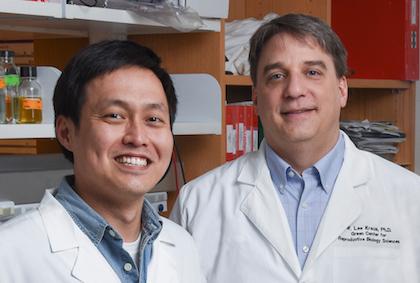
Credit: UT Southwestern
DALLAS – May 31, 2018 – Glucose is the energy that fuels cells, and the body likes to store glucose for later use. But too much glucose can contribute to obesity, and scientists have long wanted to understand what happens within a cell to tip the balance.
To solve this riddle, researchers at UT Southwestern's Cecil H. and Ida Green Center for Reproductive Biology Sciences examined specialized compartments inside the cell to reveal the role of a molecule termed NAD+ in turning on genes that make fat cells.
A Google search for NAD+ reveals that the molecule is found in every cell of the body and that some scientists believe that boosting its production may be tied to better health and to the slowing down of the aging process.
What is NAD+?
NAD+ stands for nicotinamide adenine dinucleotide. It's a molecule found inside cells in the body that helps transfer energy between molecules.
Why is it important?
NAD+ is believed to play important roles in longevity, aging, and diseases ranging from neurodegenerative disorders to cancer.
Where can I find out more?
Scientific American primer on NAD
Green Center's Science paper
Kraus Lab
UT Southwestern biologists examined individual compartments inside cells that house NAD+ molecules to determine how they control genes that are essential to the fat-storing process – knowledge that could help in a wide range of ailments, including metabolic disorders, neurodegenerative diseases, inflammation and aging, and cancer.
"This compartmentalization ends up having profound effects on gene expression in the nucleus, as well as metabolism in the cytoplasm," (the jellylike substance outside the cell's nucleus), said Dr. W. Lee Kraus, Director of the Green Center and senior author on the research. "We found that these processes play key roles in fat cell differentiation and in cancer cells."
"The previous thinking in the field was that NAD+ was evenly distributed throughout cells and moved freely between different subcellular compartments," said Dr. Kraus, Professor of Obstetrics and Gynecology and Pharmacology. "We showed that NAD+ is actually compartmentalized – there are separate nuclear and cytoplasmic pools of NAD+ whose levels change under certain cellular conditions."
The research team's breakthrough is reported in the journal Science.
Accounting for the levels of NAD+ biosynthesis separately rather than in their totality helped increase the understanding of the biology involved, said first author Dr. Keun Ryu, a postdoctoral researcher in Obstetrics and Gynecology.
"Our study provides a new understanding of NAD+ biology," he said.
###
Dr. Kraus holds the Cecil H. and Ida Green Distinguished Chair in Reproductive Biology Sciences.
Scientific findings
UT Southwestern researchers have shown that compartmentalized synthesis of NAD+ integrates cellular information to control gene expression and maintain important biological processes required for metabolic health.
Researchers connected the cellular and molecular observations to the development of fat cells and the growth of cancer cells. Changes in the levels of NAD+ in the nucleus are important for adipogenesis.
Nuclear NAD+ supports PARP-1 activity in normal cellular processes, such as gene regulation and cellular differentiation. About UT Southwestern Medical Center
UT Southwestern, one of the premier academic medical centers in the nation, integrates pioneering biomedical research with exceptional clinical care and education. The institution's faculty has received six Nobel Prizes, and includes 22 members of the National Academy of Sciences, 16 members of the National Academy of Medicine, and 15 Howard Hughes Medical Institute Investigators. The faculty of more than 2,700 is responsible for groundbreaking medical advances and is committed to translating science-driven research quickly to new clinical treatments. UT Southwestern physicians provide care in about 80 specialties to more than 100,000 hospitalized patients, 600,000 emergency room cases, and oversee approximately 2.2 million outpatient visits a year.
Media Contact
Remekca Owens
[email protected]
@UTSWNews
http://www.swmed.edu
Original Source
https://www.utsouthwestern.edu/newsroom/articles/year-2018/understanding-glucose.html