• HOME
  • NEWS
  • EXPLORE
    • CAREER
      • Companies
      • Jobs
    • EVENTS
    • iGEM
      • News
      • Team
    • PHOTOS
    • VIDEO
    • WIKI
  • BLOG
  • COMMUNITY
    • FACEBOOK
    • INSTAGRAM
    • TWITTER
Sunday, July 5, 2026
BIOENGINEER.ORG
No Result
View All Result
  • Login
  • HOME
  • NEWS
  • EXPLORE
    • CAREER
      • Companies
      • Jobs
        • Lecturer
        • PhD Studentship
        • Postdoc
        • Research Assistant
    • EVENTS
    • iGEM
      • News
      • Team
    • PHOTOS
    • VIDEO
    • WIKI
  • BLOG
  • COMMUNITY
    • FACEBOOK
    • INSTAGRAM
    • TWITTER
  • HOME
  • NEWS
  • EXPLORE
    • CAREER
      • Companies
      • Jobs
        • Lecturer
        • PhD Studentship
        • Postdoc
        • Research Assistant
    • EVENTS
    • iGEM
      • News
      • Team
    • PHOTOS
    • VIDEO
    • WIKI
  • BLOG
  • COMMUNITY
    • FACEBOOK
    • INSTAGRAM
    • TWITTER
No Result
View All Result
Bioengineer.org
No Result
View All Result
Home NEWS Science News

A new synthesis method for three-dimensional nanocarbons

Bioengineer by Bioengineer
July 31, 2020
in Science News
Reading Time: 2 mins read
0
IMAGE
Share on FacebookShare on TwitterShare on LinkedinShare on RedditShare on Telegram

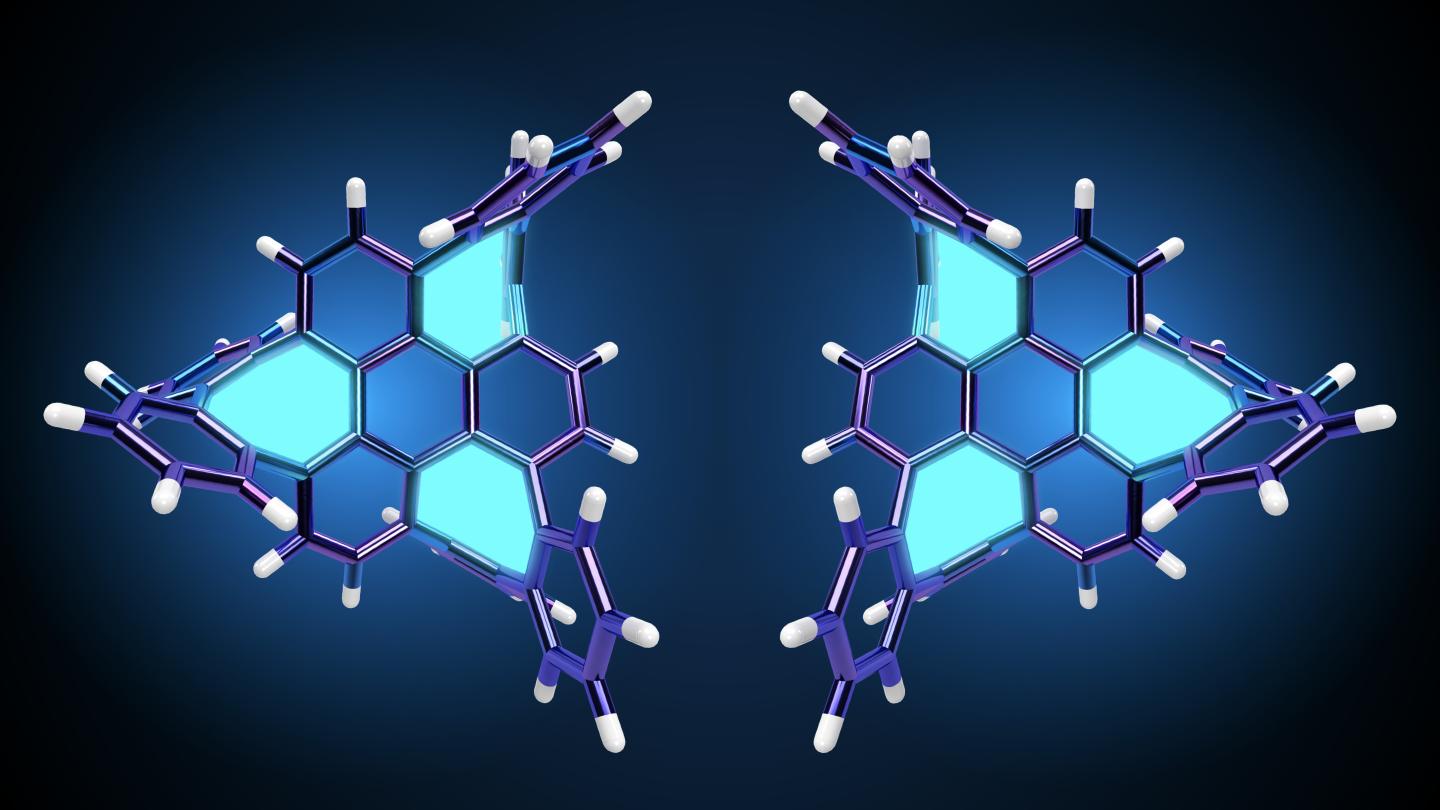
Connecting carbon by catalysis to create octagonal structures
IMAGE

Credit: Issey Takahashi

A team of scientists led by Kenichiro Itami, Professor and Director of the Institute of Transformative Bio-Molecules (WPI-ITbM), has developed a new method for the synthesis of three-dimensional nanocarbons with the potential to advance materials science.

Three-dimensional nanocarbons, next-generation materials with superior physical characteristics which are expected to find uses in fuel cells and organic electronics, have thus far been extremely challenging to synthesize in a precise and practical fashion. This new method uses a palladium catalyst to connect polycyclic aromatic hydrocarbons to form an octagonal structure, enabling successful three-dimensional nanocarbon molecule synthesis.

Nanocarbons, such as the fullerene (a sphere, recipient of the 1996 Nobel Prize), the carbon nanotube (a cylinder, discovered in 1991) and graphene (a sheet, recipient of the 2010 Nobel Prize) have attracted a great deal of attention as functional molecules with a variety of different properties. Since Mackay et al. put forward their theory in 1991, a variety of periodic three-dimensional nanocarbons have been proposed. However, these have been extraordinarily difficult to synthesize. A particular challenge is the eight-membered ring structure, which appears periodically, necessitating an efficient method for its synthesis. To do so, Dr Itami’s research team developed a new method for connecting polycyclic aromatic hydrocarbons using a palladium catalyst to produce eight-membered rings via cross-coupling, the first reaction of its type in the world.

The success of this research represents a revolutionary achievement in three-dimensional nanocarbon molecule synthesis. It is expected to lead to the discovery and elucidation of further novel properties and the development of next-generation functional materials.

###

Media Contact
Kenichiro Itami
[email protected]

Related Journal Article

http://dx.doi.org/10.1038/s41929-020-0487-0

Tags: Chemistry/Physics/Materials SciencesMaterialsNanotechnology/Micromachines
Share12Tweet8Share2ShareShareShare2

Related Posts

Quasi-Bound States Boost Quantum Well Photoresponse — Technology and Engineering

Quasi-Bound States Boost Quantum Well Photoresponse

July 4, 2026

Lysine Pyruvylation Links Glycolysis to Epigenetics

July 4, 2026

Multiphysics Coupling: Single vs. Multiple DeepONet Branches

July 4, 2026

Personalized Neoantigen Dendritic Cell Vaccine in Glioblastoma

July 4, 2026
Please login to join discussion

POPULAR NEWS

  • Detection of EDCs in Breast Milk and Infant Urine Up to Six Months Highlights Early Exposure Risks

    77 shares
    Share 31 Tweet 19
  • Saying Goodbye to PGY-6: Pediatric Fellowship Realities

    103 shares
    Share 41 Tweet 26
  • New Drug Candidate Developed at McMaster Shows Potential for Treating Brain Cancer

    58 shares
    Share 23 Tweet 15
  • KTU Researchers Explore Ultrasound’s Role in Enhancing Blood Flow Beyond Diagnostics

    53 shares
    Share 21 Tweet 13

About

We bring you the latest biotechnology news from best research centers and universities around the world. Check our website.

Follow us

Recent News

Quasi-Bound States Boost Quantum Well Photoresponse

Lysine Pyruvylation Links Glycolysis to Epigenetics

Multiphysics Coupling: Single vs. Multiple DeepONet Branches

Subscribe to Blog via Email

Success! An email was just sent to confirm your subscription. Please find the email now and click 'Confirm' to start subscribing.

Join 83 other subscribers
  • Contact Us

Bioengineer.org © Copyright 2023 All Rights Reserved.

Welcome Back!

Login to your account below

Forgotten Password?

Retrieve your password

Please enter your username or email address to reset your password.

Log In
No Result
View All Result
  • Homepages
    • Home Page 1
    • Home Page 2
  • News
  • National
  • Business
  • Health
  • Lifestyle
  • Science

Bioengineer.org © Copyright 2023 All Rights Reserved.