A research team led by Tokyo Medical and Dental University (TMDU) has identified a molecular compound that activates latent HIV-1 in cells, showing promise for HIV treatments
Credit: Department of Medicinal Chemistry, TMDU
A research team led by Tokyo Medical and Dental University (TMDU) has identified a molecular compound that activates latent HIV-1 in cells, showing promise for HIV treatments
Tokyo, Japan – A multi-institutional research group led by researchers from Tokyo Medical and Dental University (TMDU) has made a significant and promising step forward in our ability to treat human immunodeficiency virus type 1 (HIV-1), the virus underlying acquired immunodeficiency syndrome (AIDS).
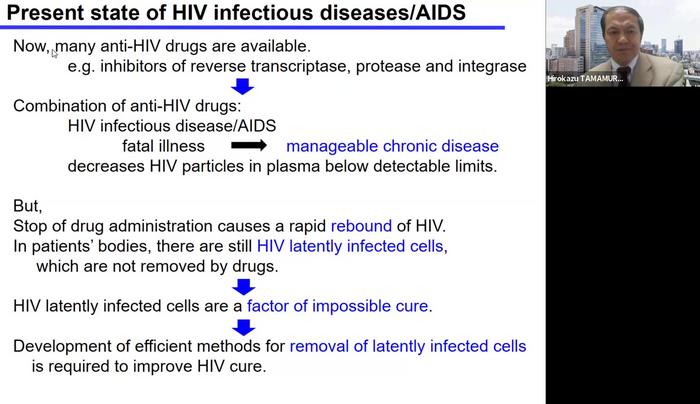
To appreciate their accomplishment, we must first know a little about why HIV-1 is difficult to eliminate. While viral replication can be inhibited by antiretroviral therapy (ART), which is usually given as a combination of drugs, this therapy is unable to fully cure HIV-1 infection. This is because the virus forms latent infections in cells, where the virus remains present but inactive and therefore not susceptible to drug therapy. Eradicating latent HIV-1 is the primary obstacle to curing HIV, and now the Japanese research group have identified a compound that can activate and allow the eradication of these latent HIV reservoirs.
Latency reversing agents (LRAs), drugs that reverse the latency process and cause the HIV virus to activate, can be used in a “shock and kill” approach to tackling HIV. The LRA shock reactivates latent HIV reservoirs, which can then be killed by the patient’s immune system. However, while the use of LRAs has previously shown reactivation of latently infected cells, no reduction in the population of latent HIV reservoirs had been observed.
In this study, the authors focused on YSE028, a derivative of a molecule called DAG-lactone. These molecules have already been studied as treatments for cancer and Alzheimer’s disease. YSE028 activates a protein called “protein kinase C” (PKC) that has proven latency-reversing activity, and shows no significant toxicity to cells.
“A previous study of ours showed that YSE028 was able to cause reactivation of cells latently infected with HIV-1 and subsequently induce caspase-mediated cell death,” explains lead author Takahiro Ishii. “We therefore explored structurally similar chemical derivatives of YSE028 with even greater latency-reversing activity.”
They used a cell line called J-Lat 10.6, cells latently infected with HIV-1 that have been modified to express green fluorescence protein when activated. This green fluorescence can be observed and so the activated cells can be identified. Many of the chemical derivatives developed failed to show significant activity, but ‘compound 2’ showed approximately ten times higher latency reversing activity than YSE028.
They were also able to identify the characteristics that affected the various qualities of the molecule, such as an affinity for binding to PKC and a resistance to being broken down by certain enzymes that can affect the stability of compounds.
“Our data will be highly informative for the design of DAG-lactone derivatives to activate PKC, which could be key for HIV treatment,” explains senior author Hirokazu Tamamura.
The use of these newly identified DAG-lactone derivatives, in combination with anti-HIV drugs and other LRAs, could bring us closer to a complete cure for HIV-1.
###
The article, “Synthesis and evaluation of DAG-lactone derivatives with HIV-1 latency reversing activity”, was published in European Journal of Medicinal Chemistry at DOI: 10.1016/j.ejmech.2023.115449
Journal
European Journal of Medicinal Chemistry
DOI
10.1016/j.ejmech.2023.115449
Article Title
Synthesis and evaluation of DAG-lactone derivatives with HIV-1 latency reversing activity