Filling a crucial gap in the materials spectrum
Credit: RMIT University
A new study, out this week, could pave the way to revolutionary, transparent electronics.
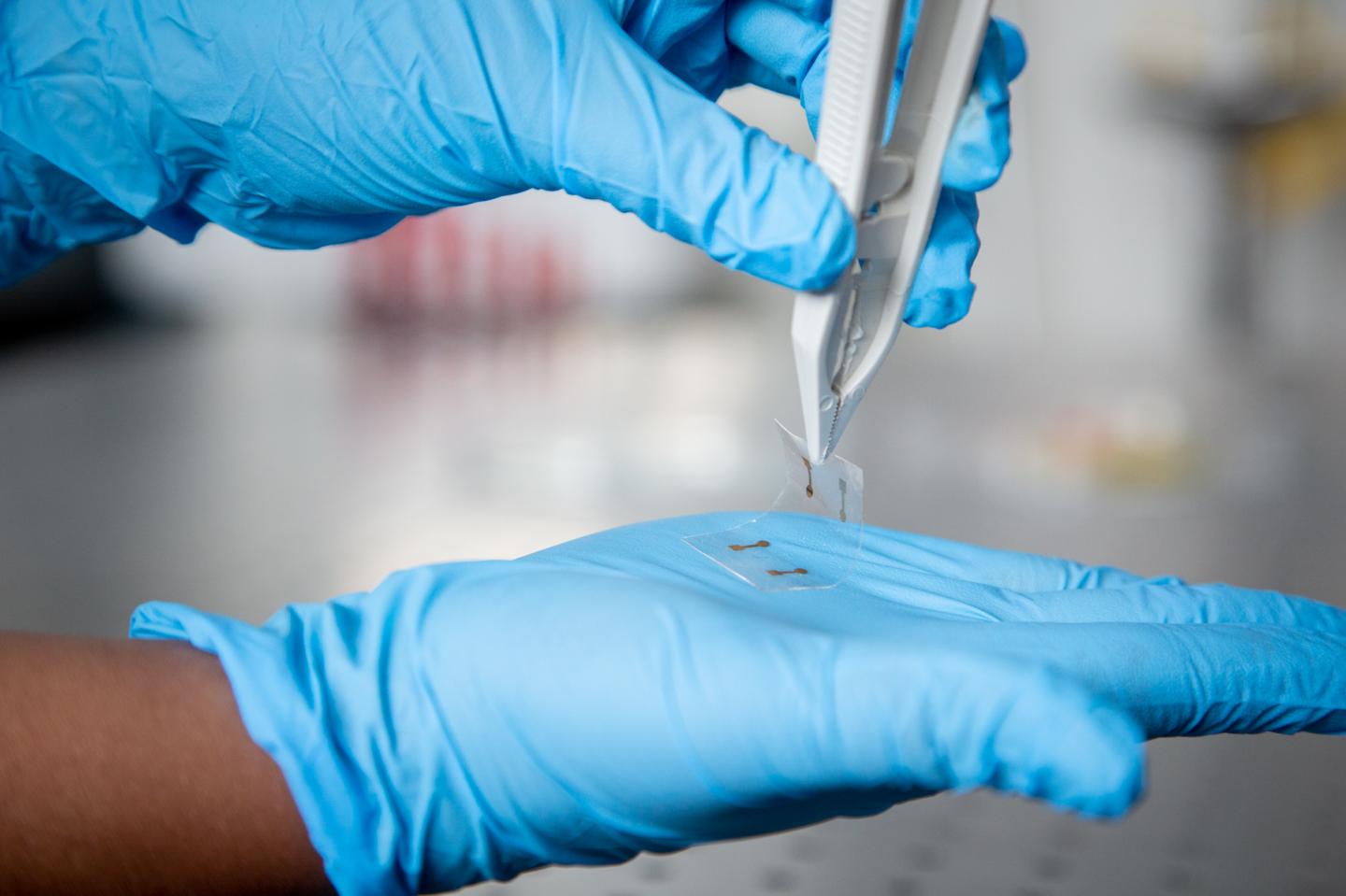
Such see-through devices could potentially be integrated in glass, in flexible displays and in smart contact lenses, bringing to life futuristic devices that seem like the product of science fiction.
For several decades, researchers have sought a new class of electronics based on semiconducting oxides, whose optical transparency could enable these fully-transparent electronics.
Oxide-based devices could also find use in power electronics and communication technology, reducing the carbon footprint of our utility networks.
A RMIT-led team has now introduced ultrathin beta-tellurite to the two-dimensional (2D) semiconducting material family, providing an answer to this decades-long search for a high mobility p-type oxide.
“This new, high-mobility p-type oxide fills a crucial gap in the materials spectrum to enable fast, transparent circuits,” says team leader Dr Torben Daeneke, who led the collaboration across three FLEET nodes.
Other key advantages of the long-sought-after oxide-based semiconductors are their stability in air, less-stringent purity requirements, low costs and easy deposition.
“In our advance, the missing link was finding the right, ‘positive’ approach,” says Torben.
Positivity has been lacking
There are two types of semiconducting materials. ‘N-type’ materials have abundant negatively-charged electrons, while ‘p-type’ semiconductors possess plenty of positively-charged holes.
It’s the stacking together of complementary n-type and p-type materials that allows electronic devices such as diodes, rectifiers and logic circuits.
Modern life is critically reliant on these materials since they are the building blocks of every computer and smartphone.
A barrier to oxide devices has been that while many high-performance n-type oxides are known, there is a significant lack of high-quality p-type oxides.
Theory prompts action
However in 2018 a computational study revealed that beta-tellurite (β-TeO2) could be an attractive p-type oxide candidate, with tellurium’s peculiar place in the periodic table meaning it can behave as both a metal and a non-metal, providing its oxide with uniquely useful properties.
“This prediction encouraged our group at RMIT University to explore its properties and applications,” says Dr Torben Daeneke, who is a FLEET associate investigator.
Liquid metal – pathway to explore 2D materials
Dr Daeneke’s team demonstrated the isolation of beta-tellurite with a specifically developed synthesis technique that relies on liquid metal chemistry.
“A molten mixture of tellurium (Te) and selenium (Se) is prepared and allowed to roll over a surface,” explains co-first author Patjaree Aukarasereenont.
“Thanks to the oxygen in ambient air, the molten droplet naturally forms a thin surface oxide layer of beta-tellurite. As the liquid droplet is rolled over the surface, this oxide layer sticks to it, depositing atomically thin oxide sheets in its way.”
“The process is similar to drawing: you use a glass rod as a pen and the liquid metal is your ink,” explains Ms Aukarasereenont, who is a FLEET PhD student at RMIT.
While the desirable β-phase of tellurite grows below 300 °C, pure tellurium has a high melting point, above 500 °C. Therefore, selenium was added to design an alloy that has a lower melting point, making the synthesis possible.
“The ultrathin sheets we obtained are just 1.5 nanometres thick – corresponding to only few atoms. The material was highly transparent across the visible spectrum, having a bandgap of 3.7 eV which means that they are essentially invisible to the human eye” explains co-author Dr Ali Zavabeti.
Assessing beta-tellurite: up to 100 times faster
To assess the electronic properties of the developed materials, field-effect transistors (FETs) were fabricated.
“These devices showed characteristic p-type switching as well as a high hole mobility (roughly 140 cm2V-1s-1), showing that beta-tellurite is ten to one hundred times faster than existing p-type oxide semiconductors. The excellent on/off ratio (over 106) also attests the material is suitable for power efficient, fast devices” Ms Patjaree Aukarasereenont said.
“The findings close a crucial gap in the electronic material library,” Dr Ali Zavabeti said.
“Having a fast, transparent p-type semiconductor at our disposal has the potential to revolutionise transparent electronics, while also enabling better displays and improved energy-efficient devices.”
The team plans to further explore the potential of this novel semiconductor. “Our further investigations of this exciting material will explore integration in existing and next-generation consumer electronics,” says Dr Torben Daeneke.
###
The study
The paper High mobility p-type semiconducting two-dimensional β-TeO2 was published in Nature Electronics in April 2021. (DOI: 10.1038/s41928-021-00561-5)
FLEET researchers from RMIT, ANU and UNSW collaborated with colleagues from Deakin University and the University of Melbourne. FLEET’s Matthias Wurdack (ANU) performed 2D nanosheet transfer experiments while Kourosh Kalantar-zadeh (UNSW) assisted with analysis of material and device characteristics.
This project was supported by the Australian Research Council (Centre of Excellence and DECRA programs), the authors also acknowledge support from RMIT University’s Microscopy and Microanalysis Facility (RMMF), the RMIT University’s MicroNano Research Facility (MNRF) and funding received via the McKenzie postdoctoral fellowship program from the University of Melbourne.
Media Contact
Torben Daeneke
[email protected]
Original Source
http://www.
Related Journal Article
http://dx.