• HOME
  • NEWS
  • EXPLORE
    • CAREER
      • Companies
      • Jobs
    • EVENTS
    • iGEM
      • News
      • Team
    • PHOTOS
    • VIDEO
    • WIKI
  • BLOG
  • COMMUNITY
    • FACEBOOK
    • INSTAGRAM
    • TWITTER
Thursday, June 25, 2026
BIOENGINEER.ORG
No Result
View All Result
  • Login
  • HOME
  • NEWS
  • EXPLORE
    • CAREER
      • Companies
      • Jobs
        • Lecturer
        • PhD Studentship
        • Postdoc
        • Research Assistant
    • EVENTS
    • iGEM
      • News
      • Team
    • PHOTOS
    • VIDEO
    • WIKI
  • BLOG
  • COMMUNITY
    • FACEBOOK
    • INSTAGRAM
    • TWITTER
  • HOME
  • NEWS
  • EXPLORE
    • CAREER
      • Companies
      • Jobs
        • Lecturer
        • PhD Studentship
        • Postdoc
        • Research Assistant
    • EVENTS
    • iGEM
      • News
      • Team
    • PHOTOS
    • VIDEO
    • WIKI
  • BLOG
  • COMMUNITY
    • FACEBOOK
    • INSTAGRAM
    • TWITTER
No Result
View All Result
Bioengineer.org
No Result
View All Result
Home NEWS Science News Health

A new plant-based system for the mass production of allergens for immunotherapy

Bioengineer by Bioengineer
May 11, 2020
in Health
Reading Time: 2 mins read
0
IMAGE
Share on FacebookShare on TwitterShare on LinkedinShare on RedditShare on Telegram

Researchers from the University of Tsukuba develop a novel high-yield method for the efficient production of birch pollen allergen for immunotherapeutic purposes
IMAGE

Credit: University of Tsukuba

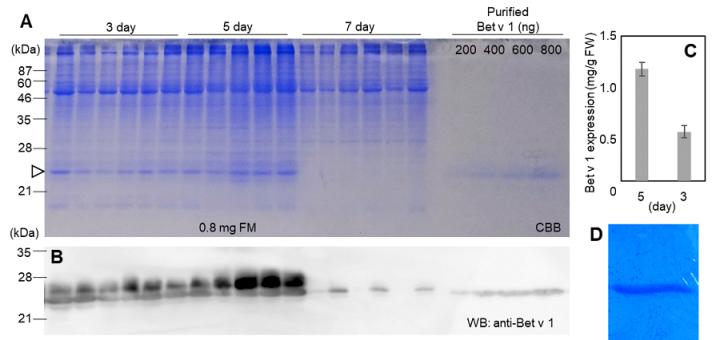
Tsukuba, Japan – Allergies can significantly affect health and quality of life. While allergen immunotherapy provides long-lasting therapeutic relief to people suffering from environmental allergies, the therapy can last several years and requires large amounts of allergen. Now, researchers from the University of Tsukuba developed a novel system that enables the mass production of the major birch pollen allergen Bet v 1 in plant leaves in just a matter of days. In a new study published in Frontiers in Plant Science, they showed that their system not only produces large amounts of Bet v 1, but the purified protein was also highly reactive towards the IgE antibodies in sera from individuals with birch pollen allergy.

“The idea of allergen immunotherapy is to desensitize the body’s response to the allergen by exposing patients to it in gradually increasing amounts,” says corresponding author of the study Professor Kenji Miura. “Because a significant drawback is the difficult, expensive and low-yield production of allergens, our goal was to develop a new system that allows for the rapid and massive production of allergens that can be used in the clinical setting.”

To achieve their goal, the researchers turned to their previously established “Tsukuba system,” which makes use of a method called agroinfiltration. They first introduced the gene for Bet v 1 into a specific type of bacteria called Agrobacterium tumefaciens and let them grow. They then immersed leaves of the plant Nicotiana benthamiana into the bacterial solution to bring the bacteria into close contact with the plant, so the bacteria could transfer the Bet v 1 gene to plant cells, which in turn started producing the protein. To test the quality of their product, the researchers also produced the protein in Brevibacillus brevis, which is a standard bacterial host for protein production.

“We were able to purify 1.2mg of Bet v 1 protein from 1g leaves in just 5 days,” explains Professor Miura. “This is a relatively large amount that is otherwise difficult to achieve using standard methods. Our next goal was to test whether our protein was immunogenic, which is a prerequisite for immunotherapy.”

The researchers isolated sera from individuals with birch pollen allergy and mixed them with Bet v 1 protein purified from plants and bacteria. In both cases, the researchers were able to show that Bet v 1-specific IgE from the patients’ sera, which is the antibody causing the allergy, was strongly reactive to their proteins.

“These are striking results that show how functional allergens can be produced in a fast and efficient way,” says Professor Miura. “Given that immunotherapy requires 5-20μg allergen per treatment over several years, our findings could offer an opportunity to significantly improve allergen immunotherapy.”

###

Media Contact
Naoko Yamashina
[email protected]

Related Journal Article

http://dx.doi.org/10.3389/fpls.2020.00344

Tags: DermatologyImmunology/Allergies/AsthmaMedicine/HealthPulmonary/Respiratory Medicine
Share12Tweet8Share2ShareShareShare2

Related Posts

Tracking Lanthanide-Labeled Microplastics in Plants

June 25, 2026

Neural Design Enables Zero-Shot Drug-Binding Proteins

June 25, 2026

Genomic Insights into Human Skin Fungi Diversity

June 25, 2026

Chiral Laser Gyroscopes Surpass Lock-In Limit

June 25, 2026
Please login to join discussion

POPULAR NEWS

  • Saying Goodbye to PGY-6: Pediatric Fellowship Realities

    103 shares
    Share 41 Tweet 26
  • Multi-Hospital Study Reveals Long Covid Burden Is Twice as High as Current Estimates

    92 shares
    Share 36 Tweet 23
  • Detection of EDCs in Breast Milk and Infant Urine Up to Six Months Highlights Early Exposure Risks

    77 shares
    Share 31 Tweet 19
  • New Drug Candidate Developed at McMaster Shows Potential for Treating Brain Cancer

    58 shares
    Share 23 Tweet 15

About

We bring you the latest biotechnology news from best research centers and universities around the world. Check our website.

Follow us

Recent News

Tracking Lanthanide-Labeled Microplastics in Plants

POSTECH Researchers Slash Cost of Reconstituted Cell-Free Systems by 95%

AI and Physics Collaborate to Design Advanced Hydrogen Storage Materials

Subscribe to Blog via Email

Enter your email address to subscribe to this blog and receive notifications of new posts by email.

Join 82 other subscribers
  • Contact Us

Bioengineer.org © Copyright 2023 All Rights Reserved.

Welcome Back!

Login to your account below

Forgotten Password?

Retrieve your password

Please enter your username or email address to reset your password.

Log In
No Result
View All Result
  • Homepages
    • Home Page 1
    • Home Page 2
  • News
  • National
  • Business
  • Health
  • Lifestyle
  • Science

Bioengineer.org © Copyright 2023 All Rights Reserved.