• HOME
  • NEWS
  • EXPLORE
    • CAREER
      • Companies
      • Jobs
    • EVENTS
    • iGEM
      • News
      • Team
    • PHOTOS
    • VIDEO
    • WIKI
  • BLOG
  • COMMUNITY
    • FACEBOOK
    • INSTAGRAM
    • TWITTER
Wednesday, May 20, 2026
BIOENGINEER.ORG
No Result
View All Result
  • Login
  • HOME
  • NEWS
  • EXPLORE
    • CAREER
      • Companies
      • Jobs
        • Lecturer
        • PhD Studentship
        • Postdoc
        • Research Assistant
    • EVENTS
    • iGEM
      • News
      • Team
    • PHOTOS
    • VIDEO
    • WIKI
  • BLOG
  • COMMUNITY
    • FACEBOOK
    • INSTAGRAM
    • TWITTER
  • HOME
  • NEWS
  • EXPLORE
    • CAREER
      • Companies
      • Jobs
        • Lecturer
        • PhD Studentship
        • Postdoc
        • Research Assistant
    • EVENTS
    • iGEM
      • News
      • Team
    • PHOTOS
    • VIDEO
    • WIKI
  • BLOG
  • COMMUNITY
    • FACEBOOK
    • INSTAGRAM
    • TWITTER
No Result
View All Result
Bioengineer.org
No Result
View All Result
Home NEWS Science News Chemistry

A new path for electron optics in solid-state systems

Bioengineer by Bioengineer
July 14, 2020
in Chemistry
Reading Time: 2 mins read
0
IMAGE
Share on FacebookShare on TwitterShare on LinkedinShare on RedditShare on Telegram

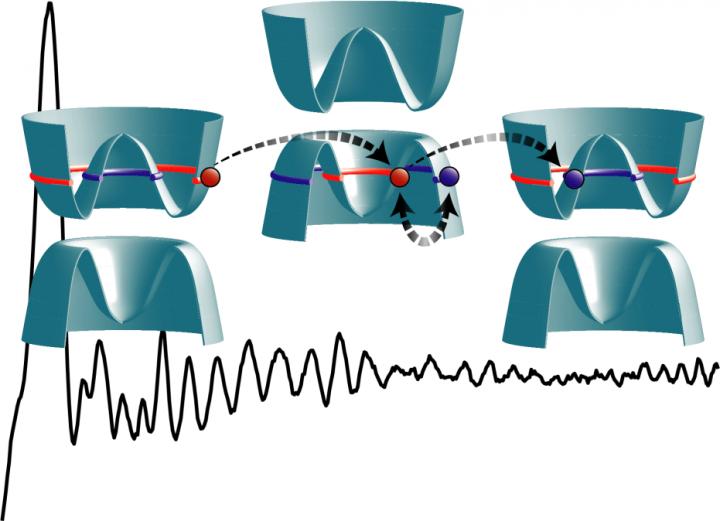
A novel mechanism for electron optics in two-dimensional solid-state systems opens up a route to engineering quantum-optical phenomena in a variety of materials
IMAGE

Credit: ETH Zurich/D-?PHYS Zilberberg group

Electrons can interfere in the same manner as water, acoustical or light waves do. When exploited in solid-state materials, such effects promise novel functionality for electronic devices, in which elements such as interferometers, lenses or collimators could be integrated for controlling electrons at the scale of mirco- and nanometres. However, so far such effects have been demonstrated mainly in one-dimensional devices, for example in nanotubes, or under specific conditions in two-dimensional graphene devices. Writing in Physical Review X, a collaboration including the Department of Physics groups of Klaus Ensslin, Thomas Ihn and Werner Wegscheider in the Laboratory for Solid State Physics and Oded Zilberberg at the Institute of Theoretical Physics, now introduces a novel general scenario for realizing electron optics in two dimensions.

The main functional principle of optical interferometers is the interference of monochromatic waves that propagate in the same direction. In such interferometers, the interference can be observed as a periodic oscillation of the transmitted intensity on varying the wavelength of the light. However, the period of the interference pattern strongly depends on the incident angle of the light, and, as a result, the interference pattern is averaged out if light is sent through the interferometer at all possible incident angles at once. The same arguments apply to the interference of matter waves as described by quantum mechanics, and in particular to interferometers in which electrons interfere.

As part of their PhD projects, experimentalist Matija Karalic and theorist Antonio Štrkalj have investigated the phenomenon of electronic interference in a solid-state system consisting of two coupled semiconductor layers, InAs and GaSb. They discovered that the band inversion and hybridization present in this system provide a novel transport mechanism that guarantees non-vanishing interference even when all angles of incidence occur. Through a combination of transport measurements and theoretical modelling, they found that their devices operate as a Fabry-Pérot interferometer in which electrons and holes form hybrid states and interfere.

The significance of these results goes firmly beyond the specific InAs/GaSb realization explored in this work, as the reported mechanism requires solely the two ingredients of band inversion and hybridization. Therefore new paths are now open for engineering electron-optical phenomena in a broad variety of materials.

###

Media Contact
Andreas Trabesinger
[email protected]

Original Source

https://www.phys.ethz.ch/news-and-events/d-phys-news/2020/07/a-new-path-for-electron-optics-in-solid-state-systems.html

Related Journal Article

http://dx.doi.org/10.1103/PhysRevX.10.031007

Tags: Chemistry/Physics/Materials SciencesMaterialsNanotechnology/MicromachinesOpticsSuperconductors/Semiconductors
Share12Tweet8Share2ShareShareShare2

Related Posts

Advancing In Vivo and In Situ Monitoring: Science Bulletin Highlights Host-Based Antifouling Gold Nanotube Sensor for Selective Detection of Mechanically Sensitive Serotonin Release in Intestinal Mucosa — Chemistry

Advancing In Vivo and In Situ Monitoring: Science Bulletin Highlights Host-Based Antifouling Gold Nanotube Sensor for Selective Detection of Mechanically Sensitive Serotonin Release in Intestinal Mucosa

May 20, 2026
How Magnetic Orientation Could Influence the Building Blocks of Life — Chemistry

How Magnetic Orientation Could Influence the Building Blocks of Life

May 20, 2026

Breaking a 200-Year-Old Belief: Novel Surface Design Achieves Two Distinct Wetting States on One Substrate

May 20, 2026

Unveiling Sound Waves: Scientists Discover Hidden Behaviors in Acoustic Phenomena

May 20, 2026
Please login to join discussion

POPULAR NEWS

  • blank

    New Study Reveals Plants Can Detect the Sound of Rain

    733 shares
    Share 292 Tweet 183
  • Research Indicates Potential Connection Between Prenatal Medication Exposure and Elevated Autism Risk

    846 shares
    Share 338 Tweet 212
  • ESMO 2025: mRNA COVID Vaccines Enhance Efficacy of Cancer Immunotherapy

    298 shares
    Share 119 Tweet 75
  • Breastmilk Balances E. coli and Beneficial Bacteria in Infant Gut Microbiomes

    58 shares
    Share 23 Tweet 15

About

We bring you the latest biotechnology news from best research centers and universities around the world. Check our website.

Follow us

Recent News

New Fossil Finds in Northwest Canada Transform Understanding of Early Animal Evolution

Gentoo Penguins in Argentina Adapt to Extreme Heat by Shifting Breeding Season Earlier, Mitigating Deadly Temperature Risks

New Study Enhances Early Detection of Pancreatic Cancer in Patients with Low-Risk Pancreatic Cysts

Subscribe to Blog via Email

Enter your email address to subscribe to this blog and receive notifications of new posts by email.

Join 82 other subscribers
  • Contact Us

Bioengineer.org © Copyright 2023 All Rights Reserved.

Welcome Back!

Login to your account below

Forgotten Password?

Retrieve your password

Please enter your username or email address to reset your password.

Log In
No Result
View All Result
  • Homepages
    • Home Page 1
    • Home Page 2
  • News
  • National
  • Business
  • Health
  • Lifestyle
  • Science

Bioengineer.org © Copyright 2023 All Rights Reserved.