• HOME
  • NEWS
  • EXPLORE
    • CAREER
      • Companies
      • Jobs
    • EVENTS
    • iGEM
      • News
      • Team
    • PHOTOS
    • VIDEO
    • WIKI
  • BLOG
  • COMMUNITY
    • FACEBOOK
    • INSTAGRAM
    • TWITTER
Saturday, May 30, 2026
BIOENGINEER.ORG
No Result
View All Result
  • Login
  • HOME
  • NEWS
  • EXPLORE
    • CAREER
      • Companies
      • Jobs
        • Lecturer
        • PhD Studentship
        • Postdoc
        • Research Assistant
    • EVENTS
    • iGEM
      • News
      • Team
    • PHOTOS
    • VIDEO
    • WIKI
  • BLOG
  • COMMUNITY
    • FACEBOOK
    • INSTAGRAM
    • TWITTER
  • HOME
  • NEWS
  • EXPLORE
    • CAREER
      • Companies
      • Jobs
        • Lecturer
        • PhD Studentship
        • Postdoc
        • Research Assistant
    • EVENTS
    • iGEM
      • News
      • Team
    • PHOTOS
    • VIDEO
    • WIKI
  • BLOG
  • COMMUNITY
    • FACEBOOK
    • INSTAGRAM
    • TWITTER
No Result
View All Result
Bioengineer.org
No Result
View All Result
Home NEWS Science News Chemistry

A new method to significantly increase the range and stability of optical tweezers

Bioengineer by Bioengineer
July 23, 2020
in Chemistry
Reading Time: 3 mins read
0
IMAGE
Share on FacebookShare on TwitterShare on LinkedinShare on RedditShare on Telegram

Scientists of Tomsk Polytechnic University jointly with a team of the V.E. Zuev Institute of Atmospheric Optics of the Siberian Branch of the Russian Academy of Sciences have discovered a method to increase the operation range of optical traps also known
IMAGE

Credit: Tomsk Polytechnic University

Optical tweezers are a device which uses a laser beam to move micron-sized objects such as living cells, proteins, and molecules. In 2018, the American physicist Arthur Eshkin received the Nobel Prize for this technology. Before this, it was impossible to move such objects since any attempt to grab it led to destruction. Optical tweezers do not disturb the internal structure of the object.

“Optical tweezer is a media name for optical traps. Their general principle of operation is as follows: the lens focuses the laser light, and the particles in the focusing field, according to the laws of physics, begin to move towards the maximum intensity of the light field. Thus, this allows capturing and moving particles. Previously, we have proposed to use microparticles made of a dielectric material, for example, quartz instead of lenses to increase the degree of localization of the optical field in the focusing area in these optical traps, operating in the reflection mode,” Igor Minin project manager, professor of the TPU Division for Electronic Engineering, says.

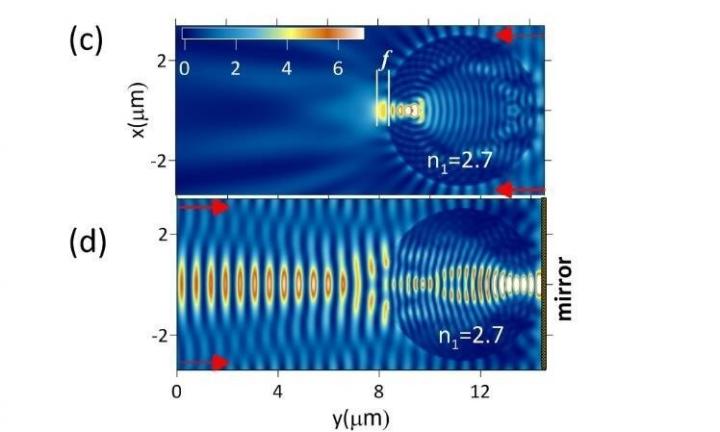
Interacting with such a particle, the light is focused in the form of a photon jet in the direction opposite to the radiation incidence. Due to its properties, it is this photon jet that acts as a trap or tweezers.

“To form a classical photonic jet, there is a necessary condition such as the ratio of the refractive indices of a particle and a medium must be less than two. If it is higher, then the jet will not form. Previously, it was believed that it is impossible to increase the refractive index and at the same time form a photon jet. We jointly with a team from the Institute of Atmospheric Optics theoretically have demonstrated that it is possible,” Igor Minin says.

To achieve this, the joint research team formed a jet in the reflection mode.

“There are two modes: refraction and reflection. In the former case, a jet is formed when light passes through a dielectric particle. In the latter case, we put a flat mirror behind the particle, and the focal point moves to the mirror. As a result, we have double-focusing when the light is focused through a particle on a mirror, which reflects it back to the same particle that forms a photonic jet. Using this mode, we managed to form a jet from a dielectric particle with the ratio of a particle and a medium higher than two. This increases the capture area at times,” the scientist underlines.

Currently, the group is preparing experiments to confirm the simulation results in practice.

###

The studies were supported by grants of the Russian Foundation for Basic Research and the TPU Competitiveness Enhancement Program.

Media Contact
Vitalii Sdelnikov
[email protected]

Original Source

https://news.tpu.ru/en/news/2020/07/23/36499/

Related Journal Article

http://dx.doi.org/10.1364/OL.398367

Tags: Chemistry/Physics/Materials Sciences
Share12Tweet8Share2ShareShareShare2

Related Posts

Transforming Microalgae Waste into High-Performance Membranes for Enhanced Municipal Wastewater Treatment — Chemistry

Transforming Microalgae Waste into High-Performance Membranes for Enhanced Municipal Wastewater Treatment

May 29, 2026
Hydrochar Transforms Agricultural Waste into a Potent Solution for Healthier, Carbon-Rich Soils — Chemistry

Hydrochar Transforms Agricultural Waste into a Potent Solution for Healthier, Carbon-Rich Soils

May 29, 2026

FAPESP Aims to Strengthen Scientific Collaboration Between São Paulo and the United Kingdom

May 29, 2026

Mild Ketone-to-Ketyl Conversion Enables Redox-Neutral Coupling

May 29, 2026
Please login to join discussion

POPULAR NEWS

  • ESMO 2025: mRNA COVID Vaccines Enhance Efficacy of Cancer Immunotherapy

    319 shares
    Share 128 Tweet 80
  • Multi-Hospital Study Reveals Long Covid Burden Is Twice as High as Current Estimates

    81 shares
    Share 32 Tweet 20
  • Common Food Preservatives Associated with Elevated Blood Pressure and Increased Heart Disease Risk

    56 shares
    Share 22 Tweet 14
  • New Study Reveals Plants Can Detect the Sound of Rain

    736 shares
    Share 294 Tweet 184

About

We bring you the latest biotechnology news from best research centers and universities around the world. Check our website.

Follow us

Recent News

Society of Nuclear Medicine and Molecular Imaging Unveils 2026 Fellows

Two Plasmodium vivax Proteins Block Liver Stage

Oliceridine and Propofol-Etomidate in Geriatric Gastroscopy

Subscribe to Blog via Email

Enter your email address to subscribe to this blog and receive notifications of new posts by email.

Join 82 other subscribers
  • Contact Us

Bioengineer.org © Copyright 2023 All Rights Reserved.

Welcome Back!

Login to your account below

Forgotten Password?

Retrieve your password

Please enter your username or email address to reset your password.

Log In
No Result
View All Result
  • Homepages
    • Home Page 1
    • Home Page 2
  • News
  • National
  • Business
  • Health
  • Lifestyle
  • Science

Bioengineer.org © Copyright 2023 All Rights Reserved.