Using recent advances in machine learning, a Dartmouth research team has developed a deep neural network to classify different types of a common form of lung cancer on histopathology slides at an accuracy level shown to be on par with pathologists
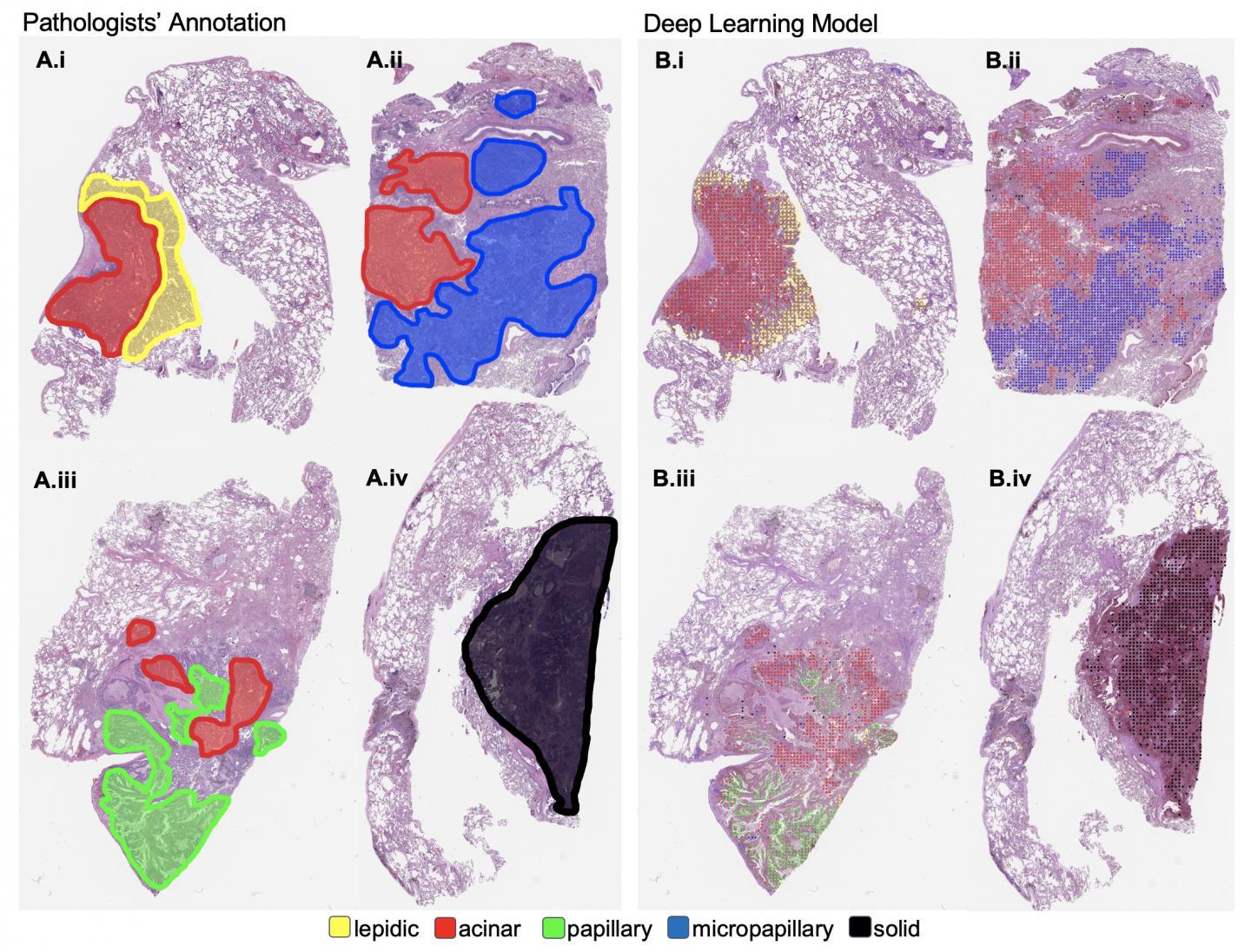
Credit: Hassanpour Lab, Dartmouth’s Norris Cotton Cancer Center
LEBANON, NH – Machine learning has improved dramatically in recent years and shown great promise in the field of medical image analysis. A team of research specialists at Dartmouth’s Norris Cotton Cancer Center have utilized machine learning capabilities to assist with the challenging task of grading tumor patterns and subtypes of lung adenocarcinoma, the most common form of the leading cause of cancer-related deaths worldwide.
Currently, lung adenocarcinoma, requires pathologist’s visual examination of lobectomy slides to determine the tumor patterns and subtypes. This classification has an important role in prognosis and determination of treatment for lung cancer, however is a difficult and subjective task. Using recent advances in machine learning, the team, led by Saeed Hassanpour, PhD, developed a deep neural network to classify different types of lung adenocarcinoma on histopathology slides, and found that the model performed on par with three practicing pathologists.
“Our study demonstrates that machine learning can achieve high performance on a challenging image classification task and has the potential to be an asset to lung cancer management,” says Hassanpour. “Clinical implementation of our system would be able to assist pathologists for accurate classification of lung cancer subtypes, which is critical for prognosis and treatment.”
The team’s conclusions, “Pathologist-level classification of histologic patterns on resected lung adenocarcinoma slides with deep neural networks” are newly published in Scientific Reports. Recognizing that the approach is potentially applicable to other histopathology image analysis tasks, Hassanpour’s team made their code publicly available to promote new research and collaborations in this domain.
In addition to testing the deep learning model in a clinical setting to validate its ability to improve lung cancer classification, the team plans to apply the method to other challenging histopathology image analysis tasks in breast, esophageal, and colorectal cancer. “If validated through clinical trials, our neural network model can potentially be implemented in clinical practice to assist pathologists,” says Hassanpour. “Our machine learning method is also fast and can process a slide in less than one minute, so it could help triage patients before examination by physicians and potentially greatly assist pathologists in the visual examination of slides.”
###
Saeed Hassanpour, PhD, is an Assistant Professor of Biomedical Data Science, Assistant Professor of Epidemiology, and Assistant Professor of Computer Science in the Departments of Biomedical Data Science and Epidemiology at Dartmouth’s Geisel School of Medicine, and member of the Cancer Population Science Research Program at Dartmouth’s Norris Cotton Cancer Center. His research interests include biomedical informatics, machine learning, and personalized medicine. https:/
About Norris Cotton Cancer Center at Dartmouth-Hitchcock
Norris Cotton Cancer Center combines advanced cancer research at Dartmouth’s Geisel School of Medicine with patient-centered cancer care provided at Dartmouth-Hitchcock Medical Center in Lebanon, NH, at Dartmouth-Hitchcock regional locations in Manchester, Nashua and Keene, NH, and St. Johnsbury, VT, and at partner hospitals throughout New Hampshire and Vermont. It is one of 49 centers nationwide to earn the National Cancer Institute’s “Comprehensive Cancer Center” designation. Learn more about Norris Cotton Cancer Center research, programs, and clinical trials online at cancer.dartmouth.edu.
Media Contact
Jaime Peyton
[email protected]
Related Journal Article
http://dx.