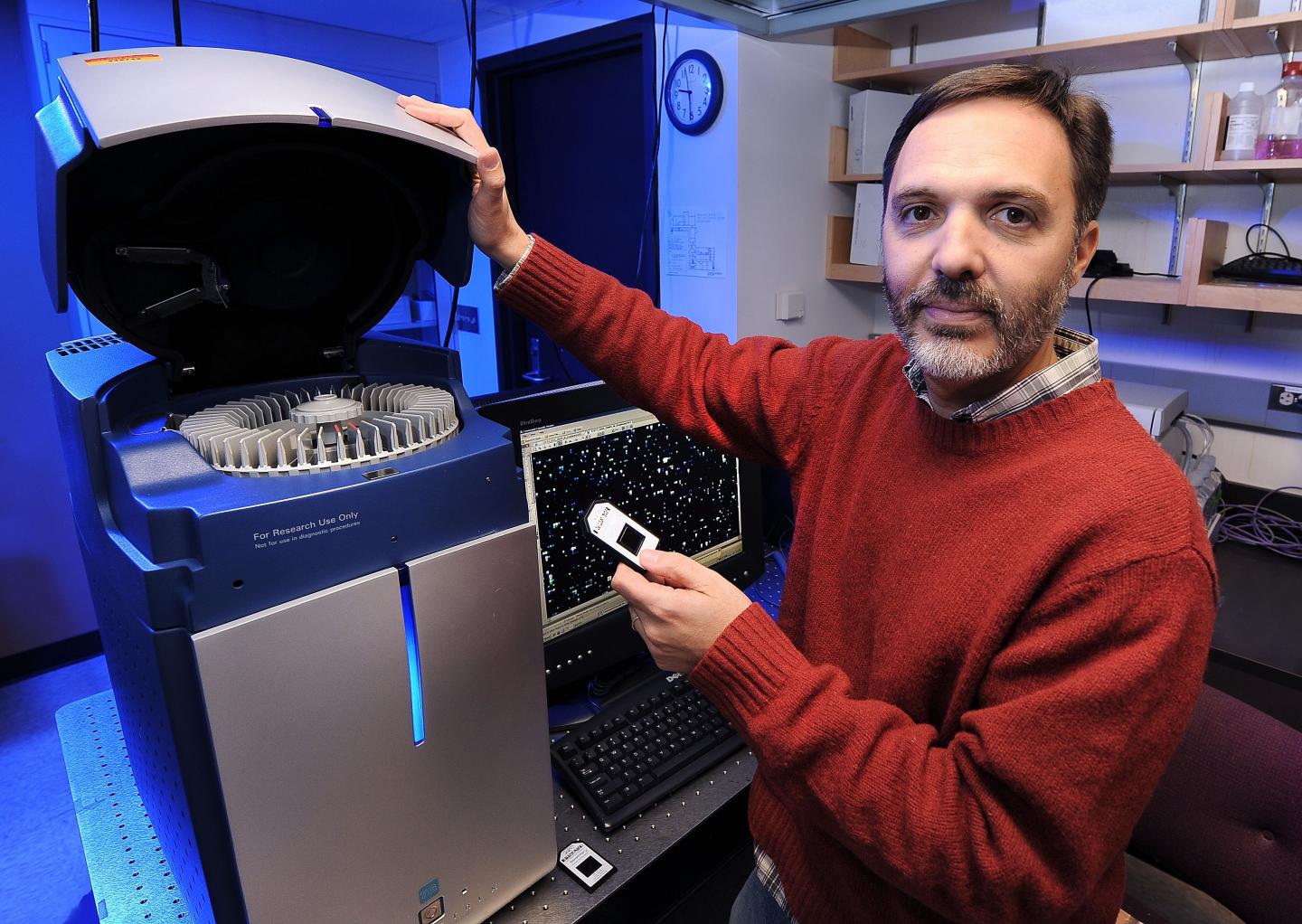
Credit: Iowa State University News Service
AMES, Iowa – A lot is riding on the continued advancement of plant sciences.
Take the food supply, for starters. Climate change and population growth will continue to pose challenges in the future, and crop production will require innovation and progress by plant scientists in order to keep pace. It isn’t an overstatement to say that populations around the world will go hungry if plant science stagnates, said Gustavo MacIntosh, a professor in the Roy J. Carver Department of Biochemistry, Biophysics and Molecular Biology at Iowa State University.
“At the end of the day, either you eat plants or you eat food that ate plants,” MacIntosh said. “Plants are the basis for the food we have.”
MacIntosh predicts plant science will play an increasingly important role in society, but he said many people lack an understanding of plants, both their biology and their critical place in the functioning of human society. He worries that plant scientists aren’t doing enough to raise awareness of the discipline among the general population, which could slow the rate of progress in the future.
So MacIntosh worked with around 30 other scientists over the course of more than two years to put together a comprehensive guide to help plant scientists communicate their work to the world. This guide takes the form of a 28-page white paper published this week in the academic journal Plant Direct. The guide identifies challenges to communicating the importance of plant science to a wide audience and provides some strategies to help plant scientists get the word out. The document stresses the importance of diversity throughout the text, offering scientists and educators a roadmap for introducing plant sciences to a wide variety of audiences.
“We want people to be convinced that we need more outreach efforts, and we want this guide to make sure those outreach efforts are effective,” MacIntosh said.
The guide grew out of a National Science Foundation-funded symposium and workshop held in Davis, California, in November of 2018. Plant scientists collaborated over the course of the three-day event to create a new vision for scientific outreach in their discipline. They formed teams and made a plan to put together a document that could act as a roadmap for the future. The document produced by the effort covers case studies and a number of strategies to communicate important plant science topics to the world at large. The document includes ideas for classroom activities as well as tips for how to plan museum exhibits and booths at farmers markets and similar events.
It also stresses the importance of humanizing plant science to make it accessible to a wide range of audiences. MacIntosh said scientists and nonscientists seem to be growing farther apart for various reasons, but he said everyone benefits when more diverse voices enter the conversation.
To that end, MacIntosh led efforts to make diversity and inclusion central tenets of the new outreach guide. He said the plant sciences will benefit by removing historical barriers related to ethnicity and gender. The white paper also calls for more involvement from undergraduates and early career scientists as well as a more dynamic mix of private and public sector collaboration.
“Good outreach is diverse outreach, in every sense,” he said.
The lack of basic plant science literacy could make a huge difference in the future, MacIntosh said. He pointed to studies showing that the number of students earning doctorates in plant-related disciplines is not growing fast enough to keep up with job trends in agriculture and plant-related industries in recent decades.
MacIntosh’s own research focuses on the study of plant cellular functions as well as how soybeans resist insect pests. He said his involvement with the outreach guide dovetails with his soybean research, which also requires extension and outreach efforts to get scientific advancements into the hands of farmers. He said the land-grant model at the heart of Iowa State’s mission, which stresses the importance of teaching and outreach alongside research, springs from the same motivations that produced the new white paper.
###
Media Contact
Fred Love
[email protected]
Original Source
https:/
Related Journal Article
http://dx.