• HOME
  • NEWS
  • EXPLORE
    • CAREER
      • Companies
      • Jobs
    • EVENTS
    • iGEM
      • News
      • Team
    • PHOTOS
    • VIDEO
    • WIKI
  • BLOG
  • COMMUNITY
    • FACEBOOK
    • INSTAGRAM
    • TWITTER
Saturday, May 23, 2026
BIOENGINEER.ORG
No Result
View All Result
  • Login
  • HOME
  • NEWS
  • EXPLORE
    • CAREER
      • Companies
      • Jobs
        • Lecturer
        • PhD Studentship
        • Postdoc
        • Research Assistant
    • EVENTS
    • iGEM
      • News
      • Team
    • PHOTOS
    • VIDEO
    • WIKI
  • BLOG
  • COMMUNITY
    • FACEBOOK
    • INSTAGRAM
    • TWITTER
  • HOME
  • NEWS
  • EXPLORE
    • CAREER
      • Companies
      • Jobs
        • Lecturer
        • PhD Studentship
        • Postdoc
        • Research Assistant
    • EVENTS
    • iGEM
      • News
      • Team
    • PHOTOS
    • VIDEO
    • WIKI
  • BLOG
  • COMMUNITY
    • FACEBOOK
    • INSTAGRAM
    • TWITTER
No Result
View All Result
Bioengineer.org
No Result
View All Result
Home NEWS Science News Health

A new formula for creating chemical reactions — with carbs

Bioengineer by Bioengineer
April 30, 2018
in Health
Reading Time: 2 mins read
0
Share on FacebookShare on TwitterShare on LinkedinShare on RedditShare on Telegram
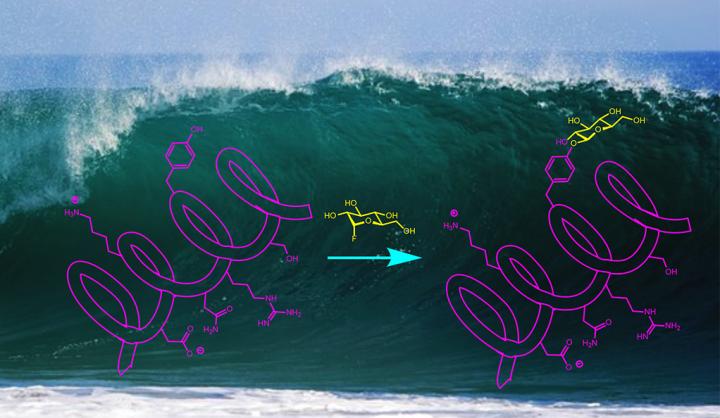
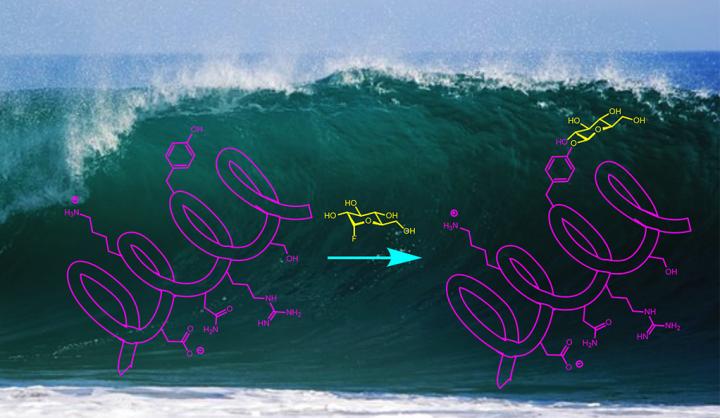
IMAGE

Credit: Yale University

New Haven, Conn. – In the world of chemistry, good things can happen if you just add sugar.

A wide range of drugs and biochemical probes — everything from antibiotics to Alzheimer's disease biomarkers — rely on natural or synthetic compounds that aid a reaction by adding carbohydrates. It's a process called glycosylation. But it is traditionally a highly specific process that makes synthesis of such compounds, for testing or large-scale production, difficult.

A team of Yale University scientists has developed a new approach to glycosylation that is remarkably simple and works in water at room temperature. A study describing the process appears April 30 in the online edition of Nature Chemistry.

"Glycoproteins serve a myriad of functions in biological chemistry," said Scott Miller, the Irénée du Pont Professor of Chemistry at Yale and co-corresponding author of the study. "Synthesis of these compounds is very challenging, and has limited the extent to which people can make multiple variants in order to find the best biochemical probes and therapeutics."

Alanna Schepartz, Sterling Professor of Chemistry at Yale and the study's other co-corresponding author, points out that many glycoprotein molecules are currently made using an enzyme catalyst. The Yale team's approach does not require an enzymatic reaction, allowing the process to be generalized to create large numbers of different compounds.

Another advantage of the new process, the researchers said, is that it occurs in water as the solvent. Often, organic synthesis of bioactive compounds happens in non-aqueous solvents, because water has a tendency to react with many catalysts and chemical agents.

"There is enormous interest right now in strategies to perform selective chemistry on complex biomolecules in water and also in cells," Schepartz said. "This paper lays a strong foundation that we and others can build upon to develop novel and useful chemistry."

The first author of the study is Tyler Wadzinski, a graduate student in Miller's lab. Co-authors, all of Yale, are Angela Steinauer, Liana Hie, and Guillaume Pelletier.

"This is truly a collaborative study that blends expertise in chemical reaction development and biological chemistry," Miller said.

###

The W.M. Keck Foundation and the National Institutes of Health supported the research.

Media Contact

Jim Shelton
[email protected]
203-432-3881
@yale

http://www.yale.edu
Share12Tweet8Share2ShareShareShare2

Related Posts

Chewing, Nutrition, and Frailty in Elderly Patients

May 23, 2026

Fish Consumption and Mercury Exposure in Chicago Asians

May 23, 2026

Assessing Osteoporotic Pelvis Fracture Score Feasibility

May 23, 2026

CD5L Protein Shields Kidneys by Reducing Oxidative Stress

May 23, 2026
Please login to join discussion

POPULAR NEWS

  • blank

    New Study Reveals Plants Can Detect the Sound of Rain

    734 shares
    Share 293 Tweet 183
  • ESMO 2025: mRNA COVID Vaccines Enhance Efficacy of Cancer Immunotherapy

    312 shares
    Share 125 Tweet 78
  • Research Indicates Potential Connection Between Prenatal Medication Exposure and Elevated Autism Risk

    847 shares
    Share 339 Tweet 212
  • Common Food Preservatives Associated with Elevated Blood Pressure and Increased Heart Disease Risk

    55 shares
    Share 22 Tweet 14

About

We bring you the latest biotechnology news from best research centers and universities around the world. Check our website.

Follow us

Recent News

Chewing, Nutrition, and Frailty in Elderly Patients

Fractional SIR Model Explores Vaccination Impact on Childhood Diseases

Fish Consumption and Mercury Exposure in Chicago Asians

Subscribe to Blog via Email

Enter your email address to subscribe to this blog and receive notifications of new posts by email.

Join 83 other subscribers
  • Contact Us

Bioengineer.org © Copyright 2023 All Rights Reserved.

Welcome Back!

Login to your account below

Forgotten Password?

Retrieve your password

Please enter your username or email address to reset your password.

Log In
No Result
View All Result
  • Homepages
    • Home Page 1
    • Home Page 2
  • News
  • National
  • Business
  • Health
  • Lifestyle
  • Science

Bioengineer.org © Copyright 2023 All Rights Reserved.