Credit: ©Science China Press
Understanding and predicting how molecules recognize each other are the key issues in the field of supramolecular chemistry and biology, etc., where the non-covalent bindings play an essential role. Among many types of non-covalent interactions, ion-π interactions, including both cation-π and anion-π interactions, are practically important in regulating many important vital processes, such as gene expression, nicotine addiction and ion channel, etc., through recognizing specific ions by the receptors. A deep insight into how the inherent binding nature determines the trends of a set of ion-π systems is critical for rational designs of drugs and advanced functional materials.
The most popular viewpoint of theory and experiment so far is that the binding interactions of ion-π systems, both cation-π and anion-π, are governed by the electrostatic interactions and the ion-induced polarizations together. Thus, the necessity of two kinds of descriptors for searching for the desired ion-π complexes has been well recognized in this field. And the widely applied descriptors are the quadrupole moment (Qzz), electrostatic potential (ESP) and the polarizability (azz) of the π systems. These models treat ions as point charges, which lead to the lack of information from the ions, and can be especially problematic for the multi-shaped ions. However, for molecular communication based on ion-π interactions, usually it is ions that carry the information read by the receptors containing one or several arene rings. Consequently, the key role of information-carrying ions cannot be recognized when these widely used models are employed.
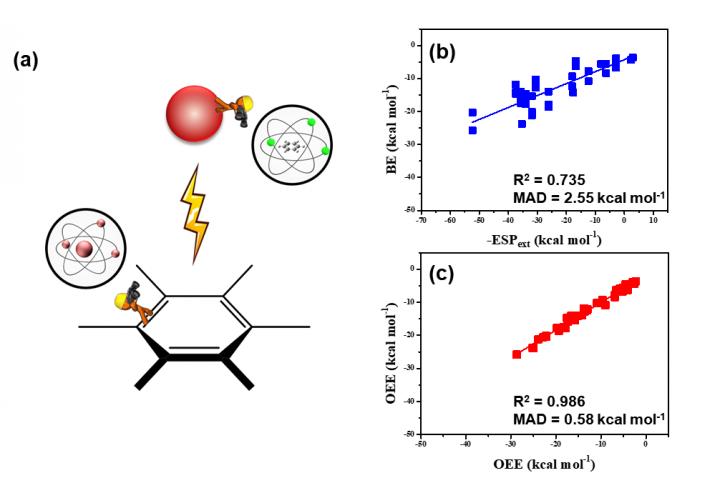
Recently, Zhangyun Liu, Zheng Chen, Jinyang Xi and Xin Xu from Fudan University proposed a new descriptor named the orbital electrostatic energy (OEE), which describes the electrostatic properties of both ions and the arene π systems in detail via electron density distributions on orbitals (Figure a). Note that, if the ion is simplified as a point charge, the OEE model is reduced naturally to the widely used ESP model. Qzz can be related to ESP by a multipole expansion, which represents a further simplification, where the information to differentiate different binding sites of the arene π system is dropped off.
A complete description of the ion-π interactions would have to invoke high-level calculations, such as an expensive coupled-cluster (CC) based method. The authors have used XYG3, which is an accurate yet efficient density functional theory method, to set up a data set of ion-π interactions made of not only simple (e.g., Na+, and Cl-) ion-π systems but also multiply-shaped (e.g., NH4+, C(NH2)3+, N3-, NO3-, BF4-, and SCN-) ion-π systems. Of course, it can be anticipated that the point charge based models should be reasonable for simple ions, which becomes erroneous for multiply-shaped ions.
To explore the binding nature, one can, in principle, carry out a detailed energy decomposition analysis (EDA) on a given system. However, a typical EDA calculation requires several constrained (variational) calculations, which can be expensive and may even fail to converge. On the other hand, people are usually more interested in finding the trend for a set of ion-π complexes, digging out some useful concepts which can help the future rational design. In this context, it is more direct and convenient to correlate the total binding energies (BEs) with certain descriptors, e.g. ESP, Qzz, and azz, as commonly done in the literature. However, it is vital that these descriptors can capture the fundamental physics of the interactions under study. The model should be as simple as possible but not simpler.
In this work, different descriptors have been explored with qualitative or quantitative differences in probing the physical nature of the ion-π interactions, in order to understand how the physical nature (i.e., the electrostatic effect and/or the polarization effect) controls the BE trend for a set of ion-π complexes. The authors found that the more accurate the descriptor is in describing the electrostatic effect, the stronger the correlation is between the descriptor and the BEs of the related ion-π complexes. The OEE is the only descriptor which strongly correlates to the BEs of both simple ion-π and multiply-shaped ion-π complexes (Figure b-c). On the other hand, unless the electrostatic effect is accurately characterized, the polarization effect can hardly refine the predictions in trends of ion-π interactions. In combination with the OEE, including polarization contributions can lead to highly accurate predictions of the cation-π binding strengths, although the same does not hold true for the anion-π complexes. These results demonstrated that it is the electrostatic contribution that controls the trend of the BEs for a set of related ion-π complexes, while the polarization effect is only important in the cation-π complexes rather than in the anion-π complexes in this regard. Based on this understanding, the authors designed a protocol where the OEEs are calculated at a low-level method, which are then used as a descriptor for the prediction of the total BEs at a high-level method.
Many EDA methods are able to yield the OEE value, while the present authors suggested to use OEE as a descriptor as opposed to ESP and Qzz, and found that OEE is solely responsible for the total BE trend, acting as a useful guide for the screening or design of a specific ion-π system. As electrostatic interactions are ubiquitous, it is anticipated that the OEE descriptor can be a useful tool in many areas such as supramolecular chemistry and biological chemistry.
###
See the article:
Zhangyun Liu, Zheng Chen, Jinyang Xi and Xin Xu
An accurate single-descriptor for ion-π interactions
Natl Sci Rev
https:/
Media Contact
Xin Xu
[email protected]
Related Journal Article
http://dx.