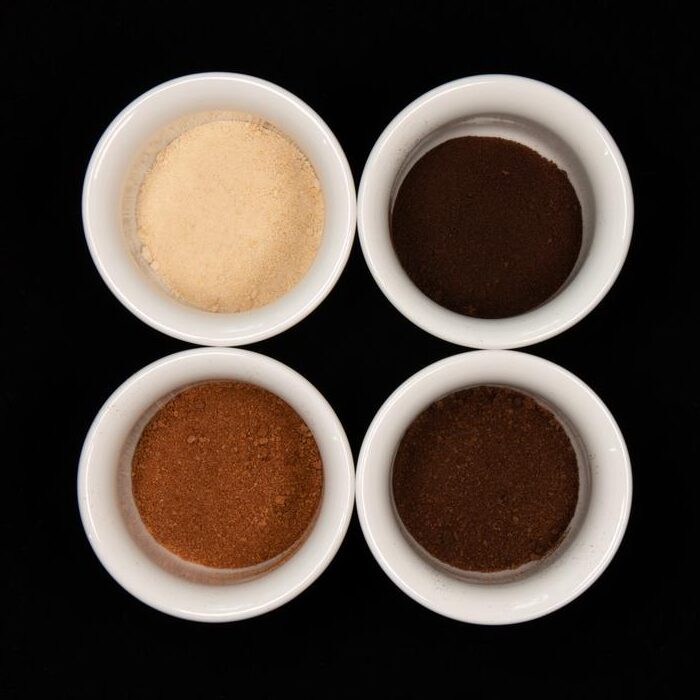
It may soon be time to wake up and smell the lab-grown coffee made from cultured plant cells. But it’s not clear whether drinks from this product replicate coffee beans’ complex flavors. Now, a study in ACS’ Journal of Agricultural and Food Chemistry found that some of the comforting aromas and tastes of a conventional cup of coffee could be reproduced by roasting and brewing coffee cell cultures.
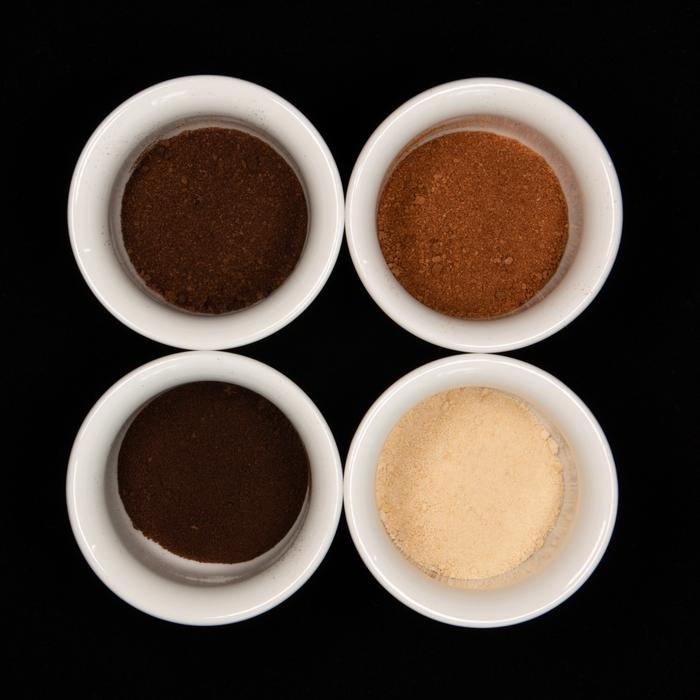
Credit: Adapted from Journal of Agricultural and Food Chemistry 2023, DOI: 10.1021/acs.jafc.3c04503
It may soon be time to wake up and smell the lab-grown coffee made from cultured plant cells. But it’s not clear whether drinks from this product replicate coffee beans’ complex flavors. Now, a study in ACS’ Journal of Agricultural and Food Chemistry found that some of the comforting aromas and tastes of a conventional cup of coffee could be reproduced by roasting and brewing coffee cell cultures.
Coffee is one of the most popular beverages worldwide. According to the U.S. Department of Agriculture, 23 billion pounds of beans are expected to be produced during the 2023–24 growing season. However, coffee cultivation is increasingly threatened by a warming climate because the plants grow only at specific temperatures and altitudes. Researchers have been investigating lab-grown coffee plant cells since the 1970s as an alternative to farmed beans, but little research has evaluated how laboratory products taste and smell compared to traditional beans. So, Hieko Rischer and coworkers tested how roasting coffee plant cells impacts them and the beverage made from them.
The team first cultured cells from chopped Coffea arabica leaves in a laboratory-scale bioreactor. Then the cells were freeze-dried, ground into a fine powder and roasted under three different conditions. Longer roasting times produced colors similar to dark roast coffee beans; the researchers mentioned this was important for flavor perception. Additionally, the current lab-grown powders contained twice as much caffeine as previous bioreactor coffee products, although the current powders’ levels were much lower than those in farmed beans. The team brewed beverages with the roasted cell cultures or dark roast C. arabica beans and served them to trained taste-testers. The following conclusions were drawn:
- Panelists identified similar levels of bitterness and sourness in lab-grown and conventional drinks.
- The new brews had more roasted, burned sugar, and smokey smells.
- Some Maillard reaction products that give coffee its distinct flavor, such as guaiacol and several pyrazines, weren’t found in the cell-based drinks, though other Maillard reaction products were present.
Overall, while some tastes and smells of a typical bean-based coffee could be produced by roasting cultured cells, the researchers say that future work is needed to explore processing techniques to further boost flavor for this alternative to conventionally grown coffee.
The authors acknowledge funding from VTT Technical Research Centre of Finland, Ltd.
###
The American Chemical Society (ACS) is a nonprofit organization chartered by the U.S. Congress. ACS’ mission is to advance the broader chemistry enterprise and its practitioners for the benefit of Earth and all its people. The Society is a global leader in promoting excellence in science education and providing access to chemistry-related information and research through its multiple research solutions, peer-reviewed journals, scientific conferences, eBooks and weekly news periodical Chemical & Engineering News. ACS journals are among the most cited, most trusted and most read within the scientific literature; however, ACS itself does not conduct chemical research. As a leader in scientific information solutions, its CAS division partners with global innovators to accelerate breakthroughs by curating, connecting and analyzing the world’s scientific knowledge. ACS’ main offices are in Washington, D.C., and Columbus, Ohio.
To automatically receive news releases from the American Chemical Society, contact [email protected].
Note: ACS does not conduct research, but publishes and publicizes peer-reviewed scientific studies.
Follow us: Twitter | Facebook | LinkedIn | Instagram
Journal
Journal of Agricultural and Food Chemistry
DOI
10.1021/acs.jafc.3c04503
Article Title
Proof of Concept for Cell Culture-Based Coffee
Article Publication Date
16-Nov-2023