A novel Light-Spin Interface with Europium(III) Molecule Advances Development of Quantum Computers – KIT Researchers Report in Nature Communications
Credit: S. Kuppusamy, KIT
Light can be used to operate quantum information processing systems, e.g. quantum computers, quickly and efficiently. Researchers at Karlsruhe Institute of Technology (KIT) and Chimie ParisTech/CNRS have now significantly advanced the development of molecule-based materials suitable for use as light-addressable fundamental quantum units. As they report in the journal Nature Communications, they have demonstrated for the first time the possibility of addressing nuclear spin levels of a molecular complex of europium(III) rare-earth ions with light. (DOI: 10.1038/s41467-021-22383-x)
Whether in drug development, communication, or for climate forecasts: Processing information quickly and efficiently is crucial in many areas. It is currently done using digital computers, which work with so-called bits. The state of a bit is either 0 or 1 – there is nothing in between. This severely limits the performance of digital computers, and it is becoming increasingly difficult and time-consuming to handle complex problems related to real-world tasks. Quantum computers, on the other hand, use quantum bits to process information. A quantum bit (qubit) can be in many different states between 0 and 1 simultaneously due to a special quantum mechanical property referred to as quantum superposition. This makes it possible to process data in parallel, which increases the computing power of quantum computers exponentially compared to digital computers.
Qubit Superposition States Are Required to Persist Long Enough
“In order to develop practically applicable quantum computers, the superposition states of a qubit should persist for a sufficiently long time. Researchers speak of ‘coherence lifetime’,” explains Professor Mario Ruben, head of the Molecular Materials research group at KIT’s Institute of Nanotechnology (INT). “However, the superposition states of a qubit are fragile and are disturbed by fluctuations in the environment, which leads to decoherence, i.e. shortening of the coherence lifetime.” To preserve the superposition state long enough for computational operations, isolating a qubit from the noisy environment is conceivable. Nuclear spin levels in molecules can be used to create superposition states with long coherence lifetimes because nuclear spins are weakly coupled to the environment, protecting the superposition states of a qubit from disturbing external influences.
Molecules Are Ideally Suited As Qubit Systems
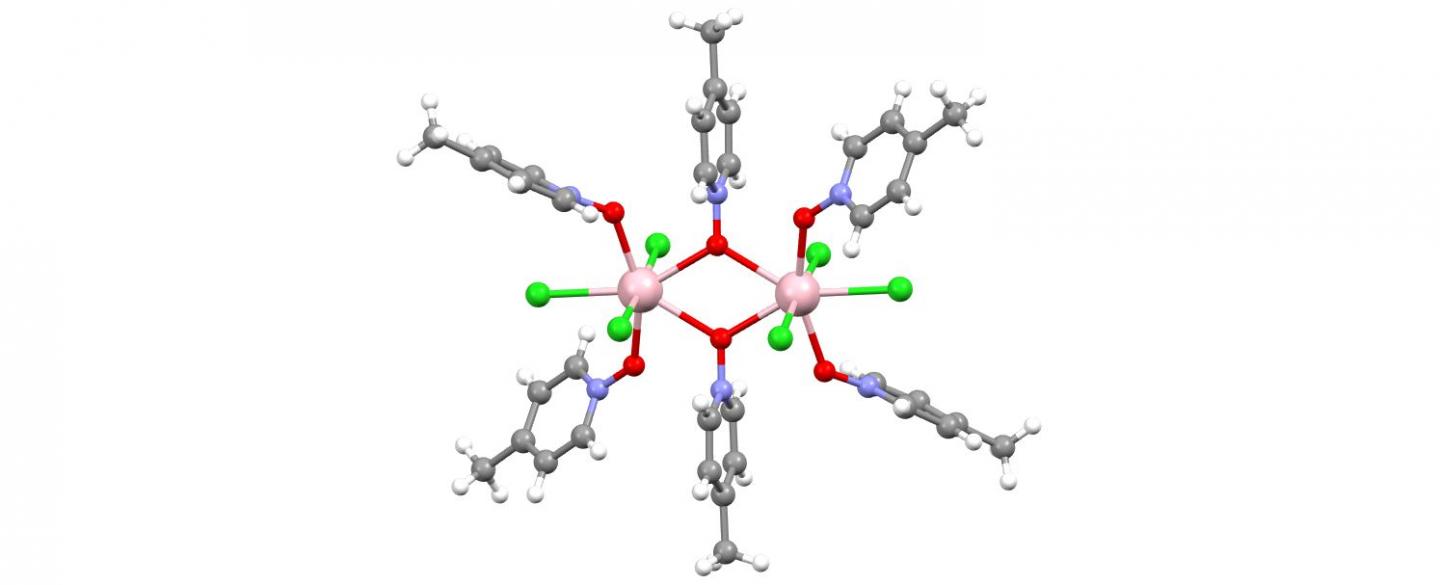
One single qubit, however, is not enough to build a quantum computer. Many qubits to be organized and addressed are required. Molecules represent ideal qubit systems as they can be arranged in sufficiently large numbers as identical scalable units and can be addressed with light to perform qubit operations. In addition, the physical properties of molecules, such as emission and/or magnetic properties, can be tailored by changing their structures using chemical design principles. In their paper now published in the journal Nature Communications, researchers led by Professor Mario Ruben at KIT’s IQMT and Strasbourg´s European Center for Quantum Sciences – CESQ and Dr. Philippe Goldner at École nationale supérieure de chimie de Paris (Chimie ParisTech/CNRS) present a nuclear-spin-containing dimeric europium(III) molecule as light-addressable qubit.
The molecule, which belongs to the rare earth metals, is designed to exhibit luminescence, i.e., a europium(III)-centered sensitized emission, when excited by ultraviolet light-absorbing ligands surrounding the center. After light absorption, the ligands transfer the light energy to the europium(III) center, thereby exciting it. Relaxation of the excited center to the ground state leads to light emission. The whole process is referred to as sensitized luminescence. Spectral hole burning – special experiments with lasers – detect the polarization of the nuclear spin levels, indicating the generation of a efficient light-nuclear spin interface. The latter enables the generation of light-addressable hyperfine qubits based on nuclear spin levels. “By demonstrating for the first time light-induced spin polarization in the europium(III) molecule, we have succeeded in taking a promising step towards the development of quantum computing architectures based on rare-earth ion-containing molecules,” explains Dr. Philippe Goldner. (or)
###
Original Paper (Open Access):
Kuppusamy Senthil Kumar, Diana Serrano, Aline M. Nonat, Benoît Heinrich, Lydia Karmazin, Loic J. Charbonnière, Philippe Goldner, Mario Ruben: Optical spin-state polarization in a binuclear europium complex towards molecule-based coherent light-spin interfaces. Nature Communications, 2021. DOI: 10.1038/s41467-021-22383-x.
https:/
Contact for This Press Release:
Margarete Lehné, Press Officer, Phone: +49 721 608-41157, Fax: +49 721 608-41157, [email protected]
Being “The Research University in the Helmholtz-Association”, KIT creates and imparts knowledge for the society and the environment. It is the objective to make significant contributions to the global challenges in the fields of energy, mobility and information. For this, about 9,600 employees cooperate in a broad range of disciplines in natural sciences, engineering sciences, economics, and the humanities and social sciences. KIT prepares its 23,300 students for responsible tasks in society, industry, and science by offering research-based study programs. Innovation efforts at KIT build a bridge between important scientific findings and their application for the benefit of society, economic prosperity, and the preservation of our natural basis of life. KIT is one of the German universities of excellence.
Media Contact
Monika Landgraf
[email protected]
Original Source
https:/
Related Journal Article
http://dx.