

• HOME
  • NEWS
  • EXPLORE
    • CAREER
      • Companies
      • Jobs
    • EVENTS
    • iGEM
      • News
      • Team
    • PHOTOS
    • VIDEO
    • WIKI
  • BLOG
  • COMMUNITY
    • FACEBOOK
    • INSTAGRAM
    • TWITTER
Wednesday, May 6, 2026
BIOENGINEER.ORG
No Result
View All Result
  • Login
  • HOME
  • NEWS
  • EXPLORE
    • CAREER
      • Companies
      • Jobs
        • Lecturer
        • PhD Studentship
        • Postdoc
        • Research Assistant
    • EVENTS
    • iGEM
      • News
      • Team
    • PHOTOS
    • VIDEO
    • WIKI
  • BLOG
  • COMMUNITY
    • FACEBOOK
    • INSTAGRAM
    • TWITTER
  • HOME
  • NEWS
  • EXPLORE
    • CAREER
      • Companies
      • Jobs
        • Lecturer
        • PhD Studentship
        • Postdoc
        • Research Assistant
    • EVENTS
    • iGEM
      • News
      • Team
    • PHOTOS
    • VIDEO
    • WIKI
  • BLOG
  • COMMUNITY
    • FACEBOOK
    • INSTAGRAM
    • TWITTER
No Result
View All Result
Bioengineer.org
No Result
View All Result
Home NEWS Science News Chemistry

A mirror tracks a tiny particle

Bioengineer by Bioengineer
June 29, 2022
in Chemistry
Reading Time: 2 mins read
0
Ion trap
Share on FacebookShare on TwitterShare on LinkedinShare on RedditShare on Telegram

Levitated nanoparticles are promising tools for sensing ultra-weak forces of biological, chemical or mechanical origin and even for testing the foundations of quantum physics. However, such applications require precise position measurement. Researchers at the Department of Experimental Physics of the University of Innsbruck, Austria, have now demonstrated a new technique that boosts the efficiency with which the position of a sub-micron levitated object is detected. “Typically, we measure a nanoparticle’s position with a technique called optical interferometry, in which part of the light emitted by a nanoparticle is compared with the light from a reference laser”, says Lorenzo Dania, a PhD student in Tracy Northup’s research group. “A laser beam, however, has a much different shape than the light pattern emitted by a nanoparticle, known as dipole radiation.” That shape difference currently limits the measurement precision.
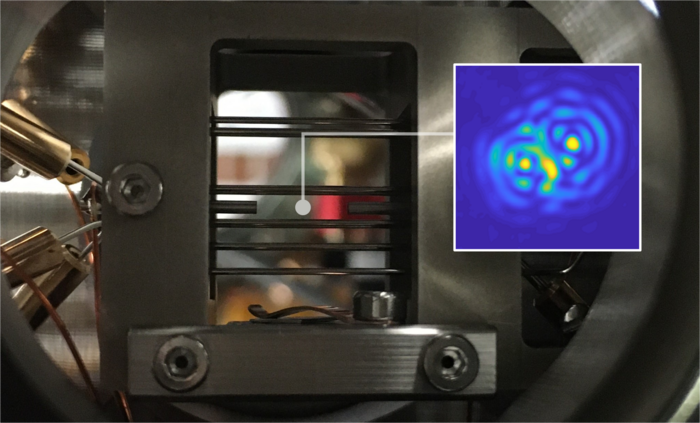
Ion trap

Credit: Quantum Interface Group, University of Innsbruck

Levitated nanoparticles are promising tools for sensing ultra-weak forces of biological, chemical or mechanical origin and even for testing the foundations of quantum physics. However, such applications require precise position measurement. Researchers at the Department of Experimental Physics of the University of Innsbruck, Austria, have now demonstrated a new technique that boosts the efficiency with which the position of a sub-micron levitated object is detected. “Typically, we measure a nanoparticle’s position with a technique called optical interferometry, in which part of the light emitted by a nanoparticle is compared with the light from a reference laser”, says Lorenzo Dania, a PhD student in Tracy Northup’s research group. “A laser beam, however, has a much different shape than the light pattern emitted by a nanoparticle, known as dipole radiation.” That shape difference currently limits the measurement precision.

Self-interference method

The new technique demonstrated by Tracy Northup, a professor at the University of Innsbruck, and her team resolves this limitation by replacing the laser beam with the light of the particle reflected by a mirror. The technique builds on a method to track barium ions that has been developed in recent years by Rainer Blatt, also of the University of Innsbruck, and his team. Last year, researchers from the two teams proposed to extend this method to nanoparticles. Now, using a nanoparticle levitated in an electromagnetic trap, the researchers showed that this method outperformed other state-of-the-art detection techniques. The result opens up new possibilities for using levitated particles as sensors — for example, to measure tiny forces — and for bringing the particles’ motion into realms described by quantum mechanics.

Financial support for the research was provided, among others, by the European Union as well as by the Austrian Science Fund FWF, the Austrian Academy of Sciences and the Austrian Federal Ministry of Education, Science and Research.


Journal

Physical Review Letters

DOI

10.1103/PhysRevLett.129.013601

Method of Research

Experimental study

Article Title

Position Measurement of a Levitated Nanoparticle via Interference with Its Mirror Image

Article Publication Date

28-Jun-2022

Share12Tweet8Share2ShareShareShare2

Related Posts

Sunspot Peaks Speed Up Space Junk Reentry, Aiding Satellite Collision Prevention

May 6, 2026
OpenBind’s Inaugural Data and Model Release Sets a New Benchmark in AI-Driven Drug Discovery — Chemistry

OpenBind’s Inaugural Data and Model Release Sets a New Benchmark in AI-Driven Drug Discovery

May 6, 2026

Step Aside Cassette Tapes, Adhesive Tape Holds Memory Too

May 5, 2026

Astronomers Trace the Origins of a Peculiar Planetary Pair

May 5, 2026

POPULAR NEWS

  • Research Indicates Potential Connection Between Prenatal Medication Exposure and Elevated Autism Risk

    836 shares
    Share 334 Tweet 209
  • New Study Reveals Plants Can Detect the Sound of Rain

    721 shares
    Share 288 Tweet 180
  • Scientists Investigate Possible Connection Between COVID-19 and Increased Lung Cancer Risk

    68 shares
    Share 27 Tweet 17
  • Salmonella Haem Blocks Macrophages, Boosts Infection

    61 shares
    Share 24 Tweet 15

About

We bring you the latest biotechnology news from best research centers and universities around the world. Check our website.

Follow us

Recent News

Diffusion Models Revolutionize Dynamic Power System Parameter Estimation

Two Keck Medicine of USC Hospitals Achieve ‘A’ Grade Again in Leapfrog Hospital Safety Rankings

Sunspot Peaks Speed Up Space Junk Reentry, Aiding Satellite Collision Prevention

Subscribe to Blog via Email

Success! An email was just sent to confirm your subscription. Please find the email now and click 'Confirm' to start subscribing.

Join 82 other subscribers
  • Contact Us

Bioengineer.org © Copyright 2023 All Rights Reserved.

Welcome Back!

Login to your account below

Forgotten Password?

Retrieve your password

Please enter your username or email address to reset your password.

Log In
No Result
View All Result
  • Homepages
    • Home Page 1
    • Home Page 2
  • News
  • National
  • Business
  • Health
  • Lifestyle
  • Science

Bioengineer.org © Copyright 2023 All Rights Reserved.