In the continuously evolving arena of space exploration and satellite deployment, managing the ever-growing cloud of debris encircling our planet has become a critical challenge. Recent research has illuminated a nuanced yet significant factor influencing the orbital decay of space junk—solar activity, particularly its cyclical peaks and troughs, plays a profound role in altering the lifespan and trajectory of debris in low Earth orbit (LEO). This groundbreaking insight not only reshapes our understanding of space environment dynamics but also has profound implications for satellite mission planning and the future management of orbital congestion.
Low Earth orbit, spanning altitudes roughly between 400 and 2,000 kilometers above Earth’s surface, serves as a bustling highway for imaging satellites, surveillance instruments, and burgeoning internet mega-constellations such as Starlink. However, this zone is increasingly clouded with defunct satellites, spent rocket stages, and fragmented debris—collectively known as space junk. These remnants of human activity in space pose a severe collision risk, one that could escalate in a perilous domino effect, jeopardizing operational satellites and new launches alike. Mitigating these risks requires innovative approaches, often combining enhanced debris tracking with long-term sustainable orbital strategies.
A collaborative study emerging from the Space Physics Laboratory at the Vikram Sarabhai Space Centre in Thiruvananthapuram, India, headed by scientist Ayisha M Ashruf, has shed new light on the relationship between solar activity and the orbital degradation of LEO debris. Published in the esteemed journal Frontiers in Astronomy and Space Sciences, the research employs extensive data analysis spanning over three decades to decode how fluctuations in solar emissions directly influence the decay rates of satellites and debris encircling Earth.
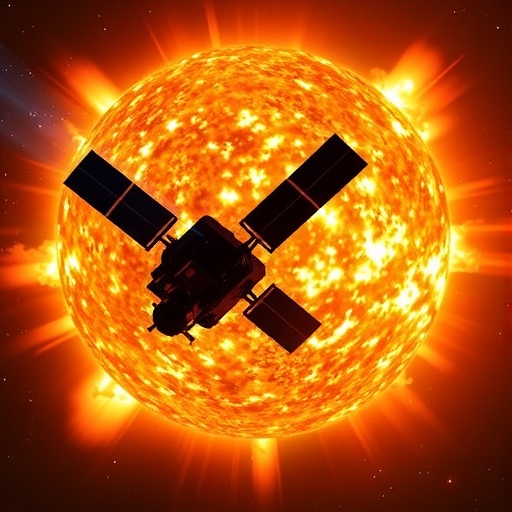
The Sun operates on an approximately 11-year cycle marked by alternating periods of heightened and diminished activity, which scientists measure by tracking the presence and intensity of sunspots visible on the solar surface. These sunspots correspond to fluctuations in solar emissions of ultraviolet (UV) radiation and charged particles, including helium nuclei and heavier ions. When solar activity peaks—such as the noticeable spike projected in late 2024—the increased emission of extreme ultraviolet (EUV) radiation heats and expands Earth’s thermosphere, a layer of the atmosphere extending roughly from 100 to 1,000 kilometers above the surface, with temperatures soaring between 500 and 2,500 degrees Celsius.
This thermospheric expansion translates into a higher atmospheric density at altitudes occupied by satellites and debris, thereby increasing aerodynamic drag on these orbiting objects. As a result, these objects experience gradual slowing, leading to orbital decay that accelerates with increasing atmospheric resistance. The intricate interplay between solar emissions and atmospheric behavior means that once a certain threshold of solar activity is surpassed, space junk plunges earthward at a much more rapid pace.
To uncover these dynamics, Ashruf and her team analyzed the orbital trajectories of 17 space debris objects in the LEO region, measuring their altitude loss over the last 36 years, covering solar cycles 22 through 24. These objects, launched in the 1960s and still orbiting at altitudes between 600 and 800 kilometers, provided an invaluable dataset because unlike operational satellites, they perform no station-keeping maneuvers and thus reflect the pure effects of atmospheric drag on orbital decay.
The research leverages detailed solar data from the German Research Centre for Geosciences in Potsdam, encompassing sunspot counts, solar radio flux, and EUV emission measurements. By correlating debris altitude data with these solar metrics, the study uncovers a compelling pattern: when solar activity reaches approximately two-thirds of its peak sunspot numbers, space debris crosses a “transition boundary.” Beyond this threshold, the rate of altitude loss increases dramatically, suggesting a nonlinear response of the thermosphere to intensifying solar emissions.
Intriguingly, this transition boundary does not appear linked to a fixed absolute value of solar radiation but rather aligns with the relative proximity of the Sun’s activity cycle to its maximum phase. This finding suggests that underlying solar processes, possibly related to the complex magnetic interactions driving EUV output, escalate disproportionately near the solar maximum, amplifying their effect on Earth’s upper atmosphere.
Understanding these solar-driven changes holds profound practical significance. Satellites, much like inert debris, contend with enhanced drag during solar maxima, necessitating additional orbital corrections to maintain operational altitudes. This increased demand not only shortens satellite lifetimes but also inflates fuel consumption, thus raising mission costs and complicating planning for future satellite constellations. For space agencies and commercial operators alike, incorporating solar cycle predictions into orbital management strategies will be essential to avoid collisions and extend satellite functionality.
Beyond predicting altitude decay, the methodology applied by Ashruf’s team positions space debris as inadvertent yet invaluable probes for gauging the long-term effects of solar activity on the upper atmosphere. These relics of past space missions, launched over half a century ago, continue to contribute scientific data critical to refining models of thermospheric behavior and solar-terrestrial interactions, highlighting a novel synergy between space debris monitoring and atmospheric science.
As global reliance on satellite infrastructure deepens—impacting communications, navigation, Earth observation, and scientific research—the imperative to secure and sustainably manage orbital environments intensifies. This research underscores the urgency of enhancing debris tracking precision and integrating solar activity prognostics into operational frameworks, ensuring safer space utilization amidst escalating commercial and governmental deployment.
Looking forward, advancements in space debris removal technologies remain necessary, but their development is nascent and complex. Meanwhile, comprehensive observation and predictive modeling, as exemplified by this study, provide immediate tools for mitigating collision risks. Collaboration across international agencies, alongside private sector engagement, will be pivotal in operationalizing these insights into tangible air traffic management for space.
Ultimately, the intersection of solar physics and orbital mechanics revealed in this study enriches our understanding of how extraterrestrial forces govern human-made objects in space. By harnessing these insights, the space community can better safeguard the increasingly crowded corridors around Earth, enabling a sustainable future for satellite operations and preserving the near-Earth environment for generations to come.
Subject of Research: Not applicable
Article Title: Characterizing Solar Cycle Influence on Long-Term Orbital Deterioration of Low-Earth Orbiting Space Debris
News Publication Date: 6-May-2026
Web References: https://www.frontiersin.org/journals/astronomy-and-space-sciences/articles/10.3389/fspas.2026.1797886/full
References: DOI: 10.3389/fspas.2026.1797886
Keywords
Space debris, Low Earth orbit, Solar cycle, Orbital decay, Thermosphere, Solar activity, Sunspots, Extreme Ultraviolet radiation, Atmospheric drag, Satellite orbital management, Space sustainability, Space traffic safety