Toward a highly stable air-insensitive aqueous organic flow battery
Credit: ©Science China Press
With the development of society, energy demand increases. A series of problems caused by the excessive use of fossil fuel requires clean renewable energy for sustainable development. However, the intermittent and random nature of renewable energy generation such as wind and solar power brings challenges to the safe and stable operation of the power grid. As a key technology for the wide application of renewable energy, large-scale energy storage technology can effectively solve the above problems. Flow batteries are one of the most promising large-scale energy storage technologies due to their attractive features of high safety, high efficiency and long cycle life. The vanadium flow battery (VFB) is one of the mature technologies and now at the stage of commercial demonstration. Nonetheless, their further development is restricted by the relatively high cost and low energy density. Therefore, the investigation of novel flow battery systems with high energy density and low cost is essential to the sustainable development of flow batteries. Recently, fast-growing interests in organic redox-active materials are found due to their advantages of resource sustainability, potentially low cost, and chemical tunability.
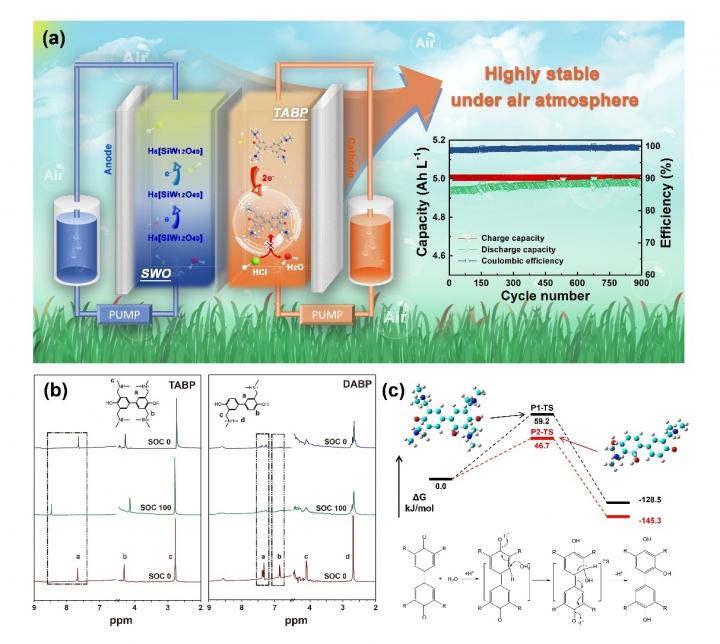
Various organic flow batteries based on quinone, ferrocene, TEMPO (2,2,6,6-tetramethyl-1-piperidinyloxy), viologen, phenazine, phenothiazine have been investigated by the structural design over the past decades. Up to now, most of the organic molecules show low redox potential and therefore have been explored as anodes. Only a few molecules display relatively high potential and can be used as cathodes. However, most of them show poor chemical and electrochemical stability. Therefore, the existing organic flow battery systems can normally be operated stably under an N2 or Ar atmosphere. Recently, researchers from the Dalian Institute of Chemical Physics reported an air-insensitive low-cost biphenol derivative (3,3′,5,5′-tetramethylaminemethylene-4,4′-biphenol (TABP)) cathode with high potential and solubility. The TABP is prepared via a simple one-step method. Paring with silicotungstic acid (SWO), an SWO/TABP flow battery shows a stable cycling performance of zero capacity decay over 900 cycles under the air atmosphere. Further, an SWO/TABP flow battery demonstrates a high rate performance with an energy efficiency of 85% and 73% at 60 and 120 mA cm-2, respectively. Also, a high practical discharge capacity of more than 47 Ah L-1 based on the 1 mol L-1 catholyte can be achieved. NMR tests and DFT calculations confirm that the biphenol structure of the TABP molecule has excellent oxidation resistance by a larger ?-conjugated structure, and the four tertiary ammonium functional groups of TABP greatly improve the stability of the TABP by inhibiting the Michael addition reaction.
Fig. 1(a) is a schematic representation of the SWO/TABP flow battery and its cycling test under the air atmosphere at a current density of 40 mA cm-2. The battery shows zero capacity fade after continuously running for 900 cycles. To investigate the role of four substituted tertiary ammonium groups, the biphenol derivative with two substituted tertiary ammonium groups, 3,3′-dimethylaminemethylene-4,4′-biphenol (DABP), is synthesized for comparison. Fig. 1(b) shows 1H NMR spectra of TABP and DABP catholytes at different state of charges (SOCs). Comparing the spectra before and after the charge and discharge process, all peak positions show no change and no new peaks are generated, indicating the high reversibility of the charge and discharge process. In contrast, the NMR spectra of catholyte from DABP at different SOCs show obvious changes due to the irreversible side reactions. By DFT calculation, they calculated the potential energy surfaces of the Michael addition reaction of two biphenol derivatives, as shown in Fig. 1(c). The activation energy of TABP is much higher than DABP, which indicates the reaction between TABP and H2O is more difficult. The DFT results are consistent with the experimental results.
To further confirm the stability of the biphenol structure in the air, the air-stability test is performed and benzoquinone with four substituted tetra-tertiary ammonium (2,3,5,6-tetrakis((dimethylamino)methyl)hydroquinone (TABQ)) is synthesized for comparison. By comparing the stability of TABP and TABQ in the air, they found that TABQ is easily oxidized in the air, while TABP with a biphenol structure remains unchanged after standing in the air for more than 20 days.
The above results show that TABP with high solubility, potential and stability is a promising anode for the application of aqueous organic flow battery. This paper confirms the possibility of an organic-based flow battery for real practical application and offers new opportunities to develop low-cost and high-performance flow batteries that promise sustainable and green large-scale energy storage technologies. More details can be found in the reference articles as below.
###
See the article:
Wanqiu Liu, Ziming Zhao, Tianyu Li, Shenghai Li, Huamin Zhang, Xianfeng Li. A high potential biphenol derivative cathode: toward a highly stable air-insensitive aqueous organic flow battery. Science Bulletin, 2020, doi: 10.1016/j.scib.2020.08.042
https:/
Media Contact
Xianfeng Li
[email protected]
Related Journal Article
http://dx.