• HOME
  • NEWS
  • EXPLORE
    • CAREER
      • Companies
      • Jobs
    • EVENTS
    • iGEM
      • News
      • Team
    • PHOTOS
    • VIDEO
    • WIKI
  • BLOG
  • COMMUNITY
    • FACEBOOK
    • INSTAGRAM
    • TWITTER
Sunday, February 8, 2026
BIOENGINEER.ORG
No Result
View All Result
  • Login
  • HOME
  • NEWS
  • EXPLORE
    • CAREER
      • Companies
      • Jobs
        • Lecturer
        • PhD Studentship
        • Postdoc
        • Research Assistant
    • EVENTS
    • iGEM
      • News
      • Team
    • PHOTOS
    • VIDEO
    • WIKI
  • BLOG
  • COMMUNITY
    • FACEBOOK
    • INSTAGRAM
    • TWITTER
  • HOME
  • NEWS
  • EXPLORE
    • CAREER
      • Companies
      • Jobs
        • Lecturer
        • PhD Studentship
        • Postdoc
        • Research Assistant
    • EVENTS
    • iGEM
      • News
      • Team
    • PHOTOS
    • VIDEO
    • WIKI
  • BLOG
  • COMMUNITY
    • FACEBOOK
    • INSTAGRAM
    • TWITTER
No Result
View All Result
Bioengineer.org
No Result
View All Result
Home NEWS Science News Chemistry

A ‘greener’ alternative for red-colored smoke

Bioengineer by Bioengineer
April 19, 2022
in Chemistry
Reading Time: 2 mins read
0
A ‘greener’ alternative for red-colored smoke
Share on FacebookShare on TwitterShare on LinkedinShare on RedditShare on Telegram

The red smoke of a flare on a roadway warns motorists to be cautious, but the anthraquinone dyes currently used to produce this smoke are thought to be harmful to human health. Now, researchers reporting in ACS Sustainable Chemistry & Engineering have identified a less toxic, “greener” alternative — an organic dye called pigment red 254 (PR254). It also forms a red-colored smoke cloud more effectively than current dyes, the researchers say.
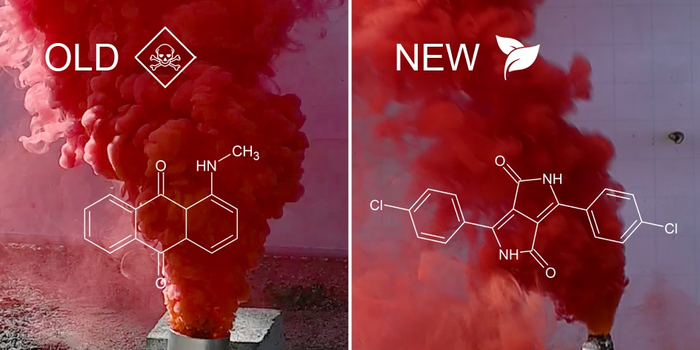
A ‘greener’ alternative for red-colored smoke

Credit: Adapted from ACS Sustainable Chemistry & Engineering 2022, DOI: 10.1021/acssuschemeng.2c01000

The red smoke of a flare on a roadway warns motorists to be cautious, but the anthraquinone dyes currently used to produce this smoke are thought to be harmful to human health. Now, researchers reporting in ACS Sustainable Chemistry & Engineering have identified a less toxic, “greener” alternative — an organic dye called pigment red 254 (PR254). It also forms a red-colored smoke cloud more effectively than current dyes, the researchers say.

Commercialized in 1986, diketopyrrolopyrrole (DPP) dyes are used as colorants in car paints (such as the famous “Ferrari red”), optics technologies and other applications. For the purpose of signal smokes, Vojtech Pelikan and colleagues chose the DPP dye PR254, which has a brilliant red color and is less toxic than anthraquinone dyes. In experiments, the researchers showed that a PR254-containing pyrotechnic composition reached a yield of red-colored smoke of 51%, compared with only 48% for the usual anthraquinone dye. PR254 was also more thermally stable than the reference dye, which might allow it to be used in a less toxic heat-generating system, according to the researchers.

The authors acknowledge funding from the University of Pardubice.

The American Chemical Society (ACS) is a nonprofit organization chartered by the U.S. Congress. ACS’ mission is to advance the broader chemistry enterprise and its practitioners for the benefit of Earth and all its people. The Society is a global leader in promoting excellence in science education and providing access to chemistry-related information and research through its multiple research solutions, peer-reviewed journals, scientific conferences, eBooks and weekly news periodical Chemical & Engineering News. ACS journals are among the most cited, most trusted and most read within the scientific literature; however, ACS itself does not conduct chemical research. As a leader in scientific information solutions, its CAS division partners with global innovators to accelerate breakthroughs by curating, connecting and analyzing the world’s scientific knowledge. ACS’ main offices are in Washington, D.C., and Columbus, Ohio.

To automatically receive news releases from the American Chemical Society, contact
[email protected].

Follow us: Twitter | Facebook | LinkedIn | Instagram


Journal

ACS Sustainable Chemistry & Engineering

DOI

10.1021/acssuschemeng.2c01000

Article Title

Diketopyrrolopyrrole — A Greener Alternative for Pyrotechnic Smoke Compositions”

Article Publication Date

30-Mar-2022

Share12Tweet8Share2ShareShareShare2

Related Posts

blank

Breakthrough in Environmental Cleanup: Scientists Develop Solar-Activated Biochar for Faster Remediation

February 7, 2026
blank

Cutting Costs: Making Hydrogen Fuel Cells More Affordable

February 6, 2026

Scientists Develop Hand-Held “Levitating” Time Crystals

February 6, 2026

Observing a Key Green-Energy Catalyst Dissolve Atom by Atom

February 6, 2026

POPULAR NEWS

  • Robotic Ureteral Reconstruction: A Novel Approach

    Robotic Ureteral Reconstruction: A Novel Approach

    82 shares
    Share 33 Tweet 21
  • Digital Privacy: Health Data Control in Incarceration

    63 shares
    Share 25 Tweet 16
  • Breakthrough in RNA Research Accelerates Medical Innovations Timeline

    53 shares
    Share 21 Tweet 13
  • Mapping Tertiary Lymphoid Structures for Kidney Cancer Biomarkers

    50 shares
    Share 20 Tweet 13

About

We bring you the latest biotechnology news from best research centers and universities around the world. Check our website.

Follow us

Recent News

Evaluating a Self-Care App for Chest Trauma Patients

Anesthesia Method’s Impact on Elderly Hip Fracture Recovery

Menopause Care: Insights from Workforce Review and Consultation

Subscribe to Blog via Email

Enter your email address to subscribe to this blog and receive notifications of new posts by email.

Join 73 other subscribers
  • Contact Us

Bioengineer.org © Copyright 2023 All Rights Reserved.

Welcome Back!

Login to your account below

Forgotten Password?

Retrieve your password

Please enter your username or email address to reset your password.

Log In
No Result
View All Result
  • Homepages
    • Home Page 1
    • Home Page 2
  • News
  • National
  • Business
  • Health
  • Lifestyle
  • Science

Bioengineer.org © Copyright 2023 All Rights Reserved.