• HOME
  • NEWS
  • EXPLORE
    • CAREER
      • Companies
      • Jobs
    • EVENTS
    • iGEM
      • News
      • Team
    • PHOTOS
    • VIDEO
    • WIKI
  • BLOG
  • COMMUNITY
    • FACEBOOK
    • INSTAGRAM
    • TWITTER
Wednesday, May 20, 2026
BIOENGINEER.ORG
No Result
View All Result
  • Login
  • HOME
  • NEWS
  • EXPLORE
    • CAREER
      • Companies
      • Jobs
        • Lecturer
        • PhD Studentship
        • Postdoc
        • Research Assistant
    • EVENTS
    • iGEM
      • News
      • Team
    • PHOTOS
    • VIDEO
    • WIKI
  • BLOG
  • COMMUNITY
    • FACEBOOK
    • INSTAGRAM
    • TWITTER
  • HOME
  • NEWS
  • EXPLORE
    • CAREER
      • Companies
      • Jobs
        • Lecturer
        • PhD Studentship
        • Postdoc
        • Research Assistant
    • EVENTS
    • iGEM
      • News
      • Team
    • PHOTOS
    • VIDEO
    • WIKI
  • BLOG
  • COMMUNITY
    • FACEBOOK
    • INSTAGRAM
    • TWITTER
No Result
View All Result
Bioengineer.org
No Result
View All Result
Home NEWS Science News Chemistry

A fast and inexpensive device to capture and identify viruses

Bioengineer by Bioengineer
December 23, 2019
in Chemistry
Reading Time: 2 mins read
0
IMAGE
Share on FacebookShare on TwitterShare on LinkedinShare on RedditShare on Telegram

IMAGE

Credit: Terrones Lab/Penn State


A device to quickly capture and identify various strains of virus has been developed, according to researchers at Penn State and New York University.

Currently, virologists estimate that 1.67 million unknown viruses are in animals, a number of which can be transmitted to humans. Known viruses, such as H5N1, Zika and Ebola have caused widespread illness and death. The World Health Organization states that early detection can halt virus spread by enabling rapid deployment of countermeasures.

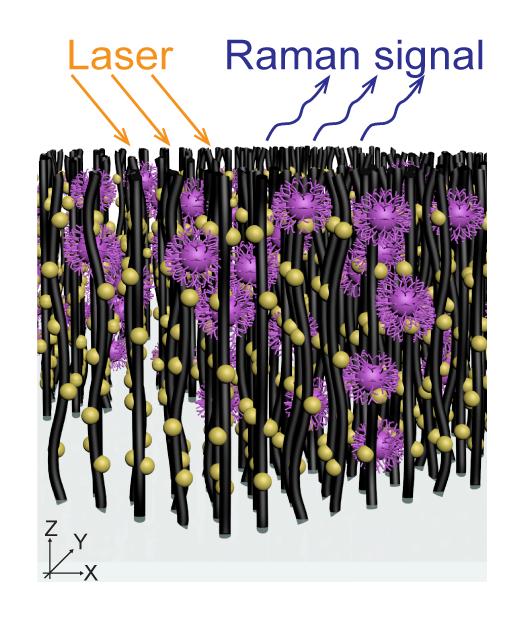
“We have developed a fast and inexpensive handheld device that can capture viruses based on size,” said Mauricio Terrones, distinguished professor of physics, chemistry, and materials science and engineering at Penn State. “Our device uses arrays of nanotubes engineered to be comparable in size to a wide range of viruses. We then use Raman spectroscopy to identify the viruses based on their individual vibration.”

This device, called a VIRRION, has a wide range of possible uses. For farmers, for example, early detection of a virus in the field can save an entire crop. Early detection of a virus in livestock can save a herd from illness. Humans also will benefit by the detection of viruses in minutes rather than in days with current methods. Because of its size and low cost, such a device would be useful in every doctor’s office as well as in remote locations when disease outbreaks occur.

“Most current techniques require large and expensive pieces of equipment,” Terrones said. “The VIRRION is a few centimeters across. We add gold nanoparticles to enhance the Raman signal so that we are able to detect the virus molecule in very low concentrations. We then use machine learning techniques to create a library of virus types.”

According to Professor Elodie Ghedin, a virologist at NYU, “The VIRRION enables the rapid enrichment of virus particles from any type of sample — environmental or clinical — which jump-starts viral characterization. This has applications in virus emergence, virus discovery and in diagnosis. Eventually, we hope to use this device for the capture and sequencing of single virions, giving us a much better handle on the evolution of the virus in real time.”

Added lead author Ying-Ting Yeh, an assistant research professor in the Terrones group, “We synthesized a gradient of aligned carbon nanotube forest arrays to capture different viruses according to their size and detect them in-situ using Raman spectroscopy. We designed and assembled a portable platform that enriches virus particles from several milliliters of clinical samples in a couple of minutes.”

###

The work is published today (Dec. 23) in Proceedings of the National Academy of Sciences. Titled “A rapid and label-free platform for virus capture and identification from clinical samples,” the paper’s co-authors are Ying-Ting Yeh, an assistant research professor in Terrones’ group; Kristen Gulino, Tsui-Wen Chou and Bin Zhou, all of NYU; and YuHe Zhang, Aswathy Sabestien, Zhong Lin, Istvan Albert, Huaguang Lu and Venkataranman Swaminathan, all of Penn State.

The National Science Foundation Growing Convergence Research Big Idea, the Thrasher Research Fund, an Infectious Disease Research Exchanges Grant from Princeton University and the startup fund from Penn State supported this work.

Media Contact
A’ndrea Elyse Messer
[email protected]
814-865-5689

Tags: Chemistry/Physics/Materials SciencesInfectious/Emerging DiseasesMaterialsMechanical EngineeringVirology
Share12Tweet8Share2ShareShareShare2

Related Posts

Advancing In Vivo and In Situ Monitoring: Science Bulletin Highlights Host-Based Antifouling Gold Nanotube Sensor for Selective Detection of Mechanically Sensitive Serotonin Release in Intestinal Mucosa — Chemistry

Advancing In Vivo and In Situ Monitoring: Science Bulletin Highlights Host-Based Antifouling Gold Nanotube Sensor for Selective Detection of Mechanically Sensitive Serotonin Release in Intestinal Mucosa

May 20, 2026
How Magnetic Orientation Could Influence the Building Blocks of Life — Chemistry

How Magnetic Orientation Could Influence the Building Blocks of Life

May 20, 2026

Breaking a 200-Year-Old Belief: Novel Surface Design Achieves Two Distinct Wetting States on One Substrate

May 20, 2026

Unveiling Sound Waves: Scientists Discover Hidden Behaviors in Acoustic Phenomena

May 20, 2026
Please login to join discussion

POPULAR NEWS

  • blank

    New Study Reveals Plants Can Detect the Sound of Rain

    733 shares
    Share 292 Tweet 183
  • Research Indicates Potential Connection Between Prenatal Medication Exposure and Elevated Autism Risk

    846 shares
    Share 338 Tweet 212
  • ESMO 2025: mRNA COVID Vaccines Enhance Efficacy of Cancer Immunotherapy

    298 shares
    Share 119 Tweet 75
  • Breastmilk Balances E. coli and Beneficial Bacteria in Infant Gut Microbiomes

    58 shares
    Share 23 Tweet 15

About

We bring you the latest biotechnology news from best research centers and universities around the world. Check our website.

Follow us

Recent News

CCHFV GP38 and GP85 Bind Cell-Surface Glycosaminoglycans

Machine Learning Reveals Drivers of Elderly Care Use

Detecting DSCP Traffic Manipulation and Network Impact

Subscribe to Blog via Email

Enter your email address to subscribe to this blog and receive notifications of new posts by email.

Join 82 other subscribers
  • Contact Us

Bioengineer.org © Copyright 2023 All Rights Reserved.

Welcome Back!

Login to your account below

Forgotten Password?

Retrieve your password

Please enter your username or email address to reset your password.

Log In
No Result
View All Result
  • Homepages
    • Home Page 1
    • Home Page 2
  • News
  • National
  • Business
  • Health
  • Lifestyle
  • Science

Bioengineer.org © Copyright 2023 All Rights Reserved.