• HOME
  • NEWS
  • EXPLORE
    • CAREER
      • Companies
      • Jobs
    • EVENTS
    • iGEM
      • News
      • Team
    • PHOTOS
    • VIDEO
    • WIKI
  • BLOG
  • COMMUNITY
    • FACEBOOK
    • INSTAGRAM
    • TWITTER
Thursday, May 28, 2026
BIOENGINEER.ORG
No Result
View All Result
  • Login
  • HOME
  • NEWS
  • EXPLORE
    • CAREER
      • Companies
      • Jobs
        • Lecturer
        • PhD Studentship
        • Postdoc
        • Research Assistant
    • EVENTS
    • iGEM
      • News
      • Team
    • PHOTOS
    • VIDEO
    • WIKI
  • BLOG
  • COMMUNITY
    • FACEBOOK
    • INSTAGRAM
    • TWITTER
  • HOME
  • NEWS
  • EXPLORE
    • CAREER
      • Companies
      • Jobs
        • Lecturer
        • PhD Studentship
        • Postdoc
        • Research Assistant
    • EVENTS
    • iGEM
      • News
      • Team
    • PHOTOS
    • VIDEO
    • WIKI
  • BLOG
  • COMMUNITY
    • FACEBOOK
    • INSTAGRAM
    • TWITTER
No Result
View All Result
Bioengineer.org
No Result
View All Result
Home NEWS Science News Biology

A fashionable chemical and biological threat detector-on-a-ring

Bioengineer by Bioengineer
October 11, 2017
in Biology
Reading Time: 2 mins read
0
Share on FacebookShare on TwitterShare on LinkedinShare on RedditShare on Telegram
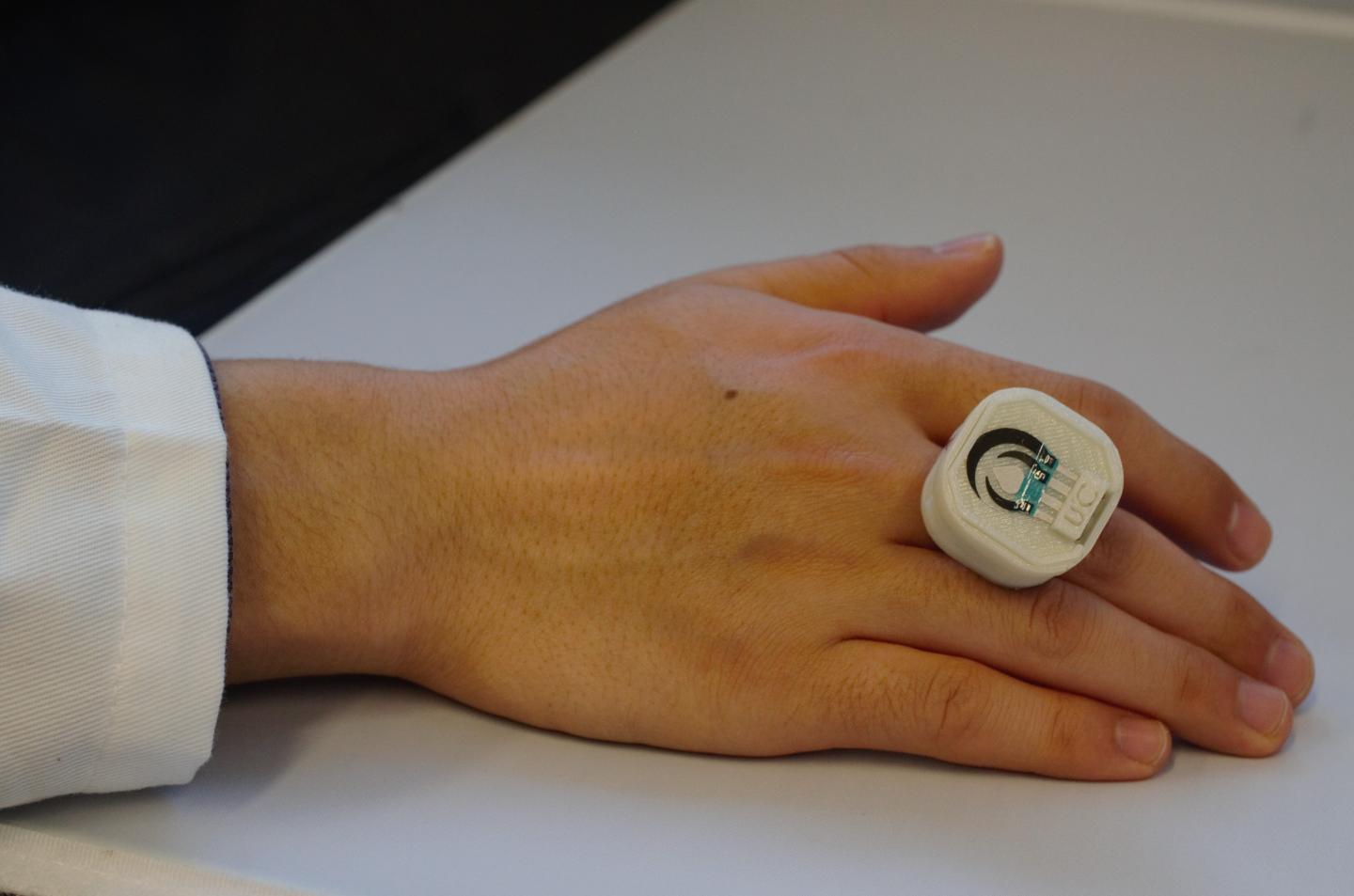
IMAGE

Credit: American Chemical Society

Wearable sensors are revolutionizing the tech-world, capable of tracking processes in the body, such as heart rates. They're even becoming fashionable, with many of them sporting sleek, stylish designs. But wearable sensors also can have applications in detecting threats that are external to the body. Researchers now report in ACS Sensors a first-of-its kind device that can do just that. And to stay fashionable, they've designed it as a ring.

According to a global analyst firm called CCS Insight, wearable electronics will be a $34 billion industry by 2020. Wearable chemical sensors currently in development include those made in the form of tattoos, mouth guards, wristbands and headbands, but all of these types of sensors face challenges. For example, a sweat sensor worn on an arm could be useful, but patients would need to produce enough sweat for the device to be successful. There is a demand for sensors that are compact, affordable, noninvasive and can be incorporated into everyday life. But more advanced sensors can be costly and difficult to produce. Joseph Wang and colleagues at the University of California, San Diego wanted to develop a portable, affordable, wearable sensor that would detect external chemical threats.

The team designed their sensor as a ring that can be worn on a finger. The ring has two parts, an electrochemical sensor cap for detecting chemical and biological threats, and a circuit board under the cap for processing and sending data wirelessly to a smartphone or laptop. It can perform voltammetric and chronoamperometric measurements, which allow the ring to detect a wide array of chemical threats. The team exposed the prototype to explosives and organophosphate nerve agents, both in vapor and liquid phases. The ring was highly selective and sensitive. Although this ring-based sensor was designed to detect explosives and organophosphate nerve agents, the researchers say the device could be expanded to other hazardous environmental or security agents.

###

The authors acknowledge funding from the Defense Threat Reduction Agency Joint Science and Technology Office for Chemical and Biological Defense.

The full text of this ACS Editors' Choice paper will be available on Oct. 11 at 8 a.m. Eastern time here: http://pubs.acs.org/doi/abs/10.1021/acssensors.7b00603

The American Chemical Society is a not-for-profit organization chartered by the U.S. Congress. ACS is the world's largest scientific society and a global leader in providing access to chemistry-related research through its multiple databases, peer-reviewed journals and scientific conferences. ACS does not conduct research, but publishes and publicizes peer-reviewed scientific studies. Its main offices are in Washington, D.C., and Columbus, Ohio.

To automatically receive news releases from the American Chemical Society, contact [email protected].

Follow us: Twitter | Facebook

Media Contact

Katie Cottingham
[email protected]
301-775-8455
@ACSpressroom

http://www.acs.org

Share12Tweet8Share2ShareShareShare2

Related Posts

Early Lipid Metabolic Remodeling Drives Function at the Human Maternal-Embryo Interface — Biology

Early Lipid Metabolic Remodeling Drives Function at the Human Maternal-Embryo Interface

May 28, 2026
Plants Demonstrate Exceptional Resilience to Protein Translation Errors — Biology

Plants Demonstrate Exceptional Resilience to Protein Translation Errors

May 28, 2026

Long-Term Study Finds Plant-Forward, Low-Insulinemic Diets May Curb Weight Gain and Obesity Risk During Menopause

May 28, 2026

The Heart’s ‘Natural Bypass’: A Potential Alternative to Risky Procedures

May 28, 2026
Please login to join discussion

POPULAR NEWS

  • ESMO 2025: mRNA COVID Vaccines Enhance Efficacy of Cancer Immunotherapy

    318 shares
    Share 127 Tweet 80
  • Multi-Hospital Study Reveals Long Covid Burden Is Twice as High as Current Estimates

    70 shares
    Share 28 Tweet 18
  • New Study Reveals Plants Can Detect the Sound of Rain

    735 shares
    Share 293 Tweet 183
  • Common Food Preservatives Associated with Elevated Blood Pressure and Increased Heart Disease Risk

    56 shares
    Share 22 Tweet 14

About

We bring you the latest biotechnology news from best research centers and universities around the world. Check our website.

Follow us

Recent News

Reevaluating Surgery Eligibility for Lung Cancer Patients Who Smoke

Unraveling the Mysteries of Quantum Physics: The Science of Bonding

Tumor Metabolism Shapes Pancreatic Cancer Therapy Outcomes

Subscribe to Blog via Email

Enter your email address to subscribe to this blog and receive notifications of new posts by email.

Join 82 other subscribers
  • Contact Us

Bioengineer.org © Copyright 2023 All Rights Reserved.

Welcome Back!

Login to your account below

Forgotten Password?

Retrieve your password

Please enter your username or email address to reset your password.

Log In
No Result
View All Result
  • Homepages
    • Home Page 1
    • Home Page 2
  • News
  • National
  • Business
  • Health
  • Lifestyle
  • Science

Bioengineer.org © Copyright 2023 All Rights Reserved.