• HOME
  • NEWS
  • EXPLORE
    • CAREER
      • Companies
      • Jobs
    • EVENTS
    • iGEM
      • News
      • Team
    • PHOTOS
    • VIDEO
    • WIKI
  • BLOG
  • COMMUNITY
    • FACEBOOK
    • INSTAGRAM
    • TWITTER
Sunday, June 28, 2026
BIOENGINEER.ORG
No Result
View All Result
  • Login
  • HOME
  • NEWS
  • EXPLORE
    • CAREER
      • Companies
      • Jobs
        • Lecturer
        • PhD Studentship
        • Postdoc
        • Research Assistant
    • EVENTS
    • iGEM
      • News
      • Team
    • PHOTOS
    • VIDEO
    • WIKI
  • BLOG
  • COMMUNITY
    • FACEBOOK
    • INSTAGRAM
    • TWITTER
  • HOME
  • NEWS
  • EXPLORE
    • CAREER
      • Companies
      • Jobs
        • Lecturer
        • PhD Studentship
        • Postdoc
        • Research Assistant
    • EVENTS
    • iGEM
      • News
      • Team
    • PHOTOS
    • VIDEO
    • WIKI
  • BLOG
  • COMMUNITY
    • FACEBOOK
    • INSTAGRAM
    • TWITTER
No Result
View All Result
Bioengineer.org
No Result
View All Result
Home NEWS Science News Health

A common genetic signature has been discovered among three cancer prone rare skin diseases

Bioengineer by Bioengineer
March 4, 2019
in Health
Reading Time: 2 mins read
0
IMAGE
Share on FacebookShare on TwitterShare on LinkedinShare on RedditShare on Telegram

Research lead by a lecturer at the UC3M
IMAGE

Credit: UC3M

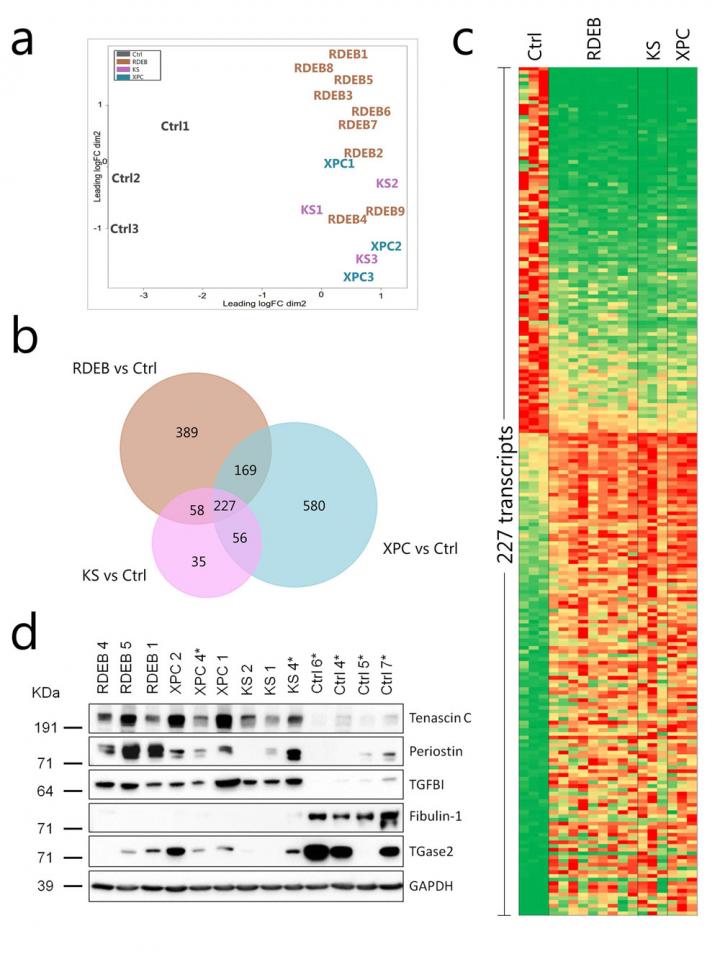
Through a global gene expression analysis (transcriptomic), the researchers were able to find and confirm a genetic signature common to these genodermatoses in patients’ cells. The profile targets cellular activation and alteration of the dermal microenvironment (lower layer of the skin) which could favour the progression of the disease, as well as skin cancer.

Recessive dystrophic epidermolisis bullosa and the Kindler syndrome are diseases that cause fragility of the skin, caused by mutations in essential genes to attach the two layers of the skin. Patients with these diseases suffer from chronic erosion and wounds on the skin and mucosa, which causes terrible scarring and metastatic squamous cell carcinoma to develop. On the other hand, xeroderma pigmentosum is a disease characterised by high sensitivity to ultraviolet light, due to a deficiency in the DNA repair mechanisms, meaning patients are 110,000 times more likely to develop skin cancer.

This study, recently published in the British Journal of Dermatology, sheds light on the underlying molecular mechanisms of the diseases and presents new pharmacological targets that are useful for the treatment of associated effects. This possibility of treating patients therapeutically (for example, with drug repositioning) is a clinical priority in order to improve their quality of life.

###

As well as the aforementioned entities, researchers from the U726 of the Rare Diseases Networking Biomedical Research Centre (Initials in Spanish: CIBERER) lead by Doctor Susana Puig at the Hospital Clínic of Barcelona, Dr. Raú de Lucas at the Hospital La Paz of Madrid, Hospital Sant Pau of Barcelona and the Príncipe Felipe Research Centre of Valencia, in collaboration with Doctor Joaquín Dopazo’s team from Hospital Virgen del Rocío of Sevilla (also from CIBERER).

Media Contact
Javier Alonso Flores
[email protected]

Original Source

https://www.uc3m.es/ss/Satellite/UC3MInstitucional/en/Detalle/Comunicacion_C/1371265129100/1371215537949/A_common_genetic_signature_has_been_discovered_among_three_cancer_prone_rare_skin_diseases

Related Journal Article

http://dx.doi.org/10.1111/bjd.17698

Tags: cancerDermatologyMedicine/Health
Share12Tweet8Share2ShareShareShare2

Related Posts

Tracking Lanthanide-Labeled Microplastics in Plants

June 25, 2026

Neural Design Enables Zero-Shot Drug-Binding Proteins

June 25, 2026

Genomic Insights into Human Skin Fungi Diversity

June 25, 2026

Chiral Laser Gyroscopes Surpass Lock-In Limit

June 25, 2026
Please login to join discussion

POPULAR NEWS

  • Saying Goodbye to PGY-6: Pediatric Fellowship Realities

    103 shares
    Share 41 Tweet 26
  • Multi-Hospital Study Reveals Long Covid Burden Is Twice as High as Current Estimates

    92 shares
    Share 36 Tweet 23
  • Detection of EDCs in Breast Milk and Infant Urine Up to Six Months Highlights Early Exposure Risks

    77 shares
    Share 31 Tweet 19
  • New Drug Candidate Developed at McMaster Shows Potential for Treating Brain Cancer

    58 shares
    Share 23 Tweet 15

About

We bring you the latest biotechnology news from best research centers and universities around the world. Check our website.

Follow us

Recent News

Tracking Lanthanide-Labeled Microplastics in Plants

POSTECH Researchers Slash Cost of Reconstituted Cell-Free Systems by 95%

AI and Physics Collaborate to Design Advanced Hydrogen Storage Materials

Subscribe to Blog via Email

Success! An email was just sent to confirm your subscription. Please find the email now and click 'Confirm' to start subscribing.

Join 82 other subscribers
  • Contact Us

Bioengineer.org © Copyright 2023 All Rights Reserved.

Welcome Back!

Login to your account below

Forgotten Password?

Retrieve your password

Please enter your username or email address to reset your password.

Log In
No Result
View All Result
  • Homepages
    • Home Page 1
    • Home Page 2
  • News
  • National
  • Business
  • Health
  • Lifestyle
  • Science

Bioengineer.org © Copyright 2023 All Rights Reserved.