• HOME
  • NEWS
  • EXPLORE
    • CAREER
      • Companies
      • Jobs
    • EVENTS
    • iGEM
      • News
      • Team
    • PHOTOS
    • VIDEO
    • WIKI
  • BLOG
  • COMMUNITY
    • FACEBOOK
    • INSTAGRAM
    • TWITTER
Saturday, May 16, 2026
BIOENGINEER.ORG
No Result
View All Result
  • Login
  • HOME
  • NEWS
  • EXPLORE
    • CAREER
      • Companies
      • Jobs
        • Lecturer
        • PhD Studentship
        • Postdoc
        • Research Assistant
    • EVENTS
    • iGEM
      • News
      • Team
    • PHOTOS
    • VIDEO
    • WIKI
  • BLOG
  • COMMUNITY
    • FACEBOOK
    • INSTAGRAM
    • TWITTER
  • HOME
  • NEWS
  • EXPLORE
    • CAREER
      • Companies
      • Jobs
        • Lecturer
        • PhD Studentship
        • Postdoc
        • Research Assistant
    • EVENTS
    • iGEM
      • News
      • Team
    • PHOTOS
    • VIDEO
    • WIKI
  • BLOG
  • COMMUNITY
    • FACEBOOK
    • INSTAGRAM
    • TWITTER
No Result
View All Result
Bioengineer.org
No Result
View All Result
Home NEWS Science News Biology

A chemical cocktail of air pollution in Beijing, China during COVID-19 outbreak

Bioengineer by Bioengineer
July 7, 2020
in Biology
Reading Time: 2 mins read
0
IMAGE
Share on FacebookShare on TwitterShare on LinkedinShare on RedditShare on Telegram

IMAGE

Credit: Hao Li

The novel coronavirus disease (COVID-19) spreads rapidly around the world, and has limited people’s outdoor activities substantially. Air quality is therefore expected to be improved due to reduced anthropogenic emissions. However, in some megacities it has not been improved as expected and severe haze episodes still occurred during the COVID-19 lockdown.

A research team led by Prof. Yele Sun from the Institute of Atmospheric Physics of the Chinese Academy of Sciences analyzed six-year aerosol particle composition measurements to investigate responses of air quality to the changes in anthropogenic emissions during the COVID-19 outbreak in Beijing, China, as well as the Chinese New Year holiday effects on air pollution.

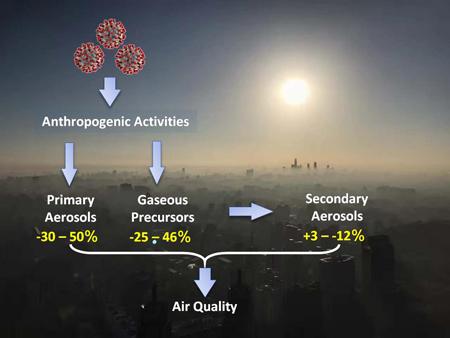
They found that air pollution during the COVID-19 lockdown was mainly due to different chemical responses of primary and secondary aerosols to changes in anthropogenic emissions.

“Primary gaseous and aerosol species responded directly to emission changes and decreased substantially by 30-50%”, said Sun. “However, secondary aerosol species that are formed from oxidation of gaseous precursors and accounted for more than 70% of particulate matter remained small changes of less than 12%. Therefore, fine particle pollution hasn’t been improved as expected.”

The air quality in Beijing has been improved during the last decade, and the mass concentrations of both primary and secondary pollutants decreased considerably.

However, according to this new study published in Sci. Total Environ, the increased sulfur and nitrogen oxidation capacity have suppressed the effects of emission reductions due to enhanced secondary formation.

These findings highlight a great challenge for mitigating secondary air pollution in regions with a cocktail of high concentrations of gaseous precursors.

“There’s an urgent need for a better understanding of the chemical interactions between precursors and secondary aerosol under complex meteorological environments,” said Sun.

###

Media Contact
Ms. Zheng Lin
[email protected]

Original Source

http://english.iap.cas.cn/home/News/202007/t20200706_240252.html

Related Journal Article

http://dx.doi.org/10.1016/j.scitotenv.2020.140739

Tags: Atmospheric ChemistryAtmospheric ScienceEarth SciencePollution/Remediation
Share12Tweet8Share2ShareShareShare2

Related Posts

Single mother must adapt swiftly — the survival of her colony depends on it — Biology

Single mother must adapt swiftly — the survival of her colony depends on it

May 15, 2026
Why Are Nearly Everyone Right-Handed? It Might Be Linked to How We Learned to Walk — Biology

Why Are Nearly Everyone Right-Handed? It Might Be Linked to How We Learned to Walk

May 15, 2026

Excessive Neuronal Activity Initiates Severe Autoimmune Brain Disorder

May 15, 2026

Precision Anti-Aging Strategies Focus on Eliminating Harmful Senescent Cells While Preserving Beneficial Ones

May 15, 2026
Please login to join discussion

POPULAR NEWS

  • Research Indicates Potential Connection Between Prenatal Medication Exposure and Elevated Autism Risk

    843 shares
    Share 337 Tweet 211
  • New Study Reveals Plants Can Detect the Sound of Rain

    730 shares
    Share 291 Tweet 182
  • Salmonella Haem Blocks Macrophages, Boosts Infection

    62 shares
    Share 25 Tweet 16
  • Breastmilk Balances E. coli and Beneficial Bacteria in Infant Gut Microbiomes

    58 shares
    Share 23 Tweet 15

About

We bring you the latest biotechnology news from best research centers and universities around the world. Check our website.

Follow us

Recent News

Carboplatin ± Nivolumab in Metastatic TNBC Trial

New Numeracy Screener Developed for Preschoolers

Genetic Dosage Influences Parkinson’s Cognitive Decline

Subscribe to Blog via Email

Enter your email address to subscribe to this blog and receive notifications of new posts by email.

Join 82 other subscribers
  • Contact Us

Bioengineer.org © Copyright 2023 All Rights Reserved.

Welcome Back!

Login to your account below

Forgotten Password?

Retrieve your password

Please enter your username or email address to reset your password.

Log In
No Result
View All Result
  • Homepages
    • Home Page 1
    • Home Page 2
  • News
  • National
  • Business
  • Health
  • Lifestyle
  • Science

Bioengineer.org © Copyright 2023 All Rights Reserved.