
Credit: Kanazawa University
Kanazawa – Proteins must fold in a specific way to function. This is often assisted by molecular chaperones–small proteins whose job is to help others fold to the right shape. Now, Japanese researchers have discovered that for one molecular chaperone at least, there's more to the process than was suspected.
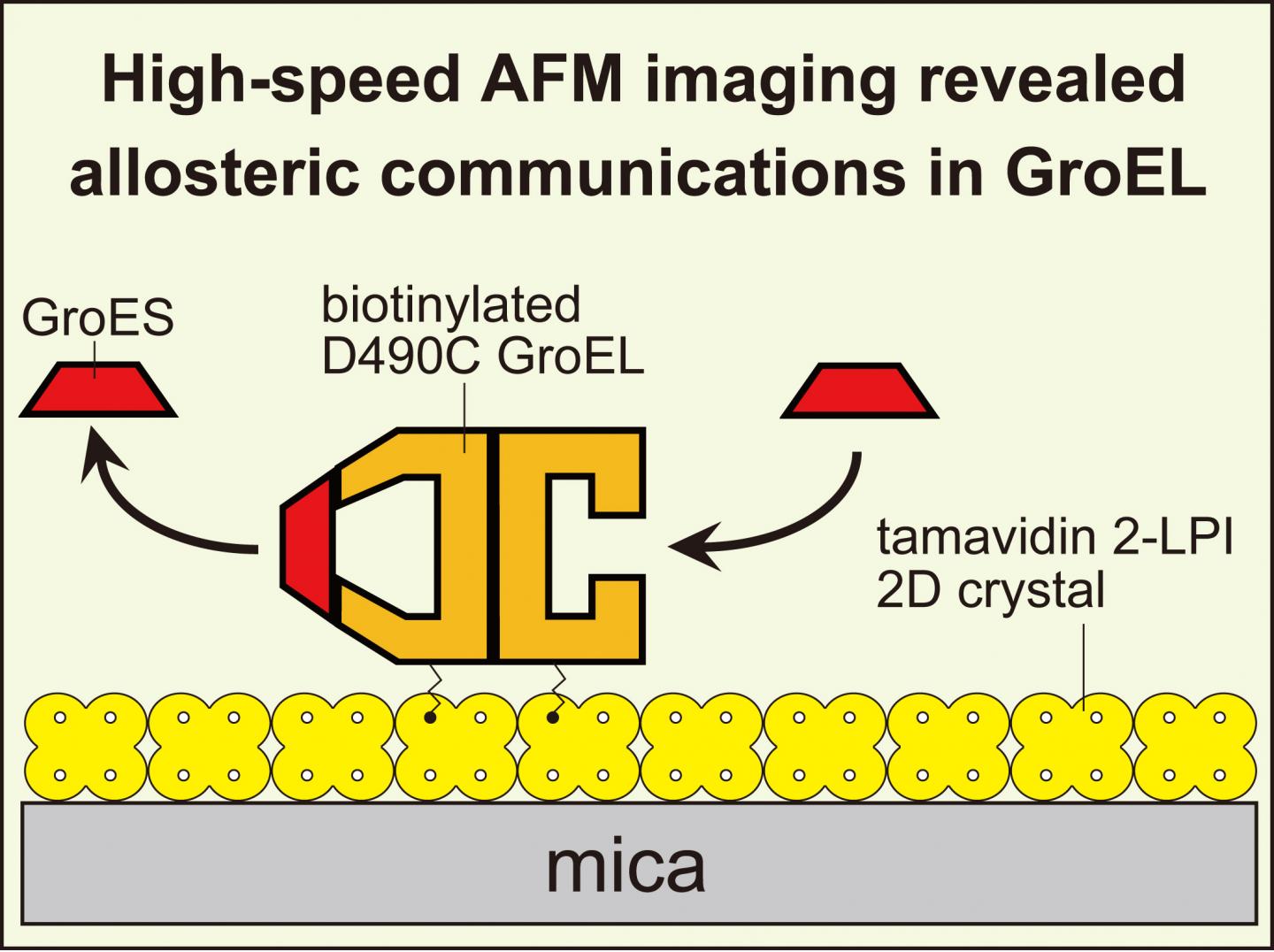
In a paper in Philosophical Transactions of the Royal Society, the Kanazawa-led group focused on GroEL, which is vital to protein folding in bacteria. The rough outline is understood: GroEL captures an unfolded target protein (the substrate) within a cavity, where it can fold correctly without aggregating. However, the mechanistic details are hard to unravel with traditional ensemble methods. In the new study, high-speed atomic force microscopy (HS-AFM) was used to visualize events more directly.
GroEL is a cylinder-shaped molecule, made of two rings stacked back to back. A key partner in its function is GroES, a ring-shaped "co-chaperonin" that binds to each end of GroEL like a domed lid. Only when GroEL is capped by GroES can it trap the substrate protein. Then, when folding is complete, GroES dissociates from GroEL, and the folded substrate is released.
Where it gets hazy is how the two rings at either end of GroEL cooperate. The rings are identical, and both can be capped by GroES. When only one end is capped, the resulting complex is termed a "bullet", by virtue of its pointed appearance. Meanwhile, the form with both ends capped is dubbed a "football", as its symmetrical oval shape resembles a gridiron ball.
"In one conventional model, the cycle of capping, protein folding, and uncapping alternates between each ring," says study co-author Daisuke Noshiro. "Capping at one ring of GroEL (which has cis stereochemistry) prevents simultaneous capping at the other (trans) end. Such intramolecular communication is known as allostery." In this view, the single-capped bullet is the active form of GroEL, and the football is merely a short-lived intermediate between cycles.
Other findings, though, have hinted at greater complexity– which has been highlighted by this new study. Depending on the substrate type, GroEL appeared as a football, rather than a bullet, up to 67% of the time, implying a breakdown of negative allosteric regulation. This was most common when the substrate was an unfoldable protein or there was no substrate at all, but even with foldable substrates, football complexes abounded.
More unexpectedly, the cycle occurred by two different pathways. In the predominant Type I, when the active ring of GroEL completes its task and the other end takes up the baton, the two rings also exchange cis and trans conformations. However, around 25% of the time (in Type II), the conformations are not exchanged, disrupting the circular, alternating rhythm of Type I. Nonetheless, protein folding still occurs. Footballs are prevalent in both cases.
"The football structure is so abundant, it must play a more active role than we thought," says corresponding author Toshio Ando. "This complex mechanism is important, because chaperonins are a natural class of molecular machines. The subtleties of GroEL may help us to understand the role of allostery in molecular machines more generally."
###
Media Contact
Tomoya Sato
[email protected]
81-762-645-076
http://www.kanazawa-u.ac.jp/e/index.html
Related Journal Article
http://dx.doi.org/10.1098/rstb.2017.0180