• HOME
  • NEWS
  • EXPLORE
    • CAREER
      • Companies
      • Jobs
    • EVENTS
    • iGEM
      • News
      • Team
    • PHOTOS
    • VIDEO
    • WIKI
  • BLOG
  • COMMUNITY
    • FACEBOOK
    • INSTAGRAM
    • TWITTER
Sunday, May 10, 2026
BIOENGINEER.ORG
No Result
View All Result
  • Login
  • HOME
  • NEWS
  • EXPLORE
    • CAREER
      • Companies
      • Jobs
        • Lecturer
        • PhD Studentship
        • Postdoc
        • Research Assistant
    • EVENTS
    • iGEM
      • News
      • Team
    • PHOTOS
    • VIDEO
    • WIKI
  • BLOG
  • COMMUNITY
    • FACEBOOK
    • INSTAGRAM
    • TWITTER
  • HOME
  • NEWS
  • EXPLORE
    • CAREER
      • Companies
      • Jobs
        • Lecturer
        • PhD Studentship
        • Postdoc
        • Research Assistant
    • EVENTS
    • iGEM
      • News
      • Team
    • PHOTOS
    • VIDEO
    • WIKI
  • BLOG
  • COMMUNITY
    • FACEBOOK
    • INSTAGRAM
    • TWITTER
No Result
View All Result
Bioengineer.org
No Result
View All Result
Home NEWS Science News Biology

Scientists produce 'designer triacylglycerols' in industrial microalgae

Bioengineer by Bioengineer
December 31, 2018
in Biology
Reading Time: 2 mins read
0
IMAGE
Share on FacebookShare on TwitterShare on LinkedinShare on RedditShare on Telegram

IMAGE

Credit: QIBEBT


Molecules of triacylglycerol (TAG), formed by attaching three molecules of fatty acid (FA) to a glycerol backbone, are the main constituents of vegetable oil in plants and fats in animals and humans. TAG plays an important role in cellular metabolism as a universal storage form and currency of energy, since its energy density is much greater than carbohydrates or proteins.

The health benefit of TAG molecules (TAGs) is dependent on which FA comprise the molecule. For example, linoleic acid (LA) can lower blood cholesterols and prevent atherosclerosis, while eicosapentaenoic acid (EPA) can treat hypertension and inflammation. Can the FA composition of TAGs be customized to create “designer” TAGs that carry tailored health benefits?

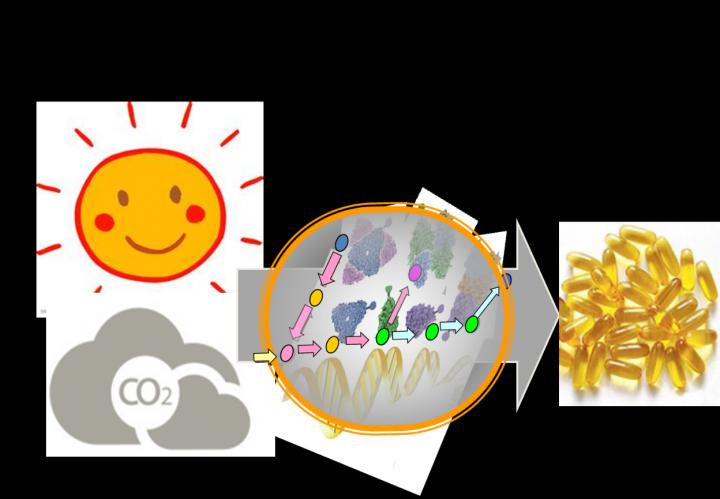
The answer is yes. A research team led by Prof. XU Jian from the Qingdao Institute of Bioenergy and Bioprocess Technology (QIBEBT), Chinese Academy of Sciences (CAS), has discovered two novel diacylglyceryl transferases (DGAT2s) that preferentially attach LA and EPA, respectively, to the glycerol backbone to form TAGs.

By modulating the ratio of these specialist enzymes in the cell, a strain bank of the industrial oleaginous microalga Nannochloropsis oceanica was created where the proportions of LA and EPA in TAGs varied by 18.7- and 34.7-fold, respectively.

LA and EPA are both “essential fatty acids” for humans. They are essential for human metabolism, but human genomes do not encode the enzymes that directly synthesize these fatty acids. Therefore, humans have to intake LA and EPA via plant or animal TAGs.

The discovery of novel DGATs that selectively assemble LA and EPA into microalgal TAGs thus lays the foundation for producing on a large scale “designer TAGs,” whether present in nature or not, for tailored or even personalized health benefits.

###

The study, published in Molecular Plant, was supported by the National Natural Science Foundation of China (NSFC).

Media Contact
CHENG Jing
[email protected]

Original Source

http://english.cas.cn/

Related Journal Article

http://dx.doi.org/10.1016/j.molp.2018.12.007

Tags: BioinformaticsBiologyBiomedical/Environmental/Chemical EngineeringBiotechnologyMolecular Biology
Share12Tweet8Share2ShareShareShare2

Related Posts

Ancient Plant Populations Reveal Fresh Insights into Climate Resilience — Biology

Ancient Plant Populations Reveal Fresh Insights into Climate Resilience

May 8, 2026
Rare Brain Disorders in Children Linked to Mutations in Lesser-Known Protein Complex — Biology

Rare Brain Disorders in Children Linked to Mutations in Lesser-Known Protein Complex

May 8, 2026

From Odd Insect to Underwater Predator: The Remarkable Evolution of a Bloodthirsty Fruit Fly

May 8, 2026

SNU Professor Sangwoo Seo’s Team Develops Next-Generation CRISPR Biocontainment Technology to Control Microbial Survival Without DNA Cleavage

May 8, 2026
Please login to join discussion

POPULAR NEWS

  • Research Indicates Potential Connection Between Prenatal Medication Exposure and Elevated Autism Risk

    840 shares
    Share 336 Tweet 210
  • New Study Reveals Plants Can Detect the Sound of Rain

    727 shares
    Share 290 Tweet 181
  • Scientists Investigate Possible Connection Between COVID-19 and Increased Lung Cancer Risk

    68 shares
    Share 27 Tweet 17
  • Salmonella Haem Blocks Macrophages, Boosts Infection

    61 shares
    Share 24 Tweet 15

About

We bring you the latest biotechnology news from best research centers and universities around the world. Check our website.

Follow us

Recent News

Evaluating Digoxin Use in Patients with Symptomatic Rheumatic Heart Disease

Evaluating the Effectiveness and Safety of Digitalis Glycosides in Treating Heart Failure

Urdu Fall Risk Questionnaire Adapted for Elderly

Subscribe to Blog via Email

Enter your email address to subscribe to this blog and receive notifications of new posts by email.

Join 82 other subscribers
  • Contact Us

Bioengineer.org © Copyright 2023 All Rights Reserved.

Welcome Back!

Login to your account below

Forgotten Password?

Retrieve your password

Please enter your username or email address to reset your password.

Log In
No Result
View All Result
  • Homepages
    • Home Page 1
    • Home Page 2
  • News
  • National
  • Business
  • Health
  • Lifestyle
  • Science

Bioengineer.org © Copyright 2023 All Rights Reserved.