Credit: Scientific Reports
Zika virus has been detected in dead monkeys found in Brazil near São José do Rio Preto, São Paulo State, and Belo Horizonte, Minas Gerais. The animals had been shot or beaten to death by locals who thought they had yellow fever. In fact, the monkeys were not bearers of that disease, but infection by Zika virus had made them sick and more vulnerable to attack by humans.
"The discovery shows the potential exists for Zika to establish a sylvatic transmission cycle [involving wild animals] in Brazil, as already occurs in the case of yellow fever. If the wild cycle is confirmed, it completely changes the epidemiology of Zika because it means there's a natural reservoir from which the virus can reinfect the human population much more frequently," Maurício Lacerda Nogueira, principal investigator for the study funded by São Paulo Research Foundation – FAPESP, told. Nogueira is a professor at São José do Rio Preto Medical School (FAMERP) and chairs the Brazilian Society for Virology (SBV).
Zika virus was detected in monkeys accustomed to the presence of humans in the state of Ceará some years ago, but this is the first detection in the wild since the ongoing epidemic began. An article on the study signed by Nogueira and researchers affiliated with several other institutions has just been published in Scientific Reports, an online journal owned by Springer Nature.
"During the yellow fever epidemic, we realized there were many dead monkeys, killed not by the disease but by people who were afraid of contagion. The monkeys had been shot, cudgeled, or bitten to death by dogs. When healthy, these primates – mainly marmosets (Callithrix sp.) and capuchins (Sapajus sp.) – are very hard to capture," Nogueira explained. "So we concluded that if they were being killed relatively easily it was probably because they were sick, not from yellow fever, which is lethal to monkeys, but from some other disease that didn't kill them but made them weak and vulnerable."
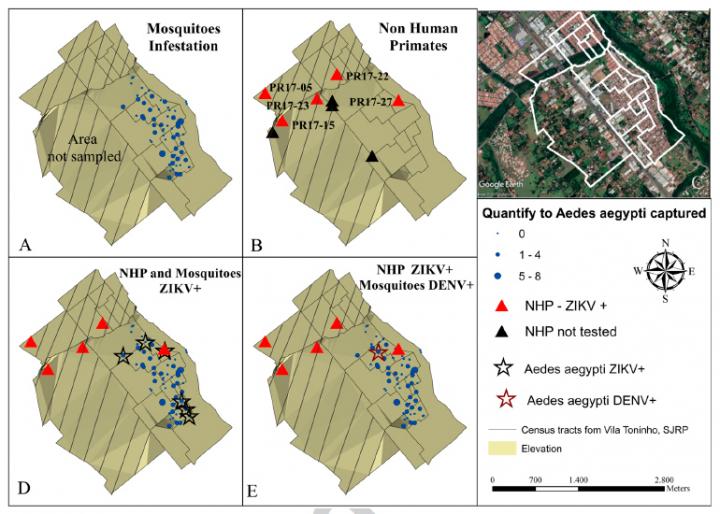
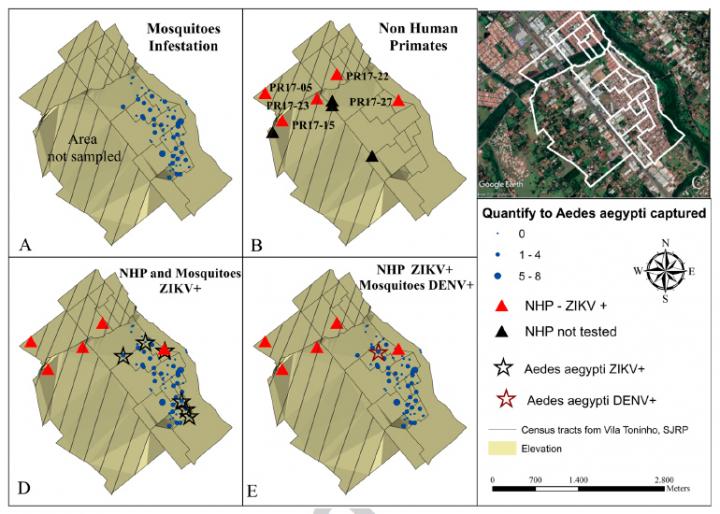
The researchers analyzed the dead monkeys and found them to have been infected by Zika in São José do Rio Preto and Belo Horizonte. Whole genome sequencing showed the virus to be very similar to the type that was infecting humans. In the same week, moreover, the researchers collected mosquitoes infected by Zika from the same places as those in which the dead monkeys were found.
"We proceeded with the study by experimentally infecting live monkeys with Zika," Nogueira said. "Inoculation with the virus caused viremia [presence of the virus in the blood]. The monkeys displayed behavioral alterations, confirming our initial hypothesis that the infection made them more susceptible to being captured and killed."
Yellow fever cycle
Natural and experimental infection of monkeys with Zika shows these animals can be vertebrate hosts, participating in transmission and circulation of the virus in tropical urban environments. According to the article just published, however, "more studies are necessary to understand the role they may play in maintaining the urban cycle of Zika virus and how they can be a channel for the establishment of an enzootic [nonhuman] transmission cycle in tropical Latin America".
"As yellow fever has shown, epizootic diseases [occurring at the same time in many animals in the same geographic area] will always be a source of epidemics among humans, even after a possible control and eradication of the urban transmission cycle through the development of successful countermeasures such as vaccines and antivirals. It's a game changer and policy makers, public health officials, as well as vaccine developers, should take notice," said Nikos Vasilakis, a professor at UTMB's Center for Tropical Diseases and one of the lead authors of the article just published.
Zika virus first appeared in monkeys in Africa. From time to time it left the jungle and infected human populations. It eventually spread to Asia, where it circulated only among humans. It apparently retained this property when it came to the Americas, suggesting a cycle similar to that of dengue virus.
The new discovery, however, points to the possibility of a different epidemiology, more like that of yellow fever. If this epidemiology is confirmed, it means combating Zika will be much harder than has been assumed to date.
"Our observations will have important implications in our understanding of the ecology and transmission of Zika in the Americas", Vasilakis said. "Although this is among the first steps in the establishment an enzootic transmission cycle among New World nonhuman primates and arboreal mosquitoes, the implications are enormous, because it is impossible to eradicate this transmission cycle."
Vasilakis stressed the importance of the funding for the study received from FAPESP and the US National Institutes of Health (NIH), which "recognized the significance of the subject early on" and supported research that also serves as an example of the "seamless and long-established collaboration between groups at UTMB and FAMERP".
###
The study was supported by the São Paulo Research Foundation – FAPESP via a Thematic Project coordinated by Nogueira and the Zika Virus Research Network in São Paulo (Rede Zika). The first author of the article, Ana Carolina Bernardes Terzian, is doing postdoctoral research at FAMERP with a scholarship from FAPESP.
Other researchers in Brazil at FAMERP, the Federal University of Minas Gerais (UFMG), Adolfo Lutz Institute, the University of São Paulo (USP), São Paulo State University (UNESP) and the National Institute of Science & Technology in Dengue also took part in the study, as well as researchers at the University of Texas Medical Branch (UTMB) in the United States.
About São Paulo Research Foundation (FAPESP)
The São Paulo Research Foundation (FAPESP) is a public institution with the mission of supporting scientific research in all fields of knowledge by awarding scholarships, fellowships and grants to investigators linked with higher education and research institutions in the State of São Paulo, Brazil. FAPESP is aware that the very best research can only be done by working with the best researchers internationally. Therefore, it has established partnerships with funding agencies, higher education, private companies, and research organizations in other countries known for the quality of their research and has been encouraging scientists funded by its grants to further develop their international collaboration. For more information: http://www.fapesp.br/en.
Media Contact
Joao Carlos Silva
[email protected]
55-113-838-4381
@AgencyFAPESP
http://www.fapesp.br
Original Source
http://agencia.fapesp.br/29071/ http://dx.doi.org/10.1038/s41598-018-34423-6