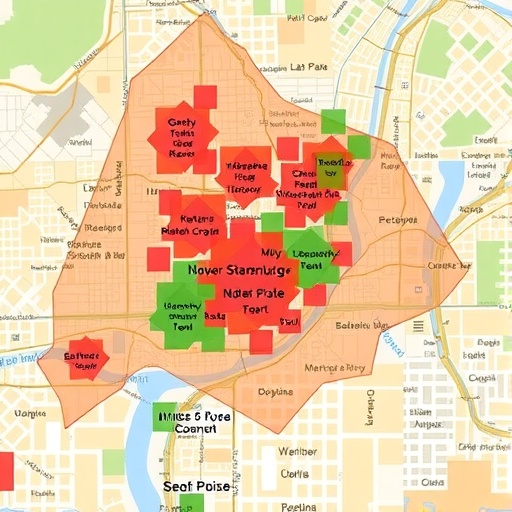
Cities are often discussed as mosaics of cultures, but a new study suggests their real mixing is far more patterned—and harder to see—than casual observation implies. By analyzing how neighborhoods interweave across different cities, the researchers uncover “hidden patterns” that only emerge when urban data are treated with advanced spatial and statistical methods rather than traditional boundaries. The findings highlight that urban diversity does not simply spread evenly; it forms structured gradients and clusters that can repeat across continents.
The work draws on data from five global cities, using methods designed to detect subtle relationships between places that may look similar on the surface. Instead of assuming that mixing is uniform, the team quantifies how proximity, movement, and demographic composition interact at multiple spatial scales. This multi-scale approach reveals that mixing can be intensified along specific corridors—such as transportation-linked zones—while remaining muted in other areas that appear comparable.
A key technical element is the way the analysis distinguishes between “local” interactions and broader regional trends. Local mixing captures what happens within and around specific urban micro-areas, while regional context accounts for how these micro-patterns are shaped by the city’s overall geography and planning history. The result is a map of mixing mechanisms that can differ even between districts within the same metropolitan region.
The study also examines whether mixing patterns resemble each other across cities, an idea that matters for universal urban theory. If similar spatial fingerprints appear in multiple locations, planners and policy-makers could better anticipate where integration may deepen or fragment over time. The authors report recurring structure—suggesting that certain urban dynamics, such as historical land use and mobility networks, may generate predictable “mixing signatures.”
Importantly, the findings have implications for how inequality and social segregation are monitored. Many common metrics rely on coarse administrative units, potentially masking the fine-grained composition that actually drives lived experience. By contrast, the study’s framework is built to detect variation across neighborhood boundaries and to surface patterns that remain invisible in standard reporting.
For readers, the takeaway is simple: cities mix in patterns, not in randomness. These patterns can be measured, compared, and potentially forecast, making them a powerful lens for evaluating urban health, opportunity, and cohesion. As urban populations grow and policies shift, understanding the mechanics of mixing may become as crucial as tracking demographics themselves.
Subject of Research: Urban mixing and spatial patterns across global cities
Article Title: Hidden patterns of urban mixing across five global cities
Article References: Fan, Z., Loo, B.P.Y., Duarte, F. et al. Hidden patterns of urban mixing across five global cities. Nat Cities (2026). https://doi.org/10.1038/s44284-026-00477-1
Image Credits: AI Generated
DOI: https://doi.org/10.1038/s44284-026-00477-1
Tags: advanced spatial statistical methodscity demographic diversitycity zoning and micro-areasglobal city comparisonhidden urban neighborhood patternsmulti-scale urban mixingpatterns of cultural interminglingregional influences on neighborhood diversityspatial clustering in citiestransportation corridors and urban connectivityurban planning and social integrationurban spatial analysis