Credit: Image by Kazushige Touhara CC-BY-SA.
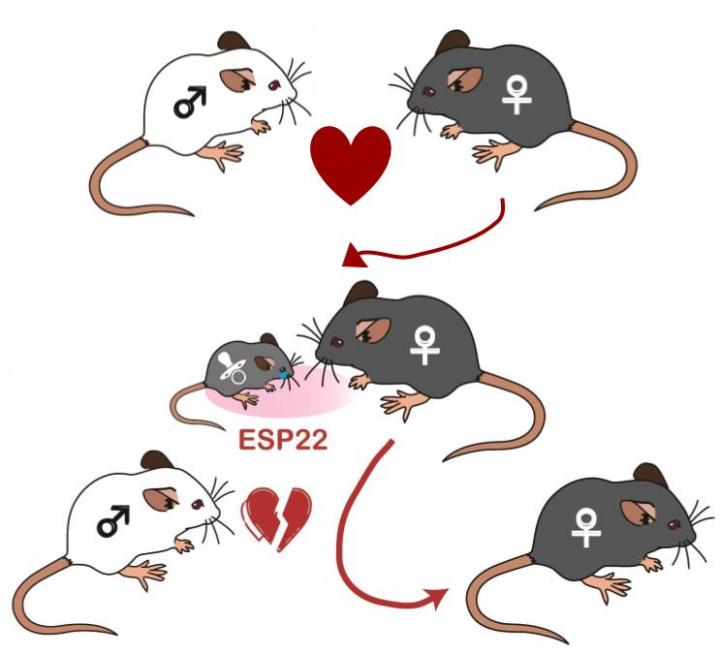
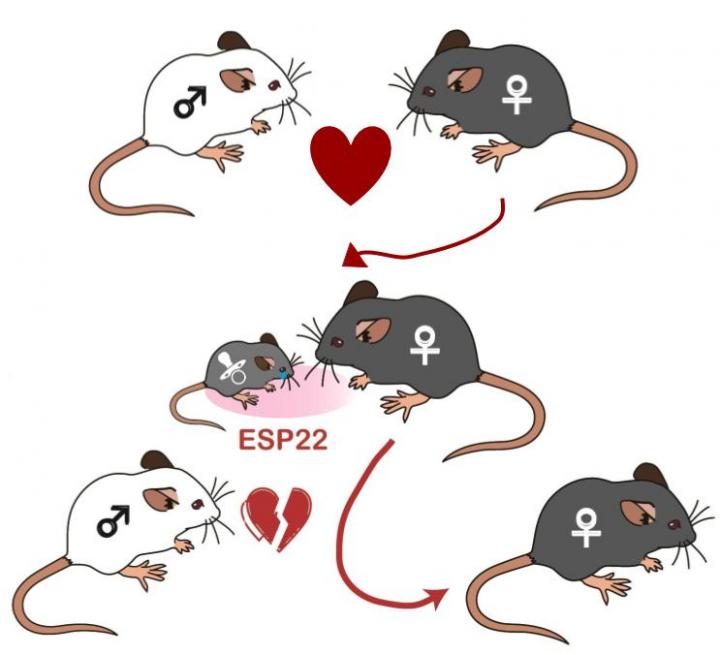
A substance in young mice's tears makes female mice more likely to reject male sexual advances. This research is part of ongoing efforts at the University of Tokyo to understand how animals communicate using chemicals called pheromones.
Direct connections between human and mouse behavior cannot be made because pheromones are highly species specific.
"If humans can detect anything in tears, we won't use the same pheromone signal or receptor as mice. But we are investigating if species share the basic neurocircuitry of how the brain processes an olfactory signal to affect behavior," said Professor Kazushige Touhara, leader of the research project.
Pheromone population control
Researchers hope to use the tear pheromone as a natural mouse birth control to reduce mouse populations in the future.
"It is unlikely that other animals would be affected because pheromones are so species specific. The sex-rejecting behavior is an innate instinct, so it's also unlikely that the mice will learn to change their behavior or ignore the artificial pheromone," said Touhara.
Only juvenile mice aged one to three weeks produce the pheromone, called exocrine gland-secreting peptide 22 (ESP22). ESP22 is not airborne and lacks a noticeable odor, but the pheromone spreads around the territory as mothers and young mice wipe tears while grooming.
Both mothers and virgin female mice reject male sexual advances after exposure to ESP22. Less female interest in sex would theoretically benefit juvenile mice by reducing the number of younger siblings competing for resources.
"ESP22 is difficult to artificially synthesize, so we want to find a smaller portion of the pheromone molecule that could be added to mouse drinking water. This could prevent mice breeding in areas where they are pests," said Touhara.
Specific receptors
ESP1 is an adult male pheromone that Touhara's research group has previously studied for its role in enhancing female acceptance of sex. In this new study, researchers tracked how ESP22 and ESP1 are received and processed by the adult female mouse brain.
Pheromone signals from young mice overrode the signals from adult males. Virgin female mice rejected male advances when they were exposed to the sex-rejecting ESP22 even after being exposed to the sex-accepting ESP1.
Both sex-rejecting ESP22 and sex-accepting ESP1 pheromones are recognized by single, dedicated receptors in the nose. Specific neurons send the different pheromone signals to the brain. The presence of similar but specific ESP1 and ESP22 receptors helps reveal how animals evolved the ability to detect and interpret pheromone signals.
"The discovery of only one receptor for each pheromone shows us that single molecules can drastically affect animal behavior," said Touhara.
Pheromones in the brain
Pheromone signals are routed to the medial amygdala, a small group of neurons in the brain.
"The medial amygdala is like a hub to receive and reroute pheromone signals," said Kentaro Ishii, a co-first author of the research paper and fifth-year doctoral student working with Touhara.
ESP22 and ESP1 signals travel separately but in parallel until reaching the medial amygdala. After that point, the pheromones affect different neurocircuitry in the brain to create different behaviors. Ongoing research in the laboratory will explore pheromone-related neurocircuitry beyond the medial amygdala hub.
"The medial amygdala is still very mysterious, so we are excited to discover more details about how pheromone signals are sorted and routed after they are received there," said Ishii.
"Additionally, we want to understand the complexity of how the brain computes and sorts olfactory signals in a natural environment, where animals are simultaneously exposed to many different pheromones and other chemical signals all the time," said Ishii.
###
The paper is published by Nature Communications. Collaborators at RIKEN Center for Brain Science in Japan and Harvard Medical School in the U.S. also contributed to the research.
Journal Article
Takuya Osakada, Kentaro K. Ishii, Hiromi Mori, Ryo Eguchi, David M. Ferrero, Yoshihiro Yoshihara, Stephen D. Liberles, Kazunari Miyamichi, and Kazushige Touhara. 2018. Sexual rejection via a vomeronasal receptor-triggered limbic circuit. Nature Communications. DOI: 10.1038/s41467-018-07003-5.
Related Links
Graduate School of Agricultural and Life Sciences, The University of Tokyo website: http://www.a.u-tokyo.ac.jp/english/index.html
Kazushige Touhara website: http://park.itc.u-tokyo.ac.jp/biological-chemistry/profile_english/index.html
Research Contact
Professor Kazushige Touhara
Laboratory of Biological Chemistry, Department of Applied Biological Chemistry, Graduate School of Agricultural and Life Sciences, The University of Tokyo, 1-1-1 Yayoi, Bunkyo-ku, Tokyo, 113-8657
Tel: +81-(0)3-5841-5109
E-mail: [email protected]
Press Contacts
Ms. Caitlin Devor
Division for Strategic Public Relations, The University of Tokyo, 7-3-1 Hongo, Bunkyo-ku, Tokyo 113-8654, JAPAN
Tel: +81-3-5841-0876
Email: [email protected]
About the University of Tokyo
The University of Tokyo is Japan's leading university and one of the world's top research universities. The vast research output of some 6,000 researchers is published in the world's top journals across the arts and sciences. Our vibrant student body of around 15,000 undergraduate and 15,000 graduate students includes over 2,000 international students. Find out more at http://www.u-tokyo.ac.jp/en/ or follow us on Twitter at @UTokyo_News_en.
Media Contact
Kazushige Touhara
[email protected]
81-035-841-5109
@UTokyo_News_en
http://www.u-tokyo.ac.jp
Related Journal Article
http://dx.doi.org/10.1038/s41467-018-07003-5