• HOME
  • NEWS
  • EXPLORE
    • CAREER
      • Companies
      • Jobs
    • EVENTS
    • iGEM
      • News
      • Team
    • PHOTOS
    • VIDEO
    • WIKI
  • BLOG
  • COMMUNITY
    • FACEBOOK
    • INSTAGRAM
    • TWITTER
Saturday, February 7, 2026
BIOENGINEER.ORG
No Result
View All Result
  • Login
  • HOME
  • NEWS
  • EXPLORE
    • CAREER
      • Companies
      • Jobs
        • Lecturer
        • PhD Studentship
        • Postdoc
        • Research Assistant
    • EVENTS
    • iGEM
      • News
      • Team
    • PHOTOS
    • VIDEO
    • WIKI
  • BLOG
  • COMMUNITY
    • FACEBOOK
    • INSTAGRAM
    • TWITTER
  • HOME
  • NEWS
  • EXPLORE
    • CAREER
      • Companies
      • Jobs
        • Lecturer
        • PhD Studentship
        • Postdoc
        • Research Assistant
    • EVENTS
    • iGEM
      • News
      • Team
    • PHOTOS
    • VIDEO
    • WIKI
  • BLOG
  • COMMUNITY
    • FACEBOOK
    • INSTAGRAM
    • TWITTER
No Result
View All Result
Bioengineer.org
No Result
View All Result
Home NEWS Science News Biology

Gas sensing gut pill beats breath test diagnosis

Bioengineer by Bioengineer
August 1, 2018
in Biology
Reading Time: 2 mins read
0
Share on FacebookShare on TwitterShare on LinkedinShare on RedditShare on Telegram
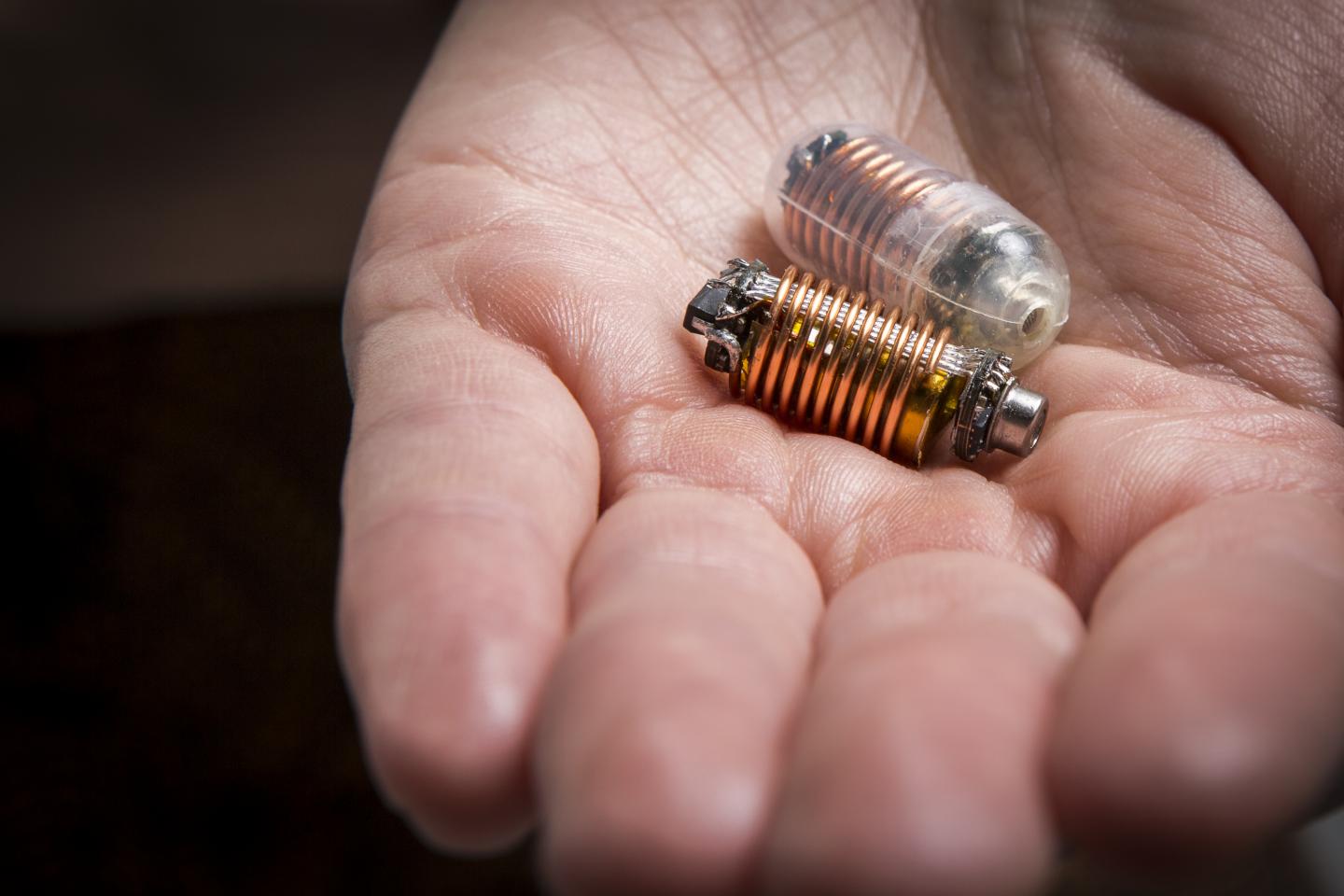
IMAGE

Credit: RMIT University

New trials of a breakthrough swallowable sensor have revealed the device is 3,000 times more accurate than current technology used to diagnose many gut disorders.

The findings show the revolutionary gas-sensing capsule developed by researchers at RMIT University in Melbourne, Australia, could surpass breath testing as the benchmark for diagnosing gut disorders, paving the way to solving previously undiagnosed conditions.

The vitamin pill-sized capsule, currently being commercialised by Atmo Biosciences, provides real time detection and measurement of hydrogen, carbon dioxides and oxygen in the gut. This data can be sent to a mobile phone.

Capsule co-inventor, RMIT's Dr Kyle Berean, said the second human trials have revealed information about gas production in the gut previously masked when measured indirectly through the breath.

"The rate of false positive and false negative diagnosis that breath tests give is a real problem in gastroenterology," Berean, who is also Chief Technology Officer at Atmo Bioscience, said.

"Being able to measure these biomarkers at concentrations over 3,000 times greater than breath tests is quite astonishing.

"Importantly this test is non-invasive and allows the patient to continue with their daily life as normal."

Intestinal gases are currently used to diagnose disorders including small intestinal bacterial overgrowth (SIBO) and carbohydrate malabsorption.

Of the one-in-five people worldwide who will suffer from a gastrointestinal disorder in their lifetime, almost a third remain undiagnosed due to a lack of reliable tests available to gastroenterologists.

Study lead and capsule co-inventor Professor Kourosh Kalantar-zadeh said the results showed high sensitivity and signal-to-noise ratio in measuring the concentration of intestinal hydrogen, providing valuable information at the site of intestinal gas production.

"This gives us confidence that our new technology could potentially solve many mysteries of the gut and help the large portion of the population who have not been able to find a useful diagnosis or treatment for their symptoms," Kalantar-zadeh said.

Findings from the first human trials revealed the stomach releases oxidising chemicals to break down and beat foreign compounds that are staying in the stomach for longer than usual. Such an immune mechanism has never been reported before.

This second paper made a direct comparison between measuring hydrogen production within the gut via the gas-sensing capsule and indirect measurement through breath testing.

Trials were conducted on nine healthy individuals in a blinded comparative study on absorbable versus fermentable carbohydrates.

Melbourne based start-up Atmo Biosciences is set to commercialise this revolutionary technology.

The trials were conducted with colleagues from Monash University. The findings have been published in the medical journal Alimentary Pharmacology and Therapeutics (DOI: 10.1111/apt.14923).

###

Media Contact

Grace Taylor
[email protected]
61-499-515-097
@RMIT

http://www.rmit.edu.au

Related Journal Article

http://dx.doi.org/10.1111/apt.14923

Share12Tweet8Share2ShareShareShare2

Related Posts

Florida Cane Toad: Complex Spread and Selective Evolution

Florida Cane Toad: Complex Spread and Selective Evolution

February 7, 2026
New Study Uncovers Mechanism Behind Burn Pit Particulate Matter–Induced Lung Inflammation

New Study Uncovers Mechanism Behind Burn Pit Particulate Matter–Induced Lung Inflammation

February 6, 2026

DeepBlastoid: Advancing Automated and Efficient Evaluation of Human Blastoids with Deep Learning

February 6, 2026

Navigating the Gut: The Role of Formic Acid in the Microbiome

February 6, 2026
Please login to join discussion

POPULAR NEWS

  • Robotic Ureteral Reconstruction: A Novel Approach

    Robotic Ureteral Reconstruction: A Novel Approach

    82 shares
    Share 33 Tweet 21
  • Digital Privacy: Health Data Control in Incarceration

    63 shares
    Share 25 Tweet 16
  • Study Reveals Lipid Accumulation in ME/CFS Cells

    57 shares
    Share 23 Tweet 14
  • Breakthrough in RNA Research Accelerates Medical Innovations Timeline

    53 shares
    Share 21 Tweet 13

About

We bring you the latest biotechnology news from best research centers and universities around the world. Check our website.

Follow us

Recent News

Digital Health Perspectives from Baltic Sea Experts

Florida Cane Toad: Complex Spread and Selective Evolution

Exploring Decision-Making in Dementia Caregivers’ Mobility

Subscribe to Blog via Email

Enter your email address to subscribe to this blog and receive notifications of new posts by email.

Join 73 other subscribers
  • Contact Us

Bioengineer.org © Copyright 2023 All Rights Reserved.

Welcome Back!

Login to your account below

Forgotten Password?

Retrieve your password

Please enter your username or email address to reset your password.

Log In
No Result
View All Result
  • Homepages
    • Home Page 1
    • Home Page 2
  • News
  • National
  • Business
  • Health
  • Lifestyle
  • Science

Bioengineer.org © Copyright 2023 All Rights Reserved.