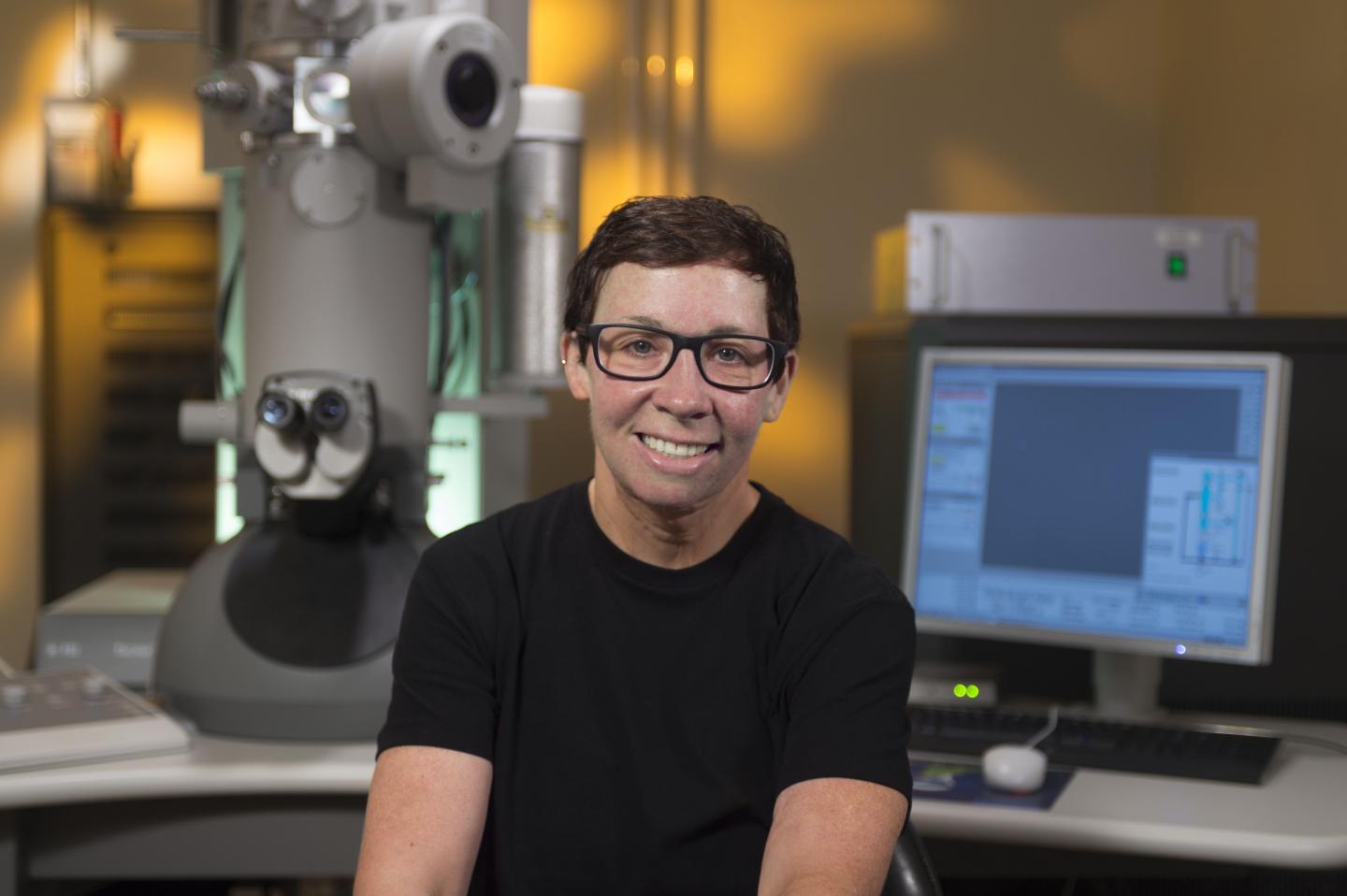
Credit: Virginia Tech Carilion Research Institute
Deb Kelly, an associate professor at the Virginia Tech Carilion Research Institute, was awarded $2.1 million by the National Cancer Institute (NCI) to study the protein that gives rise to a hard-to-treat form of breast cancer. This is her third concurrent R01 grant, which funds a specific line of research for five years, from the NCI of the National Institutes of Health (NIH).
"The awarding of three concurrent R01 research grants, through the rigorous NIH peer-review process, from the National Cancer Institute to an individual early to mid-career scientist who is working on different aspects of a common problem is highly unusual," said Michael Friedlander, executive director of the VTCRI and Virginia Tech's vice president for health sciences and technology. "It is indicative of the high regard that Debbie's colleagues have for her and her work."
Kelly's work hinges on seeing what is technologically possible, and then moving beyond those limitations.
"To solve a problem, we need to see it," Kelly said in what has become the mantra of her research program. "Our research program aims to reimagine the way we view cancer by examining the physical changes and damage to unwitting proteins implicated in causing hereditary forms of the disease. Each NCI-funded project works toward achieving that goal in a different way."
Kelly, who is also an associate professor of biological sciences in the College of Science at Virginia Tech, is working to better detect, prevent, and repair the mutations found in cancers related to the breast cancer susceptibility protein, BRCA1.
"Mutations in BRCA1 are heavily linked to the development of triple negative breast cancer," Kelly said. "This invasive breast cancer threatens the lives of women everywhere, and there is no precise treatment for the disease."
To strategically elucidate insights into the inner-workings of BRCA1, Kelly employs a three-prong approach.
First is the development of new tools. BRCA1 binds with other molecules within the cell to form assemblies. In health, BRCA1 makes these connections to repair DNA and helps suppress tumors. In cancer, mutations in BRCA1 allows the cell to multiple uncontrollably until a tumor develops. Even if the tumor is surgically removed, cancer can recur and metastasize elsewhere in the body.
To understand BRCA1's role in these activities, Kelly needs to be able to view it at different interaction points. In collaboration with the company, Protochips Inc., her team engineered semi-conductor chips that can be tuned to capture BRCA1 as it interacts with different molecules within the cell. The team then takes snapshots of the protein and its associated complexes using cryo-electron microscopy. This technique, known as cryo-EM, earned its developers the Nobel Prize in Chemistry in 2017.
These innovations allowed Kelly's team to become the first to visualize the structure of BRCA1 in health and in cancer.
In addition to imaging innovations, Kelly and her team also conduct biological and chemistry experiments to understand the functional deficits in the BRCA1 protein system.
With the funding of her second National Cancer Institute grant, Kelly's team identified a "hotspot" modification on BRCA1. The researchers treated this region of the protein with enzymes called deubiquitinases, effectively removing the deformation. Preliminary work indicates that the actions of the protein can also be restored to some extent.
"We're trying to outsmart cancer cells with new tools and techniques," Kelly said. "We're working toward a new vision of how breast cancer forms, returns, and expands in our bodies."
With the support of her most recent National Cancer Institute grant, Kelly is focusing on multi-scale imaging. She'll collaborate with Elizabeth Alli, an assistant professor of cancer biology at Wake Forest University, and Mark Yeager, a professor of molecular physics and biological physics at the University of Virginia School of Medicine. Her team at the VTCRI includes Zhi Sheng, an assistant professor, and Rob Gourdie, a professor and director of the VTCRI Center for Heart and Regenerative Medicine.
"We're expanding our work to study how molecular and cellular variability in genomic maintenance are influenced by different mutations through multiple scales of imaging and analysis," Kelly said.
To better connect the cryo-EM structural work with functional studies of breast cancer-related mutations, the scientists will also use confocal microscopy to follow BRCA1 in live cancer cells. Together, these analyses provide a new lens to see how genetic mutations change the nuanced behaviors of cells and their underlying molecular players.
"By combining our cryo-EM structural findings with live cell imaging, we expect to obtain the first integrated view of breast cancer protein assemblies in the functional state of acting upon DNA in real-time," Kelly said.
This first-of-its-kind information will provide new insight on how BRCA1 operates–or fails to operate–with other molecules in cellular repair, especially as the cancer returns or spreads to other organs.
"The return of the disease presents a major concern for breast cancer survivors. What if it comes back? What if it comes back in my brain, or liver, or bones?" Kelly said. "We expect to apply the knowledge we gain from our work to new therapeutic designs aimed at stopping recurrence and metastasis."
Kelly noted that BRCA1 is implicated in several other cancers, including pancreatic cancer.
"People across the globe–no matter their makeup or background–are vulnerable. Cancer doesn't discriminate. Cancer doesn't care who you are," Kelly said. "We're fighting for everyone."
###
Media Contact
Ashley WennersHerron
[email protected]
540-526-2002
@vtnews
http://www.vtnews.vt.edu
Original Source
http://research.vtc.vt.edu/news/2018/jun/21/vtcri-scientist-earns-third-concurrent-grant-natio/